
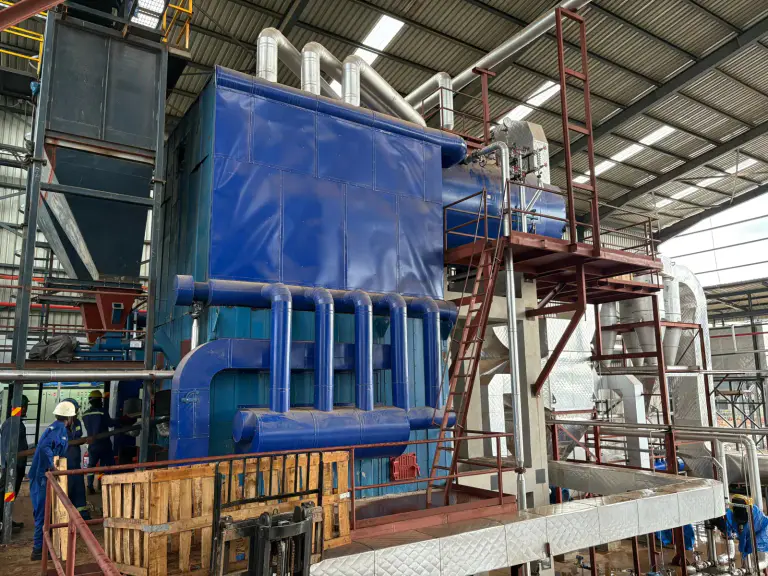
To compare biomass, diesel and heavy fuel oil (HFO) boilers fairly, calculate the lifecycle cost of each tonne of steam delivered, not the purchase price of the boiler. Fuel usually dominates that cost, so the comparison turns on fuel price per unit of useful heat, boiler efficiency and hours of operation. Labour, fuel handling, emissions control, maintenance and statutory compliance can change the answer, especially for solid fuels.
Key takeaways
- Compare fuels on cost per gigajoule of useful heat, which combines fuel price, calorific value and boiler efficiency.
- For a boiler running many hours a year, lifetime fuel spend normally outweighs the capital cost difference between fuel types.
- Biomass boilers cost more to build and operate — fuel storage and handling, ash, operators and emissions control — but can have lower fuel cost per unit of heat.
- Liquid fuels are simpler to handle, but diesel prices are set monthly by EPRA and follow world markets.
- Test the result against fuel-price, moisture and utilisation scenarios before deciding.
Why purchase price is the wrong comparison
A process boiler may run most hours of the year for many years. Over that life, the fuel it burns usually costs far more than the boiler itself. Two boilers with similar prices can have very different fuel bills. A cheaper boiler with lower efficiency, or on a more expensive fuel, can cost much more to own.
A lifecycle comparison puts every option on the same basis: total cost per tonne of steam (or per unit of useful heat) over the planning period, discounted to present value.
Step 1: Calculate the fuel cost per tonne of steam
The energy needed to make steam comes from steam tables. It is the enthalpy of the steam leaving the boiler minus the enthalpy of the feedwater entering it. Divide that by boiler efficiency to get the fuel energy required, then by the fuel's calorific value to get the fuel quantity:
Fuel per tonne of steam = (hsteam − hfeedwater) ÷ (boiler efficiency × net calorific value of fuel)
Worked example (physics only, no prices): saturated steam at about 10 bar(g) has an enthalpy of roughly 2,780 kJ/kg. Feedwater at 80 °C has an enthalpy of about 335 kJ/kg. Each tonne of steam therefore needs about 2,445 MJ, or 2.45 GJ, of heat. A boiler that is 80% efficient needs about 3.06 GJ of fuel energy per tonne of steam. At 70% efficiency it needs about 3.49 GJ — around 14% more fuel for the same steam.
To turn that into money, you need three site-specific inputs:
- Delivered fuel price per litre, kilogram or tonne, including transport and storage.
- Net calorific value of the fuel as delivered. Take this from supplier test certificates or your own laboratory results, not from a brochure. For biomass it depends heavily on moisture content.
- Seasonal boiler efficiency — the efficiency achieved across real operating loads, not the peak figure at full load.
Diesel prices in Kenya are published monthly by EPRA as maximum retail petroleum prices, based on its pump price formula. HFO and biomass are priced by supply contract. Use the price you would actually pay, delivered to site.
Step 2: Add the costs that are not fuel
| Cost area | Biomass (wood chips, briquettes, residues) | Diesel (gas oil) | Heavy fuel oil (HFO) |
|---|---|---|---|
| Boiler and auxiliaries | Highest: grate or fluidised-bed furnace, fuel feed, induced-draught fans, dust collection | Lowest: packaged burner and fuel train | Moderate: burner plus fuel heating and filtration |
| Fuel storage and handling | Large covered store, conveyors or walking floors, moisture management | Tanks and bunding | Heated, bunded tanks and heated lines |
| Operating labour | Higher: fuel receiving, feeding and ash removal | Low | Low to moderate |
| Maintenance | Higher: refractory, grates, conveyors, cleaning of heat-transfer surfaces | Low | Moderate: burner, fuel heating, soot deposits |
| Emissions control | Particulate control (cyclones, bag filters or similar) usually required | Minimal | Particulates and sulphur-related emissions need attention |
| By-products | Ash disposal or reuse | None significant | Sludge from tank cleaning |
| Load response | Slower; better suited to steady loads | Fast, wide turndown | Good |
| Fuel supply risk | Local supply quality, moisture and continuity | World oil prices and exchange rate | World oil prices, exchange rate and supplier availability |
These are general characteristics. Actual costs depend on the boiler design, fuel quality and site layout, so price them from real quotations.
Step 3: Include compliance and inspection costs
Every option carries statutory costs that belong in the model:
- Boiler examination. Under section 67(8) of Kenya's Occupational Safety and Health Act, 2007, every steam boiler and its fittings must be thoroughly examined by an approved person at least once every twelve months, and after modifications or extensive repairs. The examiner may extend the interval in writing to no more than fifteen months. Budget for the examination and the downtime it needs.
- Air emissions. The Air Quality Regulations, 2024 (Legal Notice 180 of 2024) require facilities listed as controlled facilities to hold an emission licence and to meet emission limits (regulation 13). NEMA may require other facilities that have operated for more than twelve months to apply. A stack emission report is part of the emission licence application (regulation 18). Check whether your site is listed, and budget for testing and any emissions-control equipment.
- Water treatment and blowdown. All fuels need treated feedwater. Poor water treatment raises fuel use and maintenance for every boiler type. See boiler feed water treatment.
Step 4: Build the lifecycle model
- Define the steam demand. Average and peak steam flow, pressure, operating hours per year and how the load varies.
- Calculate annual fuel cost for each option, using Step 1 with seasonal efficiency and delivered fuel price.
- Add annual non-fuel costs: labour, maintenance, spares, ash or sludge disposal, water treatment, electricity for fans and conveyors, inspection, testing and insurance.
- Add capital costs: boiler, fuel storage and handling, emissions control, civil works, chimney, installation and commissioning.
- Discount over the planning period to a net present cost. Divide by lifetime steam output to get a cost per tonne of steam.
- Run sensitivities: fuel price up and down, biomass moisture higher than planned, lower operating hours, and a period of supply disruption.
The result often depends on utilisation. A boiler that runs continuously spreads the higher capital and handling costs of biomass over many tonnes of steam. A boiler that runs a single shift, or only as standby, may favour a liquid fuel with low capital cost, even though its fuel costs more per unit of heat.
Options that change the answer
- Dual-fuel or hybrid plant. A biomass boiler for base load with an oil-fired boiler for peaks and standby can combine low fuel cost with fast response.
- Efficiency before fuel switching. Economisers, better combustion control, insulation and condensate recovery reduce fuel use whatever fuel you burn, and often pay back faster than a new boiler.
- Right boiler type. Steam, hot water and thermic fluid each suit different processes — see industrial boilers in Kenya compared.
- Fuel quality contracts. For biomass, specify moisture content, size and contamination limits in the supply contract, and test deliveries. Wet fuel lowers calorific value and efficiency together.
- Sustainable sourcing. Confirm that biomass comes from legal, sustainable sources that can supply you for the life of the plant.
Frequently asked questions
Is biomass always cheaper than diesel for steam?
No. Biomass often has a lower fuel cost per unit of heat, but higher capital, labour, maintenance and emissions-control costs. The answer depends on your delivered fuel prices, fuel quality and operating hours. Calculate it for your site.
Why does moisture content matter so much?
Water in the fuel adds no energy and absorbs heat as it evaporates. Wet biomass therefore has a lower calorific value and burns less efficiently, so you need more tonnes of fuel per tonne of steam.
Can an existing oil-fired boiler be converted to biomass?
Usually not directly. Biomass needs a different furnace, fuel feeding, ash removal and flue gas cleaning. It is normally a new boiler plant, sometimes keeping the oil-fired unit for standby.
How often must a steam boiler be inspected in Kenya?
At least once every twelve months by an approved person, and after modifications or extensive repairs. The examiner may extend the interval in writing to no more than fifteen months (OSH Act, 2007, section 67(8)).
Compare your options with real numbers
Spenomatic designs, supplies and installs industrial boilers and steam systems, including biomass plant. Examples include a boiler installation for a food company in Zambia and a boiler project for a food company in Southern Africa. Explore our boilers, chillers and biomass systems, or request a boiler assessment to model biomass, diesel and HFO options from your steam demand and fuel quotes.