
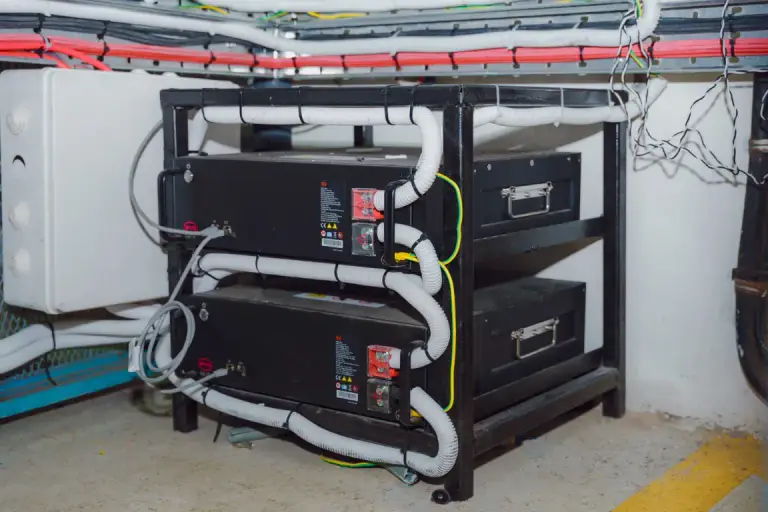
A commercial battery energy storage system (BESS) pays its way in Kenya when it does a specific job: cutting maximum-demand charges, keeping critical loads running through grid interruptions, reducing diesel generator hours, or storing midday solar for use later in the shift. Size it from interval load data for that job, not from a round number.
Key takeaways
- Define the job first. Peak shaving, backup, solar shifting and generator reduction lead to very different battery sizes.
- Power (kW) and energy (kWh) are separate sizing decisions. Most proposals get one of them wrong.
- Kenyan commercial and industrial tariffs include a maximum-demand charge, which is often where storage earns its keep.
- Battery prices have fallen sharply, but the cost of the complete system — inverters, protection, controls, housing and integration — decides the business case.
- Ask for recognised safety certification, a clear warranty on usable capacity, and a control strategy written down before you buy.
What does a commercial battery storage system actually do?
A battery energy storage system stores electrical energy and releases it under the control of a power conversion system and an energy management controller. For a factory, hotel, hospital, cold store or office park, that capability is used in four main ways.
| Application | What the battery does | What decides the size | Data you need |
|---|---|---|---|
| Peak shaving | Discharges during short demand peaks so the utility meter records a lower maximum demand | Height and duration of the peaks you want to remove | 12 months of interval (15- or 30-minute) demand data and your tariff schedule |
| Backup and ride-through | Supplies critical loads when the grid fails, or bridges the gap until a generator starts | Critical load in kW and the minutes or hours it must be supported | A list of critical circuits, outage history and restart requirements |
| Solar self-consumption | Stores daytime solar surplus for use later in the day | Size of the regular solar surplus and the evening load it can cover | Solar generation profile plus load profile, hour by hour |
| Generator reduction | Lets diesel generators run less often, or at a more efficient load point | Generator loading pattern and hours of low-load running | Generator run-hour logs, fuel records and load readings |
One system can serve more than one purpose, but the purposes compete for the same stored energy. A battery emptied at 11:00 to shave a peak cannot also carry the plant through a 14:00 outage. The control strategy has to set the priorities.
Why maximum-demand charges matter in Kenya
Commercial and industrial (CI) customers in Kenya are billed not only for the energy they use (kWh) but also for their maximum demand in kVA, under the retail tariff schedule approved by the Energy and Petroleum Regulatory Authority (EPRA). The demand charge is set by the highest demand recorded in the billing period. A short, predictable spike — several large motors starting together, a batch process, a shift change — can therefore raise the whole month's bill.
Storage is well suited to flattening those spikes because a peak often lasts minutes rather than hours. That means a relatively small amount of stored energy delivered at high power can make a measurable difference. We explain the mechanics of demand billing in more detail in our guide to peak demand charges and how solar helps. Solar alone cannot remove a peak that occurs at night or under cloud; a battery can.
Before modelling savings, confirm the current demand charge and tariff category on your latest bill. Tariffs are reviewed periodically, so a business case built on an old schedule will be wrong.
How to size a commercial battery: power versus energy
Every battery proposal should state two numbers separately:
- Power rating (kW): how fast the system can deliver energy. It is set mainly by the inverter or power conversion system.
- Usable energy (kWh): how much energy the system can deliver before it must stop. This is less than the nameplate capacity, because batteries are not normally cycled from completely full to completely empty.
Peak shaving is usually power-limited: you need enough kW to cut the peak, but perhaps only a short duration. Solar shifting and backup are usually energy-limited: you need enough kWh to cover several hours. A proposal that quotes only "a 500 kWh battery" without the power rating, the usable capacity and the duration it can sustain is incomplete.
A simple sizing method
- Collect interval data. Take at least twelve months of 15- or 30-minute demand data from the utility meter or a logger, so that seasonal production changes are captured.
- Choose the target. For peak shaving, pick the demand level you want the meter never to exceed. For backup, list the loads that must stay on and for how long.
- Measure the gap. For each peak above the target, record how many kW it exceeds the target by and for how many minutes. The largest excess sets the power rating; the largest area above the line (kW × hours) sets the energy needed.
- Add margins. Allow for inverter and battery losses, capacity fade over the warranty period, and the minimum state of charge the battery must keep for backup.
- Test the strategy. Simulate the controller against the full year of data. If the battery is empty when a second peak arrives, either the size or the dispatch rules must change.
Illustrative example (not a quotation): suppose a plant's interval data shows that on most days demand rises about 150 kW above its normal level for up to 30 minutes when two production lines start together. To hold the meter at the normal level, the system needs roughly 150 kW of discharge power and, before losses and margins, about 75 kWh of usable energy (150 kW × 0.5 h). The same plant asking for two hours of backup on a 150 kW critical load would need about 300 kWh of usable energy. The job changes the size by a factor of four.
What drives the cost of a commercial BESS?
Battery cells have become much cheaper. The International Energy Agency reports that lithium-ion battery costs have fallen by more than 90% since 2010 (IEA, Batteries and Secure Energy Transitions). But cells are only part of a commercial system. The installed cost depends on:
- Battery modules and management system — chemistry, usable capacity and warranted cycle life.
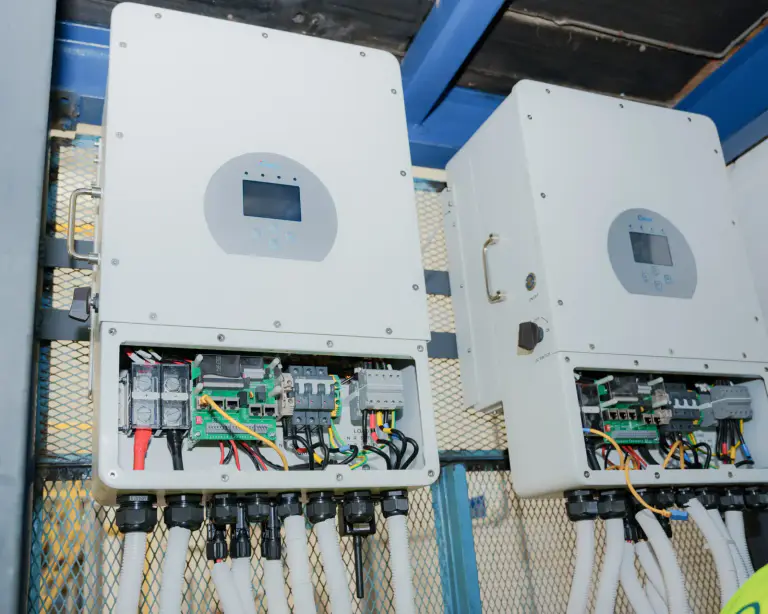
- Power conversion — inverter or power conversion system rating, and whether it can form a grid (island) during outages.
- Protection and switchgear — DC and AC protection, changeover or islanding switchgear, and earthing.
- Housing and environment — indoor room or outdoor enclosure, ventilation or cooling, fire detection and suppression, and access for maintenance.
- Controls and metering — the energy management system, the measurement point it reads, and remote monitoring.
- Integration work — changes to the main switchboard, coordination with existing generators and solar, commissioning and testing.
- Lifecycle costs — maintenance, monitoring, insurance and eventual replacement or recycling.
Compare proposals on the cost per usable kWh and per kW, over the warranty period, including integration. A low cell price with an undersized inverter, or with no islanding capability, may not deliver the job you need.
Solar plus storage, and how net metering changes the case
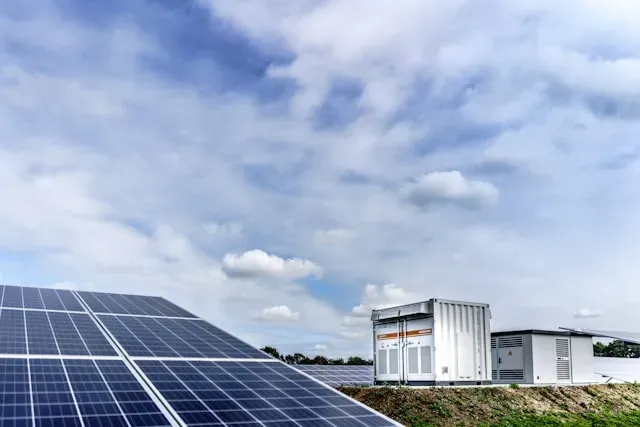
Many sites add storage to an existing or planned commercial and industrial solar PV system. The value of storing a unit of solar depends on what the alternative would have been. Under Kenya's Energy (Net-Metering) Regulations, 2024, exported energy earns a credit of fifty percent of the exported unit (regulation 10(3)). Storing surplus solar and using it on site can therefore be worth more than exporting it, if the storage cost per cycle is low enough. We cover the rules in detail in net metering in Kenya for commercial solar.
For sites whose main problem is diesel spend during outages, compare storage against the generator's actual running cost, not only its purchase price. Our comparison of solar batteries and generators explains the trade-offs.
Safety, standards and warranties to check
A commercial battery holds a large amount of energy in a small space. Before you approve a system, ask for:
- Evidence of safety certification for the battery system to recognised international standards (for example IEC 62619 for industrial lithium batteries, or IEC 62933 for energy storage systems), and fire test data where available.
- A fire risk assessment for the installation location, covering detection, suppression, ventilation, separation distances and emergency isolation.
- A warranty that states usable capacity at end of warranty, cycle and throughput limits, operating temperature limits, and who handles claims locally.
- The written control strategy: what the system does during a peak, during an outage and when both happen together.
- Commissioning tests that prove the system meets the agreed power, energy and changeover performance on your site.
Grid-connected equipment must also meet the licensee's connection requirements and relevant Kenya Standards. Use a contractor licensed by EPRA for the solar and electrical scope.
Frequently asked questions
How long does a commercial battery last?
Life is measured in cycles and years, and it depends on how deeply and how often the battery is cycled, and at what temperature. Compare warranted cycle life and end-of-warranty usable capacity, under the operating profile you expect, rather than a headline number of years.
Can a battery replace my generator?
For short outages, often yes. For long outages, a battery is usually combined with a generator: the battery covers the transfer and light-load periods, and the generator runs only when it is needed and at an efficient load. Size the combination from outage history.
Is storage worth it without solar?
It can be, if maximum-demand charges or outage costs are high enough. Peak shaving and backup do not require solar. Solar improves the case when there is regular daytime surplus to store.
What data do I need before asking for a proposal?
Twelve months of electricity bills, interval demand data if you can get it, a list of critical loads, generator run-hour and fuel records, and outage history. Our commercial solar proposal checklist lists the same questions for solar and storage together.
Plan your battery storage project
Spenomatic's solar division designs grid-tied, hybrid and storage systems around each site's load profile. If you have interval data and a clear objective — lower demand charges, fewer outages or less diesel — request a solar and storage assessment and we will size the system from your data.