
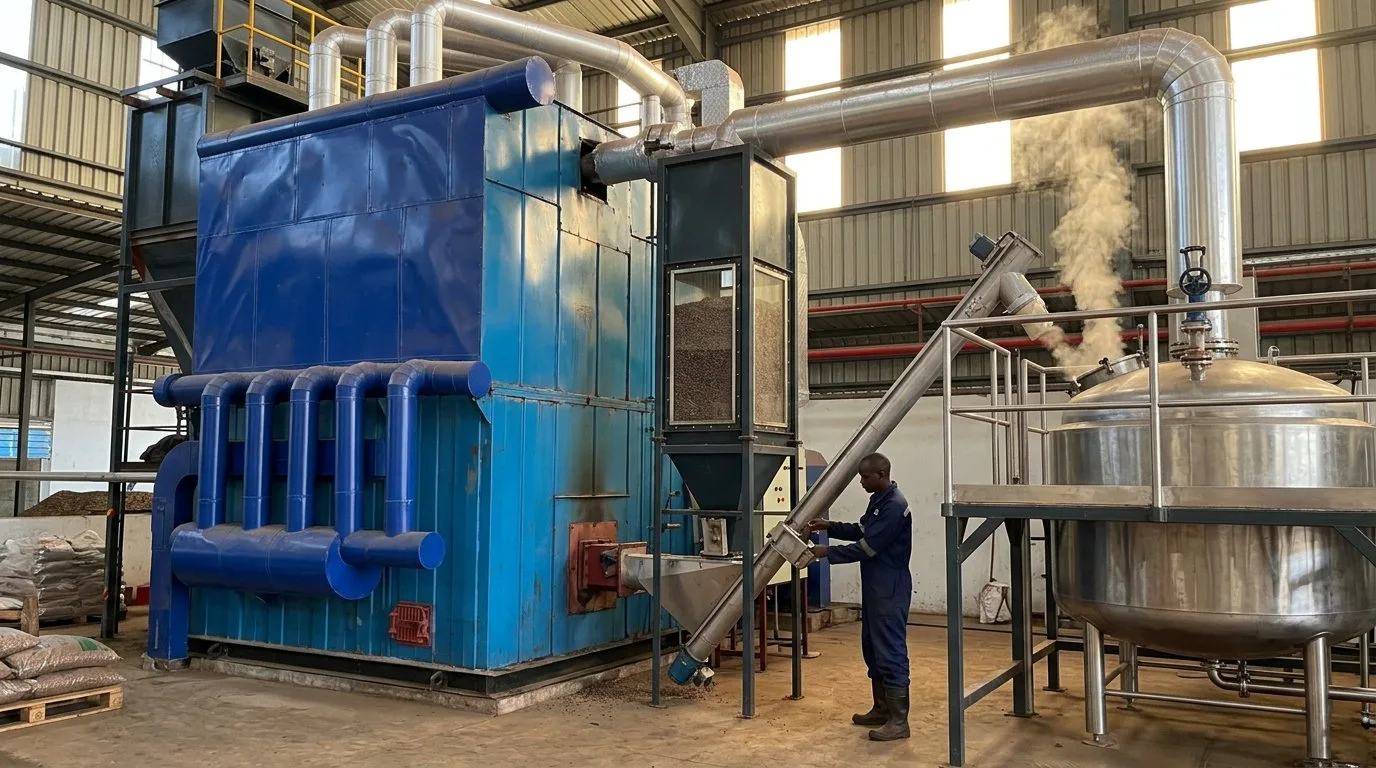
For food processing operations, a wood pellet steam boiler can suit plants sourcing biomass externally, while firewood can fit operations with dependable local supply and sustained operating hours. Modular boiler capacities range from 1.5 to 10 TPH, with combustor options selected by Spenomatic Group to match fuel characteristics and steam demand across facilities in Kiambu and nationwide.
Fuel choice alone does not determine performance or operating economics. Moisture, calorific value, ash behaviour, handling needs and operating schedules all matter. This guide explains how to assess wood pellets and firewood for your plant, including why the actual fuel’s properties should inform the boiler specification.
It also explains how boiler capacity and combustion equipment relate to food and textile processes, which operating requirements to consider, and how production patterns and fuel properties affect long-term performance.
Key Takeaways
- Assess fuel quality, availability, ash behaviour, and handling needs before choosing between pellets and firewood.
- Match boiler capacity and combustor type to your steam demand and the physical characteristics of your fuel.
- Account for operating hours, production schedules, storage, labour, and maintenance when assessing long-term returns.
- Use your food or textile process requirements and plans for future expansion to guide boiler system selection.
Firewood and biomass boilers for Kenyan industries
For food plants in Kiambu, compare fuel supply, combustion characteristics and steam demand before selecting a boiler. Assess a wood pellet steam boiler for food processing in Kiambu against the site layout and production schedule, not fuel type alone.
Biomass Fuel and Boiler Comparisons
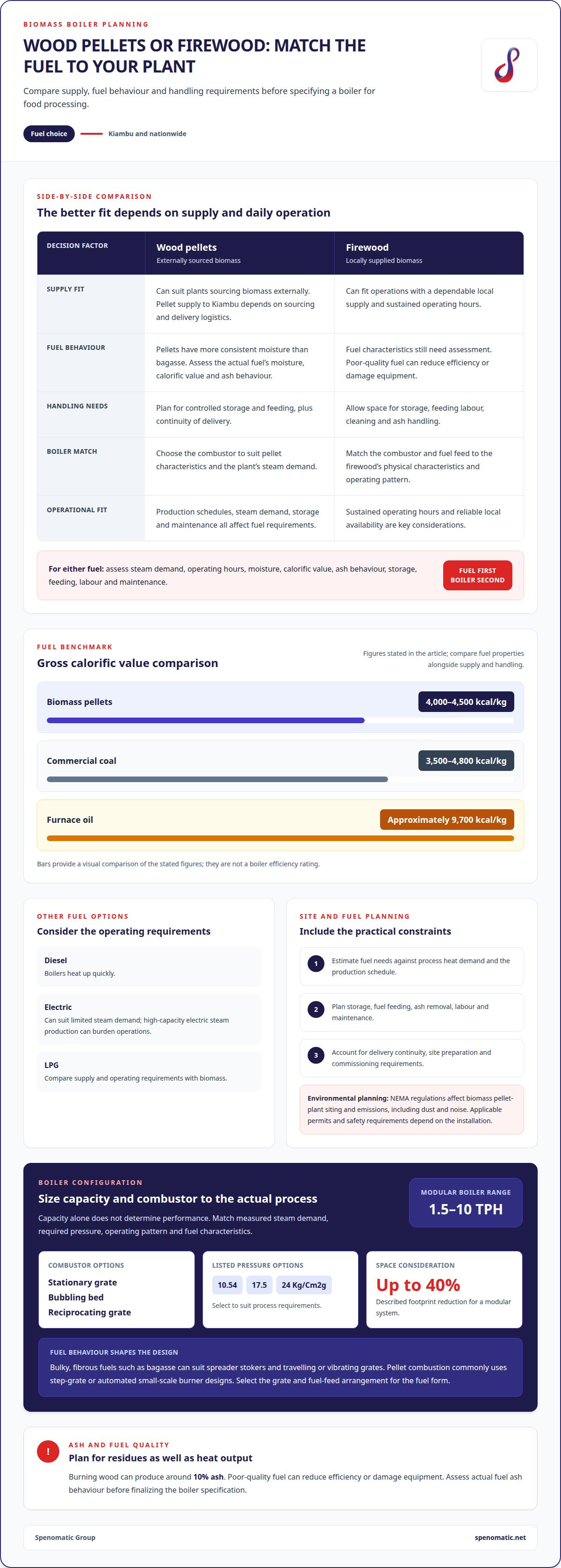
Biomass pellets have a typical gross calorific value of 4,000-4,500 kcal/kg; commercial coal is 3,500-4,800 kcal/kg, while furnace oil is approximately 9,700 kcal/kg. Diesel boilers heat up quickly, and electric boilers suit limited steam demand, but high-capacity electric steam production can burden operations. LPG is another option; compare its supply and operating requirements with biomass.
Bagasse, the residue from crushing sugarcane, generally suits sugar mills with an in-house supply. Its moisture varies, while pellets suit external sourcing and have more consistent moisture. Biomass pellet plants are listed at 1.5-2.0 T/H and 3.0-4.0 T/H. These figures describe pellet production capacity, not boiler steam output.
Fuel Consumption and Operating Requirements
Fuel consumption depends on steam demand, operating hours, moisture and combustion performance. Estimate fuel needs against process heat demand, then account for storage, feeding, ash removal, labour and maintenance. The production schedule determines how these needs affect daily operations. Assess the actual fuel’s calorific value and ash behaviour before specifying the boiler.
Pellet Availability and Supplier Installation
Biomass is locally available in many parts of Kenya, while pellet supply to Kiambu depends on sourcing and delivery logistics. Industrial boiler suppliers install systems in Kiambu County. Installation and commissioning time depends on site preparation, fuel-handling equipment, project scope, and commissioning requirements; no single duration applies to every plant. Include delivery continuity in the project plan.
Permits, Emissions, and Boiler Drawbacks
NEMA regulations affect biomass pellet-plant siting and emissions, including dust and noise. Applicable permits and safety requirements depend on the installation. Pellet systems need controlled storage and feeding; firewood requires space, feeding labour, cleaning, and ash handling. Burning wood can produce around 10% ash, and poor-quality fuel can reduce efficiency or damage equipment. Assess these factors when specifying a wood pellet steam boiler for food processing in Kiambu.
Modular boiler capacity and combustor options
Size the boiler around measured steam demand, required pressure, operating pattern, and planned production changes. A modular boiler rated from 1.5 to 10 TPH can support different plant loads, while its combustor must match the fuel’s physical characteristics. Capacity alone does not determine performance; fuel feed, combustion control, and heat transfer also matter.
Available modular combustors include stationary grate, bubbling bed, and reciprocating grate designs. Listed pressure options are 10.54, 17.5, or 24 Kg/Cm2g, supporting different process requirements. A modular system is described as reducing footprint by up to 40%, which can matter where an existing plant has limited boiler-house space. Match pressure and output to process equipment before finalizing the configuration.
For other load profiles, a water cum smoke tube design has a 4 to 30 TPH capacity range. It uses a stationary grate up to 8 TPH or a fluidized bed combustor. These options allow engineering to account for fuel behaviour and plant output, rather than selecting a grate by capacity alone. Travelling grates can also suit straw pellets, while moving or vibrating grates help manage bulky, fibrous fuels.
Pellet production is a separate plant decision. A Kenyan sawdust and wood-waste pellet-making machine project is listed at 5T/H; that rate describes pellet production, not boiler steam output. Agro-residues can also become boiler fuel, but potassium and sodium compounds may create sticky tube deposits at high combustion temperatures. Wider tube spacing and automated soot blowers help manage fouling. Combustion-gas treatment and controlled fuel handling also belong in environmental and emissions planning. For project-specific capacity and combustor engineering, review industrial boiler system options.
Spreader stokers and travelling or vibrating grates are suited to bulky, fibrous bagasse. Pellet combustion systems commonly use step-grate or automated small-scale burner designs. The installation may also include a biomass combustion chamber with a travelling grate adapted to straw pellets. Consider fuel form and combustor choice together, while distinguishing the approaches described for bagasse and straw pellets.
Spenomatic Group describes its Modular Boiler as compatible with biomass and fossil fuels. Its Instant Steam Generator has a range of 50-850 kg/hr.
Food and textile industry applications
Food plants use steam for cooking, blanching, cleaning, and heating process vessels. Each duty creates a different demand pattern: a batch cooker needs steam during production cycles, while continuous processing can require a steadier supply. For a Kiambu facility, map each steam-using step, its operating schedule, and required temperature before choosing boiler capacity. This links steam generation to the actual production sequence.
Food processing requires coordinated heat transfer across the boiler, distribution pipework and process equipment. A plant using steam for product heating and cleaning, for example, must account for simultaneous demand, not just the largest individual load. Record when those duties overlap, then size the system around the combined requirement. This helps distinguish a brief peak from sustained demand.
Textile plants use steam for process heating, fabric treatment, and drying operations. Their requirements depend on equipment and production schedules, so boiler output and pressure must align with the process rather than a generic plant-size assumption. Listed small industrial boiler capacity is 300-1500 Kg/Hr, while package boilers range from 1 - 32 TPH. These figures describe different equipment categories and should be matched to the facility’s measured steam demand.
Fuel choice affects the plant layout as well as combustion. A sawdust-based fuel stream needs receiving, storage, and controlled feeding arrangements, while ash removal and maintenance access affect daily operations. For food or textile sites considering biomass, include those interfaces in the engineering design alongside steam distribution and condensate return. A process review should also identify future production changes before the final capacity is selected. Steam applications and distribution requirements can be coordinated through industrial steam systems.
Pellet boilers for food-processing facilities
A pellet boiler may suit a food plant that needs process steam and sources biomass externally. For food processing in Kiambu, assess a wood pellet steam boiler against production schedules, steam duties, fuel availability, sustainability goals and expansion plans. Map batch cooking, cleaning and heating periods to identify overlapping loads, then use that profile to define the required output and operating conditions.
Food safety and steam quality depend on how steam contacts the product. Direct-contact steam and indirect heating have different process requirements, so specify the necessary steam quality, boiler-water treatment and condensate management for each duty. A wood pellet steam boiler for Kiambu food processing must fit those conditions; do not assume one specification suits every product or machine.
Build the design around the facility’s operating sequence. Identify each steam-using machine, its schedule and the pressure required at the point of use. Then account for simultaneous duties, distribution losses and condensate return. This engineering sequence helps align boiler output with actual heating demand instead of relying on total production volume.
Pellet supply also shapes daily operations. A processor sourcing agricultural pellets externally needs a receiving and storage plan that supports consistent feeding. Conveyors, storage conditions, ash removal and maintenance access all affect the site layout. Allow space for these requirements, not just the boiler footprint.
Combustion planning should include emissions and site impacts. Biomass burning produces emissions, so assess environmental controls and applicable site requirements as part of project development. Keep boiler steam distinct from any separate process-water requirements. To assess a wood pellet steam boiler for food processing in Kiambu against your process needs, request a boiler engineering discussion.
Spenomatic Group: Boilers, Chillers and Biomass Systems
Spenomatic Group helps food processors translate steam demand, fuel characteristics and site constraints into a boiler project scope. Its Boilers, Chillers and Biomass Systems and Steam Systems offerings address equipment and process-steam requirements, while Tea Processing Machinery serves tea operations. For wider energy integration, Commercial & Industrial Solar is also available.
Turn to Spenomatic Group for engineering support to align boiler capacity, combustor selection, biomass fuel handling, steam distribution and commissioning within one project lifecycle. Base the design discussion on your production schedule, existing plant layout, required steam conditions and expansion plans, rather than fuel choice alone.
Contact Spenomatic Group to discuss your process requirements.
Plan the Next Engineering Step
For your next planning discussion, turn production requirements into a defined project basis. Record the steam duties that run together, the operating schedule, available fuel format, and space for storage and equipment access. These practical inputs help the engineering team assess a wood pellet steam boiler for food processing in Kiambu, including how it would connect with your existing process.
Spenomatic Group addresses thermal requirements through its Boilers, Chillers and Biomass Systems and Steam Systems offerings. If your wider site strategy includes electricity generation or energy supply, Commercial & Industrial Solar includes grid-tied, hybrid and off-grid systems, as well as Home & Small Business Solar. Plan these as distinct requirements within a coordinated facilities strategy, not as interchangeable solutions.
Bring your process needs and site constraints into the discussion, then define a practical route to design and implementation. Contact Spenomatic Group to discuss your project requirements and take the next step with a clear engineering basis.
Frequently Asked Questions
ROI Analysis: Which Boiler Gives Better Returns?
Performance depends on a plant’s operating pattern, available fuel and whole-system requirements, so no boiler type suits every facility. Compare expected fuel use with handling, storage, labour, maintenance and the steam output production requires. For continuous operations, evaluate fuel-supply reliability throughout the year. For variable production, include low-demand periods when assessing boiler operation.
What boiler capacity and steam output does a food processing plant in Kiambu need?
Required capacity is the steam output that meets simultaneous process demand at the pressure each item of equipment needs. Build the estimate from the production schedule, including cleaning and heating duties that overlap with processing, then account for pressure losses through distribution. Separate steady demand from short peaks. This load profile helps engineers assess boiler output and configuration without relying on total production volume alone.