
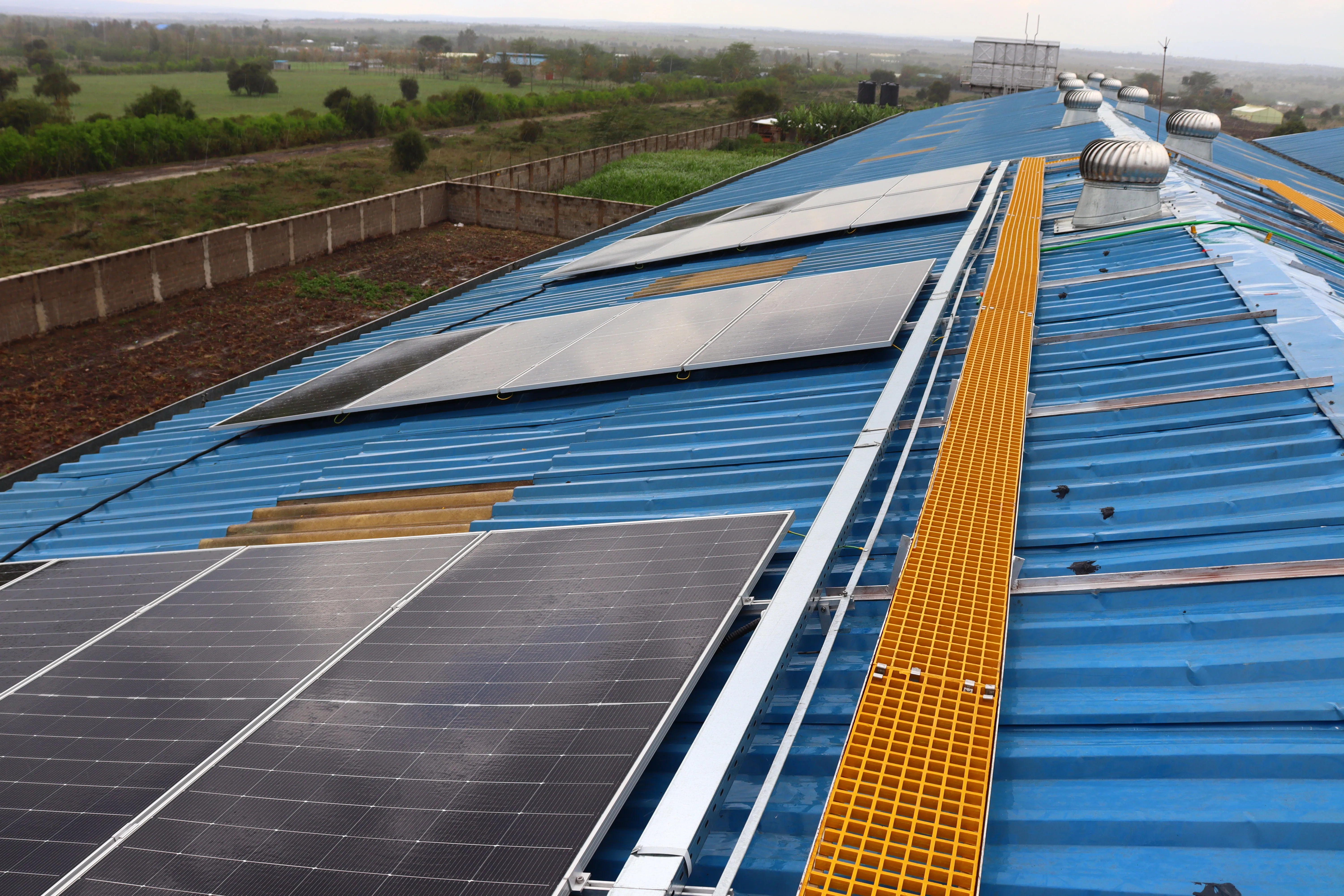
A hybrid solar system for business in Kenya combines solar panels, battery storage, and a public-grid connection, with an inverter converting panel output into usable electricity.
To assess a hybrid solar system for business, start with equipment demand and operating hours. Your production schedule helps show when solar can serve site loads and when battery storage may be needed.
This article explains how a hybrid system coordinates solar, batteries, and grid power, and how to assess business energy use, system configurations, and potential savings in Kenya.
Key Takeaways
- Understand how solar panels, batteries, inverters and grid supply work together to support business operations.
- Use your production schedule and equipment demand to identify which loads solar can serve and where backup capacity matters.
- Compare example system configurations and savings in Kenya as reference points, then assess what fits your site’s operating profile.
- See how Spenomatic Group’s hybrid solar and battery energy storage offerings can support a system designed around your business needs.
How does a Hybrid Solar System work?
A hybrid system combines solar panels and battery storage with a connection to the public electricity grid. Its inverter and switchboard direct power between solar generation, equipment, storage, and grid supply.
Grid, Solar, Battery, and Inverter Roles
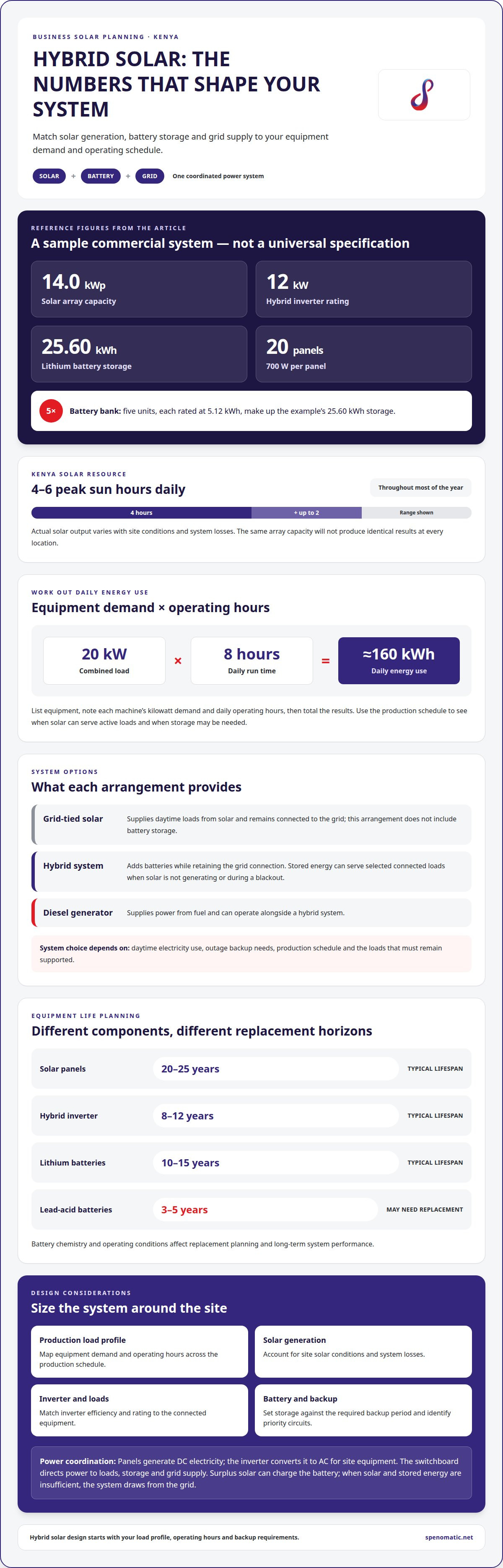
Solar panels produce direct-current electricity, which the inverter converts into alternating current for site equipment. The switchboard directs power to operating loads, while surplus solar energy can charge the battery. When solar generation and stored energy are insufficient, the system draws power from the public grid. This coordination matters in commercial operations because solar, battery, and grid supply serve different conditions.
Backup Power at Night and During Blackouts
Battery storage holds surplus solar energy for use when panels are not generating, including at night. During a blackout, the battery can supply connected loads configured for backup, such as essential lighting, controls, or selected equipment. The backup period depends on usable stored energy and the demand of those loads. For example, prioritising controls over non-essential equipment can conserve battery capacity during an outage.
Solar Array and Battery Sizing
Sizing matches solar generation and battery storage to the site’s electrical load and operating pattern. The design accounts for solar irradiation, system losses, inverter efficiency, load variation, and the required backup period. A daytime-heavy production schedule may call for an array focused on serving active loads, while overnight operations increase the role of battery storage. For smaller premises, home and small commercial solar systems are another scale of application.
Equipment lifespans also shape system planning. Solar panels typically last 20 to 25 years, while hybrid inverters typically last 8 to 12 years. Lithium batteries typically last 10 to 15 years; lead-acid batteries may need replacement every 3 to 5 years. Battery chemistry and operating conditions therefore affect replacement planning and long-term system performance.
Example system configurations and customer savings in Kenya
For a business in Kenya, system capacity, inverter rating, and battery storage should be matched to the site’s operating needs. Savings depend on how much electricity the business can offset, its operating schedule, and how it uses stored energy.
One listed commercial configuration pairs a 14.0 kWp solar array with a 12 kW hybrid inverter and 25.60 kWh of lithium battery storage. Its array comprises 20 panels rated at 700 W each, while five 5.12 kWh battery units make up the storage bank. This example illustrates equipment sizing, not a universal specification for every commercial site.
In an industrial operation, solar can supply daytime loads, while batteries can support selected equipment when generation falls or grid supply is interrupted. Monitoring generation, consumption, and battery status helps operators assess performance across production shifts. The investment case depends on the facility’s load profile and how much solar power it can use directly.
Kenya receives 4 to 6 peak sun hours daily throughout most of the year. Solar output still varies with site conditions and system losses, so the same array capacity will not produce identical results at every location. Grid connection remains relevant when solar generation and battery energy cannot meet demand.
Commercial solar approvals depend on the project’s scale, site, environmental impact assessment requirements, and grid connection. A grid interconnection study assesses the technical requirements for connecting the system. Applicable approvals must be established for each project.
Connecting to the Kenya Power grid does not by itself mean exported electricity earns a credit. Net metering is a billing arrangement that credits exported electricity under an agreement, so the applicable agreement determines how exports are treated.
Rather than assume a standard savings percentage, model the site’s daytime use, production schedule, and backup requirements. For example, a facility operating mainly during solar production hours can use more generated power directly, while overnight demand increases the importance of battery storage. A battery energy storage system forms part of that assessment.
Load estimates and daily energy consumption
Start with the equipment schedule: multiply each machine’s kilowatt demand by its daily operating hours, then total the results. For example, a combined 20 kW load running for 8 hours uses approximately 160 kWh per day. That daily consumption helps frame array capacity and storage needs, while the production schedule shows when solar energy can serve active equipment.
For Kenyan businesses, grid-tied solar supplies daytime loads but does not include battery storage. A hybrid system adds batteries while retaining the grid connection. A diesel generator supplies power from fuel and can operate alongside a hybrid system. The right arrangement depends on whether your priority is daytime electricity savings, backup during outages, or both.
System suitability also depends on site conditions, energy consumption, and the required backup period. A facility with high daytime consumption may direct more solar generation straight to equipment, while night shifts place greater emphasis on storage. Modelling helps compare the desired capacity and backup coverage with project requirements.
Commercial energy storage should match the loads that need support and the length of time they need it. A battery’s usable capacity and power rating affect what it can supply, while the inverter must coordinate generation, storage, and connected equipment. This matching matters during outages, when essential production loads may take priority over non-essential demand.
Switchboards distribute electricity between solar generation, the grid, batteries, and facility loads. Their configuration determines how available power is routed and which circuits receive backup. Surplus solar can charge storage; later, the battery can serve demand when solar output falls, reducing reliance on grid supply during those periods.
Assessment and installation follow defined engineering stages: profile the production load, model solar generation and storage, design inverter and switchboard integration, then install and commission the system. After commissioning, monitoring compares actual generation, consumption, and battery cycling with the design assumptions. This supports operational adjustments and helps clarify savings.
How hybrid solar systems work
A hybrid system coordinates solar generation, battery storage, grid power, and, where configured, a generator. Its controls balance available supply against the facility’s electricity demand. Solar can serve operating equipment first, for example, while surplus generation charges the battery. This coordinated operation distinguishes a hybrid arrangement from grid-tied solar without batteries.
During daylight, panels generate direct current, and the inverter converts it into alternating current for compatible loads. The system can direct available solar electricity to those loads and send excess energy to storage. If demand exceeds solar generation and battery output, grid power can cover the shortfall. This allows your site to draw on more than one energy source.
At night or when solar production falls, the battery can supply connected loads using stored energy. During a grid outage, backup depends on the system design and which circuits are configured to receive power. A production line and essential controls may have different priorities, so the selected backup loads determine how stored energy is allocated.
A hybrid system can also work with a generator, giving a site another supply option when solar, battery, or grid power cannot meet demand. The system configuration determines how these sources coordinate. An off-grid installation, by contrast, operates without relying on the public grid and needs enough battery storage for its intended operating conditions.
After installation, monitoring generation, consumption, battery charge, and grid imports helps operators assess how the system performs. The readings can show whether solar serves daytime loads as intended or whether demand patterns call for operational adjustments. A hybrid system’s value comes from coordinating energy flows, not simply adding panels and batteries.
For a design aligned with your site’s electrical loads and supply priorities, discuss your solar PV system requirements.
Spenomatic Group: Home & Small Business Solar
Spenomatic Group provides Home & Small Business Solar for homes and smaller operations assessing on-site generation and backup needs. Its Grid-Tied, Hybrid & Off-Grid Solar options address different priorities: daytime use of solar power, battery-backed supply, or operation without reliance on the public grid.
For commercial sites, the right choice depends on the production load profile, grid connection, and required backup. Spenomatic Group provides Commercial & Industrial Solar and Battery Energy Storage Systems for facilities whose demand and storage needs call for a larger system. The design should align the solar array, inverter, battery capacity, and connected loads with the operating pattern.
To discuss which configuration fits your site, contact Spenomatic Group with your energy requirements and backup priorities.
Move from energy priorities to a project brief
The next step is to turn an energy objective into a clear project brief. Identify what matters most: reducing reliance on grid electricity, maintaining selected operations during outages, or supplying a site with limited grid access. This sets the direction for engineering and ties system selection to your facility’s requirements.
Spenomatic Group offers Commercial & Industrial Solar for larger operational demands and Home & Small Business Solar for smaller premises. Its Grid-Tied, Hybrid & Off-Grid Solar options support different system approaches. Choosing a hybrid solar system for business should start with the intended role of storage and the loads that matter most, rather than a generic equipment package.
A clear project brief frames design discussions around production schedules, backup priorities, site conditions, and future operating needs. These criteria help decision-makers move from initial assessment to a defined solar project, with technical requirements guiding the next decisions.
Connect with Spenomatic Group to take your solar project forward with a clear operational brief.
Frequently Asked Questions
What maintenance do commercial solar systems require?
Commercial solar systems need planned inspection and maintenance of panels, mounting, wiring, inverters, switchboards, and batteries. Keep modules clear of debris that could limit generation, and review monitoring data for output changes or alarms. Qualified personnel should inspect accessible equipment for visible damage, loose connections, corrosion, or unusual heating. Maintenance frequency depends on site conditions, equipment instructions, and the operating environment. Record findings to track recurring issues.
Are LiFePO4 batteries suitable for commercial solar storage?
Yes, LiFePO4 batteries can suit commercial solar storage when their ratings and operating limits match the installation. Assess usable capacity, power rating, battery-management functions, temperature range, warranty conditions, and compatibility with the inverter and control system. Performance also depends on cell design, depth of discharge, charging conditions, operating temperature, and installation environment. These factors determine how the battery bank performs under the site’s actual cycling pattern, not chemistry alone.
Can solar power run factory equipment and heavy machinery?
Yes. Solar can supply factory equipment and heavy machinery when system capacity and electrical design match each load. Assessment should account for rated power, starting demand, duty cycle, operating hours, voltage, and phase requirements. Large motors may create brief demand peaks that differ from steady running consumption, so inverter and distribution design matter. Depending on the system configuration, solar may serve daytime operations, with grid power or storage supporting remaining demand.
How much solar capacity does a commercial building need?
Required capacity depends on the building’s consumption pattern, daytime demand, solar conditions, and the loads you want solar to supply. Estimate equipment demand and operating hours, then compare the estimate with measured site data. A data logger can help capture changing energy-use patterns across operating shifts before sizing. Include production schedules, seasonal variations, and planned changes in demand, since each can affect the array capacity needed to serve the building.
What Should a Commercial Solar Quotation Include?
A useful commercial solar proposal should describe the proposed system capacity, panel array, inverter, battery storage if required, and grid connection arrangement. It should also explain design assumptions, expected energy yield, loads served, backup scope, installation work, commissioning, and monitoring. Review the technical scope against your facility’s operating requirements, including any stated exclusions, warranty conditions, and required approvals.
What is a hybrid solar system for a business?
A hybrid solar system for business combines on-site solar generation, battery storage, and a connection to the public grid. Its controls direct available solar power to operating loads or storage, while grid supply can cover demand when solar and stored energy fall short. This arrangement suits sites seeking both daytime solar use and battery-backed supply for selected loads, subject to system design and operating priorities.