
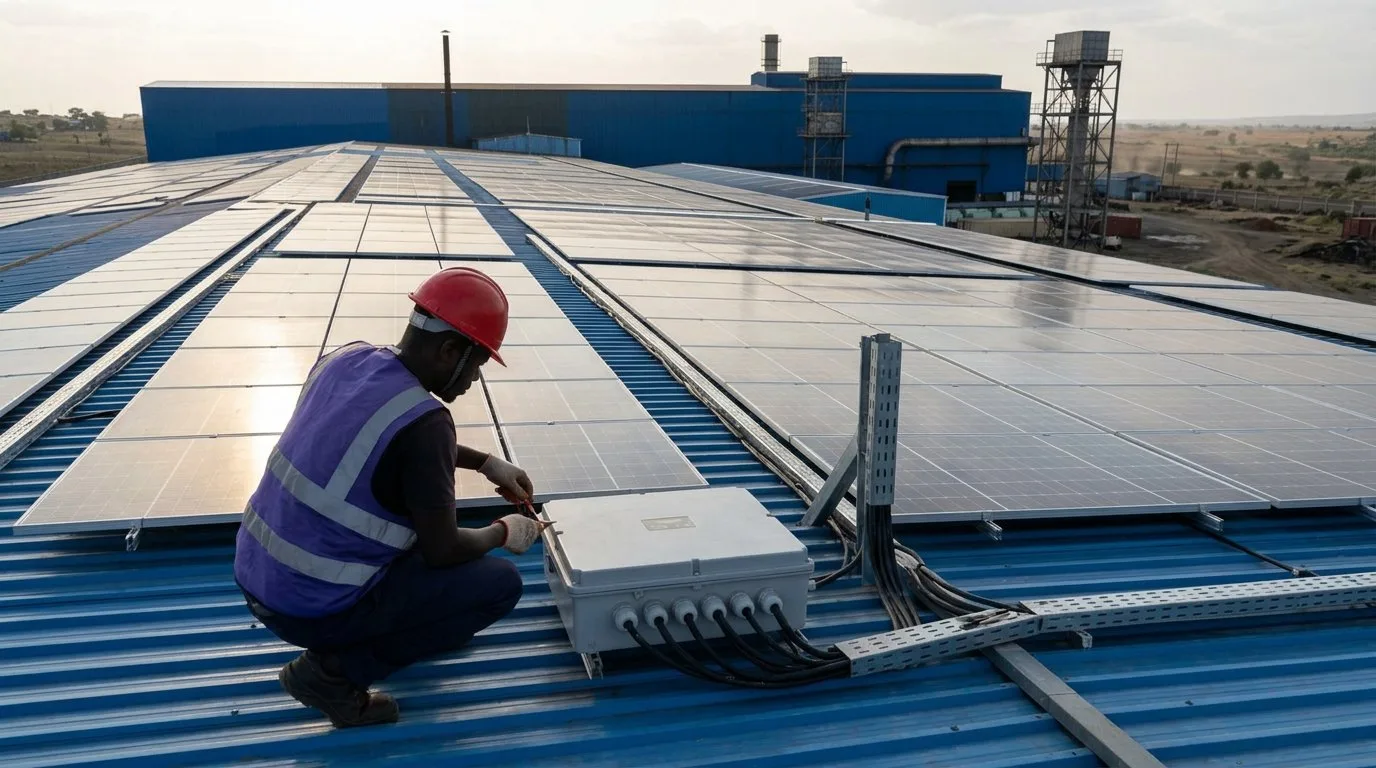
A module certificate alone cannot establish reliable industrial solar output. Industrial solar power reliability depends on how modules perform outdoors, how strings and inverters operate, and how the system integrates with battery storage and the grid. Each factor affects the electricity available to a production site.
IEC 61215, which the International Electrotechnical Commission identifies as a solar-module performance and reliability standard, supports assessment of module design; dependable field output also depends on installation quality, maintenance, weather exposure, the facility’s production load profile, and the stability of its grid connection.
Well-constructed solar panels have demonstrated real-world lifespans of 25 to 30 years or more, and this article explains how degradation, system reliability, service life, storage, and grid conditions shape dependable output, including why quality testing matters when modules move from controlled assessment into Kenya’s operating conditions.
Key Takeaways
- Use your production load profile to see when on-site solar can serve operations directly and when storage or grid support may be needed.
- Assess modules, inverters, maintenance access, weather exposure and grid conditions as parts of one operating system.
- Compare EPC companies on how they coordinate engineering, procurement, installation and commissioning across the project lifecycle.
- Match the system configuration to your sector’s load requirements and the applicable project approvals in Kenya.
Industrial Solar Power Reliability Challenges
Dependable output over a system’s service life depends on module condition, maintenance, weather exposure and grid behaviour.
Failure Causes and Prevention
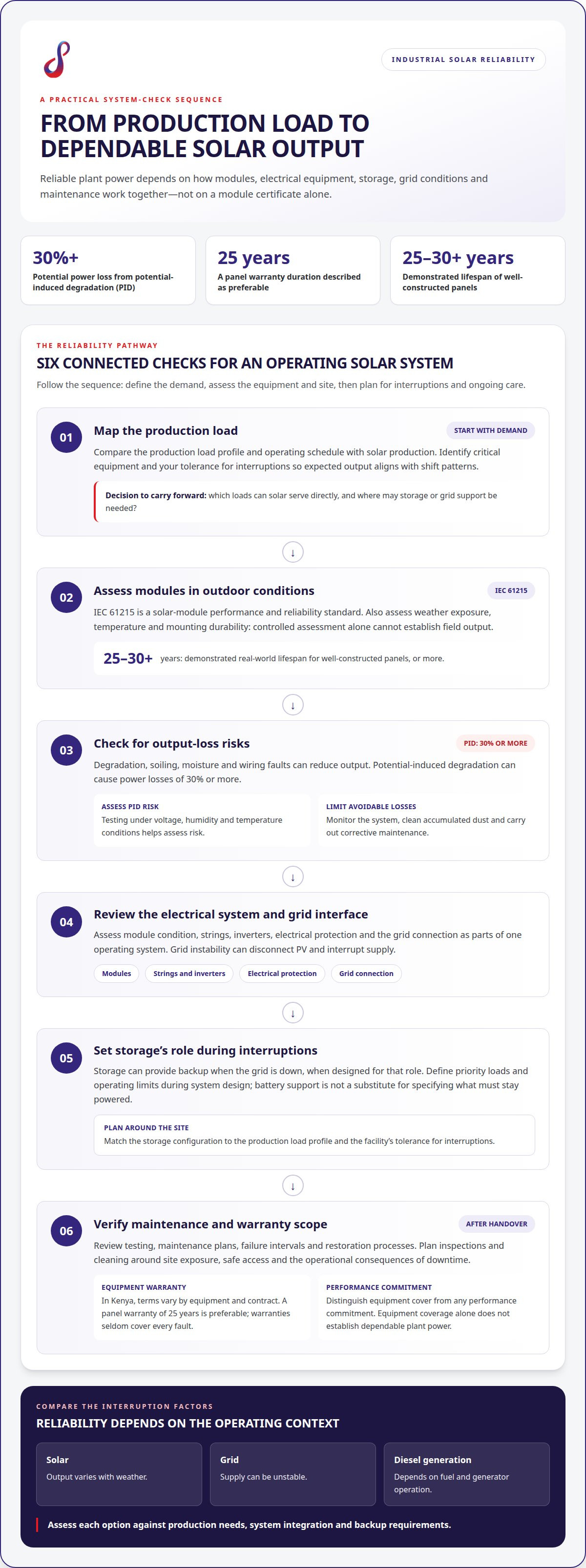
Degradation, soiling, moisture and wiring faults reduce output; potential-induced degradation can cause power losses of 30% or more. Testing under voltage, humidity and temperature conditions helps assess PID risk. Monitoring, corrective maintenance and cleaning accumulated dust help prevent avoidable losses.
Equipment Warranties and Performance Guarantees
In Kenya, warranty terms vary by equipment and contract. A panel warranty of 25 years is preferable, but warranties seldom cover every fault; distinguish equipment cover from any performance commitment.
Weather Resistance and System Durability
IEC 61215 is a module performance and reliability standard, according to the International Electrotechnical Commission. Assess outdoor exposure, temperature and mounting durability; well-constructed panels have demonstrated lifespans of 25 to 30 years or more.
Grid-Connected PV Reliability
Grid instability can disconnect PV and interrupt supply. Storage can provide backup when the grid is down.
Comparing Solar, Grid, and Diesel Reliability
Solar output varies with weather, grid supply can be unstable, and diesel generation depends on fuel and generator operation. Assess each option against production needs, system integration and backup requirements.
Assessing Installers and Verifying Reliability
Review testing, maintenance plans, failure intervals and restoration processes. System design should match your load, from industrial operations to home and small business solar.
TL;DR
Dependable industrial solar begins with matching system design to the facility’s production load, operating schedule and tolerance for interruptions. PV modules, inverters, protection, grid connection and maintenance all affect the electricity available to processes; no single component determines performance alone. Solar can reduce daytime grid demand, while battery storage can support selected loads during outages when designed for that role.
- Model the load profile against solar production so expected output aligns with shift patterns and critical equipment.
- Define storage’s role, priority loads and operating limits during system design.
- Plan inspections, cleaning and fault response around site exposure, safe access and the operational consequences of downtime.
- Review grid behaviour, performance records and warranty scope together; equipment coverage alone does not establish dependable plant power.
What to Look for in an Industrial Solar EPC Company
Assess whether the EPC team manages engineering, procurement, construction, commissioning and lifecycle support with clear project accountability. For an industrial site, the design should reflect the production load profile, operating schedule, grid interface and safe maintenance access, rather than treating panel capacity as the only requirement.
Review how equipment selection, quality management and compliance are handled across each project stage. Spenomatic sources solar panels from manufacturers and includes safe maintenance access in its installations. A strong delivery plan also defines commissioning checks, system documentation, maintenance responsibilities and how faults are identified and addressed. These details help operations teams manage equipment performance after handover, not just during installation. For projects requiring a coordinated solar PV system, lifecycle accountability supports dependable integration with facility operations.
Industrial Sectors Served
Solar requirements vary with the process, shift pattern, available roof or ground space, and the consequences of a supply interruption. A production load profile helps match generation to the facility’s operating demands.
- Steel plants need designs that account for energy-intensive production and electrical loads.
- Food processors can align daytime generation with processing and refrigeration schedules.
- Tea factories need systems matched to seasonal processing and machinery loads.
- Chemical plants require careful integration with process equipment and electrical protection.
- Water-treatment facilities need dependable power for pumps and treatment processes.
- Textile mills can assess solar against spinning, weaving and finishing schedules.
- Cement works need designs suited to heavy equipment and continuous process demands.
- Plastic manufacturers can profile loads across moulding and production shifts.
- Cold-storage operators must account for refrigeration demand and continuity requirements.
- Mining sites need system designs suited to site conditions and operating loads.
Case Studies and Performance Figures
An industrial reference is useful when it shows project scale and operating context, not just installed capacity. Spenomatic delivered a 17.2 MWp solar power system for steel manufacturing and a rooftop project for an integrated steel plant.
This example shows deployment in high-demand manufacturing, but capacity alone does not establish annual generation, availability or outage coverage. These depend on operating conditions, equipment performance, maintenance and grid interaction.
Spenomatic’s portfolio includes 278 MWp of solar PV and 53.22 MWh of battery energy storage across projects. These are portfolio totals, not performance guarantees for an individual Kenyan facility.
When reviewing project evidence, distinguish measured generation and downtime from estimates. Note the system boundary, reporting period and production load profile. A reference is most useful when its operating conditions resemble yours.
Solar Reliability Engineering and Technical Processes
Engineering analysis examines how equipment failures affect generation and restoration. Reliability, availability and maintainability reviews consider failure frequency, repair time and the effect of outages on production.
Module qualification and exposure testing help assess risks from heat, humidity and electrical stress. Potential-induced degradation testing applies voltage under humidity and temperature conditions; damp-heat tests can run for 1000 hours or more. IEC 61701 addresses salt-mist corrosion testing for modules used near the sea.
Operational records provide field evidence: compare expected with measured output, log inverter trips and record repair times. Use corrective maintenance to address faults, and schedule cleaning based on accumulated dust or visible uneven soiling rather than relying on a fixed calendar alone.
Battery storage can support continuity during grid interruptions when configured for backup. Controls determine which loads receive power and how battery cycling is managed. Model these priorities alongside grid interruptions to assess dependable system output over its service life.
Industrial Solar Reliability Comparison Table
Compare each system element using its performance evidence and operational impact. This helps reveal reliability gaps before they constrain production.
| Factor | Assess | Operational implication |
|---|---|---|
| PV modules | Degradation, soiling and inspection findings | Output loss can reduce electricity available to processes. |
| Inverters and strings | Trips, fault records and restoration time | Failures can interrupt conversion and generation. |
| Weather exposure | Mounting, corrosion risks and site conditions | Damage can affect system condition and availability. |
| Grid connection | Voltage behaviour and disconnection events | Grid disturbances may interrupt supply or export. |
| Battery storage | Backed-up loads, controls and cycling strategy | Defined priorities determine which operations receive backup. |
| Maintenance | Cleaning records, inspections and corrective actions | Response time influences outage duration and output recovery. |
Use the comparison alongside measured generation, outage logs and the facility’s production schedule. The right configuration addresses critical loads, site exposure and grid conditions as parts of one operating system.
Regulatory Requirements for Industrial Solar Projects
For an industrial project in Kenya, map approvals and grid-connection conditions to the proposed system configuration and site before procurement. Requirements can differ for grid-tied, hybrid and off-grid installations, so the design basis should identify the applicable review pathway instead of assuming one process fits every project.
Build compliance planning into engineering, procurement and commissioning. Record equipment specifications, electrical protection design, connection details and commissioning results in the project documentation. IEC 61215 provides a module performance and reliability standard, according to the International Electrotechnical Commission, but a product standard does not replace project approvals or grid-interface review.
Across Kenya and other target markets, apply the same disciplined sequence: identify the relevant authorities, establish jurisdiction-specific approval requirements, document design decisions and retain handover records. This keeps compliance work connected to system safety, connection conditions and dependable operation without treating regulatory review as a final-stage formality.
Discuss Your Industrial Solar Site Requirements
A site assessment establishes whether solar generation, storage and grid integration suit your facility. To prepare, gather your site location, electricity bills, production schedule, major electrical loads, backup arrangements and records of known grid interruptions. Include roof or ground constraints, safe maintenance access and planned production changes.
Spenomatic Group’s commercial and industrial solar solutions can be configured as grid-tied, hybrid or off-grid systems, with battery storage where appropriate. An assessment connects these options to your operating requirements, identifies key engineering constraints and informs the project design.
Share the information available about your facility and power needs to begin the assessment. For an industrial site in Kenya, the review can consider local grid conditions alongside generation and continuity requirements. Request a site assessment from Spenomatic Group to discuss a configuration suited to your operations.
Sources
These organizations publish technical standards and analysis relevant to photovoltaic systems. Their materials help explain equipment testing, technology development and renewable energy integration. Use them alongside site-specific engineering assessments and operating records.
- International Electrotechnical Commission: international electrotechnical standards and information for energy technologies.
- International Energy Agency: analysis of solar photovoltaic technology, deployment and electricity-system integration.
- International Renewable Energy Agency: reports on renewable energy development and solar PV supply chains.
Use these references for broader technical context, not as substitutes for project design documents or measured operating results. For industrial systems, interpretation depends on site conditions, equipment configuration, grid behaviour and maintenance records. Comparing standards and sector reports with generation and downtime data helps distinguish general guidance from evidence about a particular installation. This source list supports further technical reading while keeping project decisions grounded in facility requirements.
Industrial solar power reliability depends on decisions made before installation and maintained throughout operation. Make the next step an engineering decision: align the system configuration with your production schedule, critical electrical loads, grid conditions and continuity requirements. This gives your team a clearer basis for balancing generation, storage and backup needs.
Spenomatic Group offers Commercial & Industrial Solar, Home & Small Business Solar, and Grid-Tied, Hybrid & Off-Grid Solar. The right configuration depends on the site and the way you use electricity, so bring your operational requirements into the discussion from the outset. Contact Spenomatic Group to start a technical conversation about your solar requirements. With a defined load profile and clear operating priorities, you can move toward a system designed around the demands of your facility.
Frequently Asked Questions
How Quality Testing Impacts Solar Performance in the Field?
Quality testing can reveal design weaknesses before modules enter operating conditions. Tests for electrical insulation, moisture exposure, temperature stress and potential-induced degradation examine different failure risks. Results inform equipment selection, but field performance also depends on transport, installation, mounting and maintenance. For an industrial plant, testing is most useful when procurement specifications and commissioning checks relate product evidence to the site environment.
What is Photovoltaic Reliability and Standards Development?
Photovoltaic reliability is the ability of modules and connected equipment to continue producing electricity safely under expected operating conditions. Standards provide shared test methods and qualification criteria, making product characteristics easier to assess. The International Electrotechnical Commission identifies IEC 61215 as a standard for solar module performance and reliability. Standards support selection, but they do not replace system-level evaluation of inverters, electrical connections, environmental exposure and maintenance.
Why Are Solar Panels Important for Industry?
Solar panels provide industrial facilities with an on-site electricity source that can serve loads during sunlight hours. This can reduce grid electricity use while production is underway, particularly when daytime demand aligns with solar output. A facility running pumps or process equipment during daylight, for example, can assess solar against those loads. Panels work most effectively when generation is integrated with the plant’s electrical infrastructure and operating requirements.
What is the typical uptime and performance ratio of industrial solar PV systems?
No single uptime or performance-ratio figure applies to every industrial PV system. Uptime records how long equipment remains operational; performance ratio compares actual energy yield with expected yield under measured solar conditions. Track both alongside inverter interruptions, grid disconnections, maintenance periods and energy output. This separates equipment availability from weather-driven variation and helps show whether operational faults are reducing generation.
How do dust, heat, rain, and cloud cover affect solar reliability in Kenya?
Dust and uneven soiling can reduce the sunlight reaching cells, while elevated module temperatures affect conversion performance. Cloud cover changes available sunlight and immediate system output. Rain may wash away some surface dust but does not remove every deposit. In Kenya, site exposure and local weather patterns shape inspection and cleaning needs. Monitoring output alongside weather and cleaning records helps distinguish environmental variation from equipment faults.
What battery storage options and backup systems improve industrial solar reliability?
Battery Energy Storage Systems can store solar electricity for later use or provide backup to selected loads during grid interruptions. A grid-tied system without storage does not provide the same backup function. Design decisions should identify critical equipment, its power needs, backup duration and battery recharging arrangements. Grid-tied, hybrid and off-grid configurations serve different operating needs, so controls and electrical integration must match the facility’s continuity priorities.