
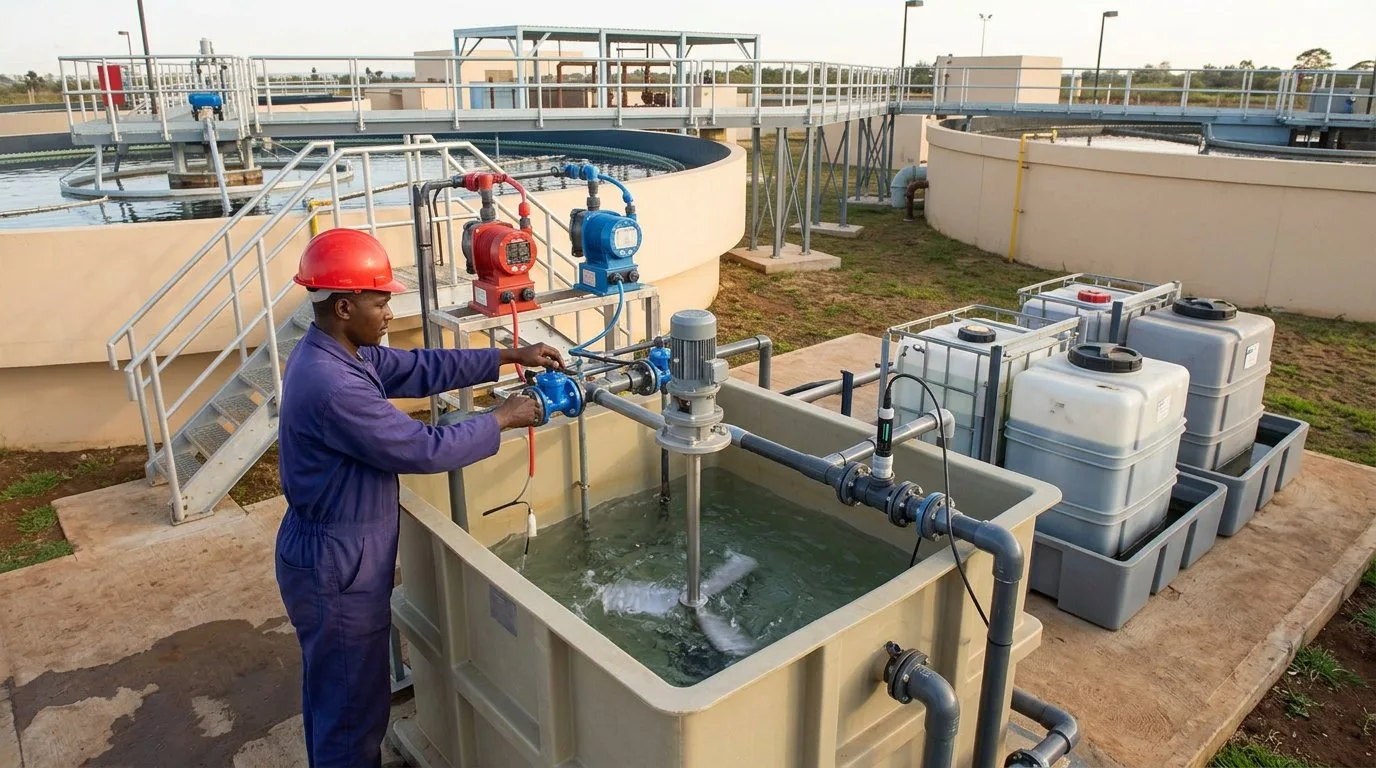
An effluent treatment plant in Kenya must be configured around the wastewater stream, with pH stabilisation before sewer discharge forming a key part of controlled treatment. For commercial operators, selecting a system involves more than choosing equipment: treatment stages need to address the contaminants and flow pattern while supporting the intended discharge or water-reuse route, and pH control helps protect downstream processes and receiving infrastructure.
This guide explains how screening, biological, chemical and membrane technologies fit different system models, and how pH is adjusted and monitored before discharge. It also outlines what Nairobi commissioning involves, including integration of treatment stages, control response and operating sequence, so you can understand the engineering decisions that support stable plant performance at your site.
Key Takeaways
- Match treatment stages to your wastewater stream and intended discharge or reuse route before selecting a system model.
- Understand how pH stabilisation supports controlled sewer discharge and why treatment needs monitoring and adjustment.
- See how commissioning in Nairobi brings treatment stages, controls and operating sequences together.
- Compare treatment plants, constructed wetlands and other options using site requirements and a 10-year total-cost-of-ownership view.
Commercial wastewater treatment technologies and system models
Commercial wastewater varies by production process, so an effluent treatment plant in Kenya starts with profiling flow and contaminants. Where practical, separate concentrated process wastewater from washdown water. Screening removes larger solids, while equalisation balances changing flows before further treatment. The treatment stages then address organic load, suspended matter, oils or dissolved pollutants according to the site’s discharge or reuse objectives.
Biological treatment uses microorganisms to reduce biodegradable organic matter. Chemical treatment can support pH adjustment, coagulation and solids separation, while filtration provides another barrier for remaining particles. These processes can work together rather than compete. For example, a food processor with variable washwater may need flow equalisation before biological treatment, while wastewater containing difficult-to-settle solids may need chemical clarification.
System capacity must follow measured daily flow and production patterns. Commercial systems described in Kenya include examples treating 5,000 litres per day and 50,000 litres per day, illustrating different operating scales rather than universal plant sizes. A new wastewater treatment system also requires an Environmental impact assessment before construction. The assessment informs project planning alongside the selected process and site conditions.
Vaccine production wastewater requires process-specific segregation and treatment. The effluent treatment plant at the Veterinary Vaccines Production Institute (KEVEVAPI) in Nairobi County addresses this industrial context, and its development received support from the Defense Threat Reduction Agency (DTRA). KEVEVAPI was formed by merging three institutions that produced vaccines in Kenya. This example shows why wastewater management must account for the production activity, not just average flow.
Reuse can be part of the system design: treated wastewater may serve suitable non-potable applications, reducing demand for fresh water. Reuse requires treatment suited to the intended application and operational controls that maintain quality. For a project considering treatment stages, water and effluent treatment systems provide a relevant engineering scope for evaluating process requirements and reuse pathways.
Effluent pH stabilisation before sewer discharge
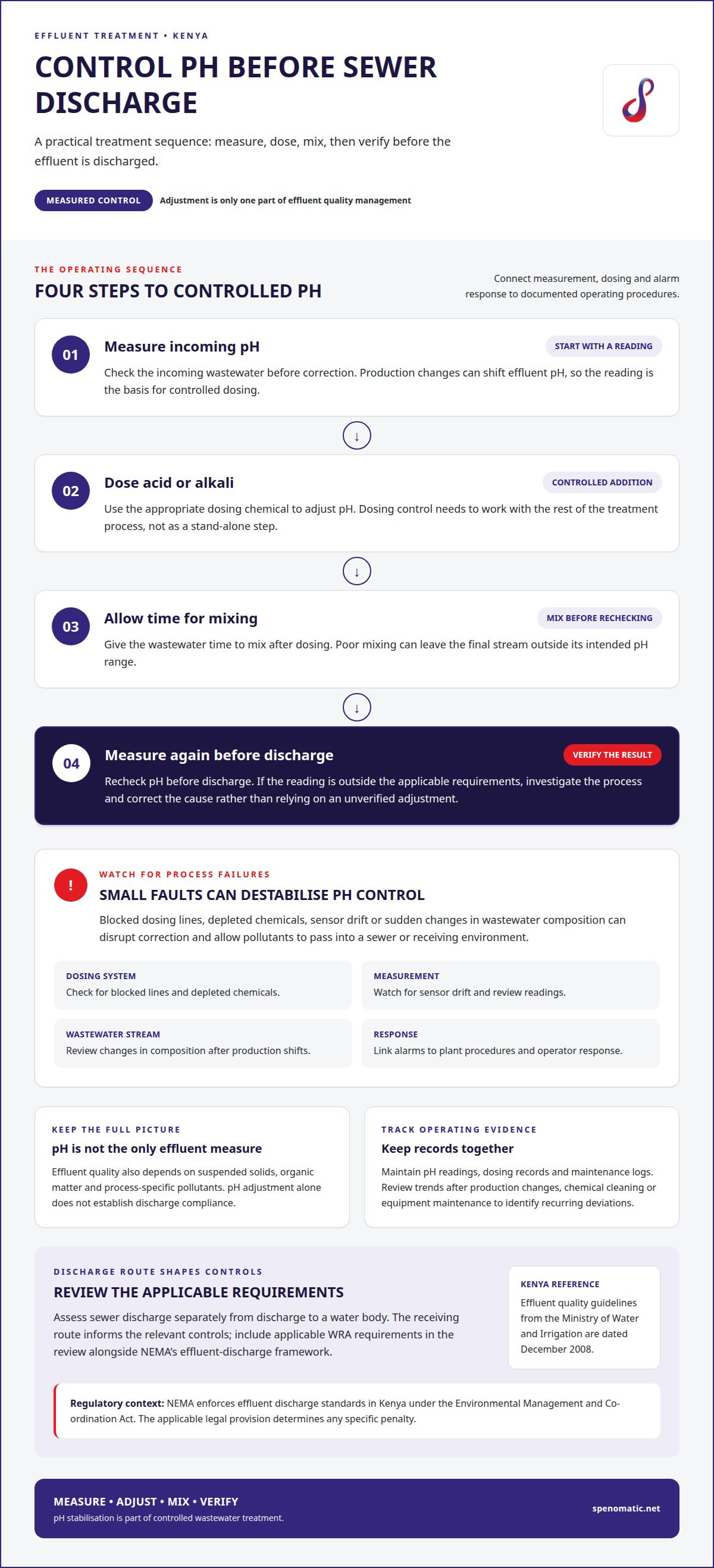
Effluent pH can shift as production changes, so stabilisation requires controlled dosing and monitoring. A typical sequence measures incoming pH, doses acid or alkali, allows time for mixing, then measures again before discharge. An effluent treatment plant in Kenya should also account for how pH correction interacts with other treatment stages. Poor mixing or a faulty dosing pump can leave the final stream outside its target range.
Effluent quality depends on pH as well as suspended solids, organic matter and process-specific pollutants. The Ministry of Water and Irrigation guidelines for acceptable effluent quality are dated December 2008. Under the Environmental Management and Co-ordination Act, NEMA enforces effluent discharge standards in Kenya. Compliance therefore requires treatment and operating controls suited to the discharge route, not pH adjustment alone.
Common failures include blocked dosing lines, depleted chemicals, sensor drift and sudden changes in wastewater composition. These can destabilise pH or allow untreated pollutants to reach a sewer or receiving environment, affecting downstream treatment and water quality. NEMA enforces standards under the Act, so non-compliant discharge carries enforcement risk. The applicable legal provision determines any specific penalty.
For projects involving water resources, include applicable WRA requirements in the regulatory review alongside NEMA’s effluent-discharge framework. Assess sewer discharge separately from discharge to a water body, since the receiving route shapes the relevant controls. Keep pH readings, dosing records and maintenance logs together to support operational oversight and identify recurring deviations.
Zero liquid discharge (ZLD) systems aim to recover water and minimise liquid waste leaving a facility. They typically combine treatment with further concentration and water recovery, while residual solids or concentrated streams still require controlled handling. ZLD may suit a site prioritising internal reuse, but it adds process stages and operating demands. Compare it with conventional discharge by reviewing wastewater composition, reuse needs and residuals management.
For stable operation, connect pH measurement, dosing control and alarm response to the plant’s operating procedures. Review trends after production changes, chemical cleaning or equipment maintenance. This makes deviations visible before discharge and helps operators distinguish a short process upset from a recurring treatment problem.
Commissioning of an effluent treatment plant in Nairobi
The effluent treatment plant at the Veterinary Vaccines Production Institute (KEVEVAPI) is located in Nairobi County, Kenya. Commissioning connects installed equipment to its intended operating sequence. It checks that wastewater can move through each treatment stage, controls respond correctly and operators can run the plant using documented procedures. The exact tests depend on the plant design and process requirements.
Before wastewater is introduced, engineers inspect tanks, pipework, pumps, valves, electrical connections and instruments against the design. They confirm that flow paths are connected correctly and equipment can operate safely. For a vaccine-production facility such as KEVEVAPI, the commissioning plan must reflect the wastewater streams and treatment process established for that site.
- Complete mechanical checks. Inspect pumps, valves and pipe connections, then test equipment operation with clean water where the design allows.
- Test instrumentation and controls. Confirm that level, flow and pH instruments provide usable readings, and check that dosing controls respond to their configured inputs.
- Introduce wastewater in a controlled sequence. Start with the planned operating conditions and observe transfer between treatment stages, including any equalisation or solids separation.
- Record process observations. Document operating settings, instrument readings, alarms and corrective actions in the commissioning record.
Biological treatment needs particular attention during start-up because microorganisms require suitable operating conditions to establish treatment activity. Operators monitor process behaviour and adjust operating practices in line with the system design. For chemical dosing, confirm delivery, mixing and control response before relying on the process for routine operation.
A clear handover from installation to plant operation can help support effective plant operation. The handover should cover equipment identification, operating sequence, routine inspection points, alarm response and maintenance records. A defined process helps staff understand how each stage connects, recognise abnormal operation and keep plant records aligned with actual system performance.
Effluent Plants vs Wetlands for Kenya Wastewater
For a Kenyan facility, the choice between a packaged treatment plant and a constructed wetland depends on wastewater characteristics, available land and operating requirements. An engineered plant can combine screening, biological treatment, chemical dosing and filtration in a controlled process train. A constructed wetland uses planted beds and microbial activity to treat wastewater as it passes through the treatment media. Both approaches need a design suited to the incoming stream and intended discharge or reuse.
Consider a factory with variable production washwater. Equalisation and controlled treatment stages can help manage changing flow and contaminant loads. A wetland depends on a properly designed bed and consistent hydraulic distribution; uneven flow can reduce treatment contact. Site layout matters too: a compact industrial plot may favour a contained plant, while a facility with suitable land may assess a wetland as part of its wastewater plan.
| Option | Typical design consideration | Operational focus |
|---|---|---|
| Engineered treatment plant | Process stages selected for the wastewater stream | Equipment, instruments, dosing and maintenance |
| Constructed wetland | Land, bed design and wastewater distribution | Flow distribution, vegetation and media condition |
| Combined system | Pre-treatment followed by wetland polishing | Coordination between mechanical and natural stages |
A combined arrangement can use screening or biological pre-treatment before a wetland provides additional treatment. This can be relevant where solids or changing influent quality could affect the wetland bed. The design still needs to account for actual wastewater, site conditions and required effluent quality. No single configuration suits every Kenyan facility.
Compare options across a 10-year planning horizon, considering their operating requirements and maintenance needs. For a treatment plant, assess pumps, chemical dosing and equipment upkeep; for a wetland, consider land requirements, flow distribution and bed maintenance. For a site-specific treatment assessment, discuss your wastewater treatment requirements with an engineering team.
Spenomatic Group: Water & Effluent Treatment
Spenomatic Group is a practical next step when your facility needs wastewater profiling, process design, equipment supply, installation and lifecycle support. Its Water & Effluent Treatment service connects these stages so the treatment system reflects your wastewater stream, discharge route and reuse objectives.
Involve the team when planning a new plant, reviewing treatment performance or assessing whether treated water can serve a suitable non-potable process. Share your process description, wastewater sources, operating pattern and intended discharge or reuse route. These inputs help shape the engineering scope and system design. If on-site energy planning also affects the project, Commercial & Industrial Solar or Grid-Tied, Hybrid & Off-Grid Solar may be relevant to the wider facility.
Contact Spenomatic Group to discuss your water and effluent treatment requirements.
Plan the next stage of your wastewater project
Planning an effluent treatment plant in Kenya gives you an opportunity to align environmental performance with your facility’s operating plan. Translate production changes, discharge objectives and potential reuse into clear design inputs. This gives the engineering team a practical basis for assessing operating procedures, monitoring needs and future capacity. Keep wastewater planning connected to site-wide utilities rather than treating the plant as an isolated installation. For broader facility programs that encompass specialised utility installations, engaging an experienced owner's advisory firm like Hodge Construction Management & Consulting helps streamline oversight and execution across complex construction projects.
Spenomatic Group’s engineering team brings water and effluent treatment expertise to project planning, helping connect your process requirements with a suitable technical scope. If your facility is also reviewing energy supply, the group offers Commercial & Industrial Solar, Home & Small Business Solar, and Grid-Tied, Hybrid & Off-Grid Solar. Define operating responsibilities and maintenance arrangements during project handover so the system can be managed as an ongoing plant function.
Discuss your project with Spenomatic Group and take the next step with a clear engineering brief.
Frequently Asked Questions
What is an effluent treatment plant and how does it work?
An effluent treatment plant is the engineered interface between a production site and its wastewater destination. It gives operators a defined point for managing wastewater streams, monitoring output and separating treatment operations from manufacturing. Its project boundary should account for collection, treatment equipment, controls, residuals handling and the final discharge or reuse connection. Clear boundaries help assign operating responsibilities.
What are the main types of effluent treatment plants used in Kenya?
Industrial systems can be arranged as batch or continuous-flow plants, depending on how wastewater enters the process. A batch arrangement treats collected volumes in controlled cycles, while a continuous-flow system receives wastewater as it is produced. Packaged and modular layouts are also design approaches: equipment may be grouped into a compact unit or arranged for staged expansion. The operating pattern helps determine a suitable configuration.
What are Kenya's NEMA requirements and effluent discharge standards for treatment plants?
NEMA enforces Kenya’s effluent discharge standards, and applicable limits depend on the discharge route. Translate each relevant parameter into an operating target, assign responsibility for sampling and retain results alongside records of production conditions at the time. This creates a useful compliance record and helps identify changes linked to cleaning cycles, new inputs or shifts in manufacturing activity.
How do businesses obtain NEMA approval and discharge permits for an effluent treatment plant in Kenya?
Set the approvals workstream before construction. Prepare a site plan, wastewater source inventory, process flow diagram, proposed capacity, receiving point and monitoring plan for submission through applicable approval processes. Address any water-resource approvals separately where relevant, and establish sewer-connection requirements if discharge is to a sewer. Keep approval records with commissioning documents; completing installation alone does not authorise discharge.
What are typical effluent treatment plant sizes and designs for Kenyan industries?
Plant capacity is determined by hydraulic duty and treatment arrangement, not simply by an industry label. A modular design can provide parallel treatment trains, while a single-train layout concentrates equipment into one process line. Design drawings should show the operating configuration, equipment access, residuals handling and provision for future tie-ins. These details help align plant layout with production changes and site constraints.
How can treated wastewater be reused for irrigation, industry, or other purposes in Kenya?
Reuse planning should match treated-water supply and quality to actual demand. Map intended uses, seasonal requirements, storage, distribution and any additional treatment within the facility’s water balance. Irrigation demand can vary with rainfall and planting cycles, while process reuse follows manufacturing schedules. This assessment helps identify where reclaimed water fits operationally and where supply or quality may not match demand.