
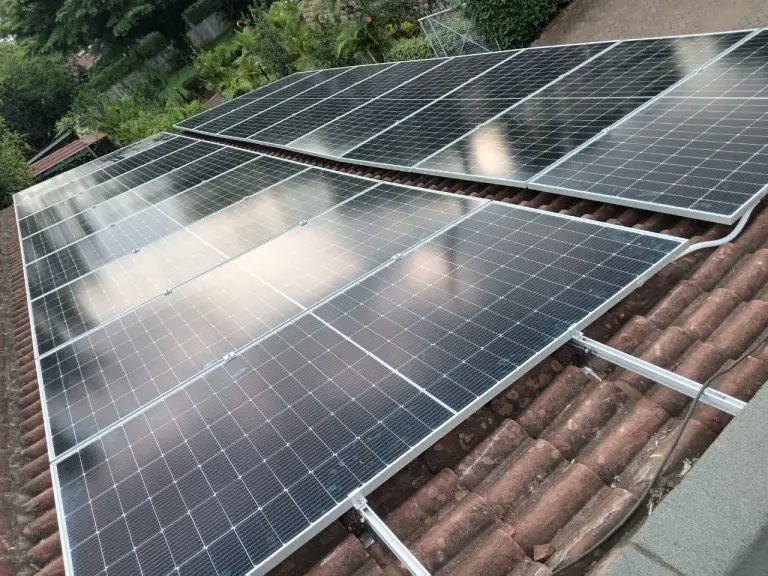
Yes, you can add solar to a house that is already connected to KPLC. Most installations work alongside the existing meter and distribution board, without rewiring the house. What you need to arrange depends on one question: will the system export power to the grid?
Key takeaways
- Solar connects to your existing distribution board; full rewiring is only needed if the wiring is old or non-compliant.
- Exporting surplus power needs a net-metering agreement with KPLC under the Energy (Net-Metering) Regulations, 2024.
- Systems without that agreement should be set up so they cannot export, because EPRA now charges for unauthorised exports.
- Installation must be carried out by an EPRA-licensed solar contractor.
Can I add solar to a house that already has a KPLC connection?
Yes. We install a grid-tied or hybrid system that works alongside your existing meter and wiring, and you keep KPLC as backup.
Do I need approval from KPLC?
It depends on whether the system exports power:
- Exporting to the grid (net metering): you need a net-metering agreement with KPLC and a compliant inverter and meter. Under the Energy (Net-Metering) Regulations, 2024, exported power earns a credit of half a unit for each unit exported. Our guide to net metering in Kenya explains the rules.
- No export: the system only supplies your home. It should be configured with export limiting so it cannot feed power into the KPLC network, because EPRA's September 2026 tariff notice treats unauthorised exports as "dumping" and charges for them.
We can guide you through the requirements for either setup.
Do I need to rewire my whole house?
No. We connect to your existing distribution board and add a solar circuit. We only recommend upgrades if the existing wiring is old, undersized or non-compliant, which we check during the site survey.
Will solar work with my existing appliances?
Yes. We assess your existing loads, such as the fridge, pump, TV and lighting, and size the system to match. You do not need to replace appliances.
What happens during a power outage?
A grid-tied system without batteries switches off during a blackout; this is a safety requirement that protects line workers. A hybrid system with batteries keeps your essential circuits, or the whole house if the battery is large enough, powered. See grid-tied, hybrid and off-grid systems compared.
Can I keep my KPLC connection as backup?
Yes, and most homeowners do. A hybrid system uses solar first and draws from KPLC only when solar and batteries are not enough, for example on cloudy days or during periods of high use.
How disruptive is installation?
Disruption is minimal. A typical home installation takes days rather than weeks, and the site survey confirms the schedule. Power is switched off briefly for the final connection to your distribution board, at a time that suits you.
Will solar reduce my KPLC bill straight away?
Yes. From the first day, solar covers part of your daytime use, so you buy fewer KPLC units, provided the system is either configured not to export or covered by a net-metering agreement. Savings depend on the system size compared with your consumption. For what drives the cost, read solar panel prices in Kenya.
Do I need any other approvals?
Under the Energy (Solar Photovoltaic Systems) Regulations, 2012, the system must be designed and installed by an EPRA-licensed solar contractor. Exporting systems also need the KPLC net-metering agreement. We flag during the site survey if your property needs anything more, for example if the roof requires structural work.
What roof types can solar be installed on?
Most roofs work: mabati (iron sheet), tiles and flat concrete. We assess the roof's condition, age and strength during the site survey before quoting. Asbestos roofs, still found on some older buildings, must not be drilled; they need to be replaced safely before installation.
Frequently asked questions
Can I add solar to a house already connected to KPLC?
Yes. A grid-tied or hybrid system connects to your existing distribution board and works alongside the KPLC meter, which stays as backup.
Do I need KPLC approval for home solar?
You need a net-metering agreement with KPLC if the system exports power to the grid. A system that does not have one should be configured so it cannot export.
Does home solar work during a blackout?
Only with batteries. Grid-tied systems without batteries switch off during outages for safety; hybrid systems with batteries keep essential circuits running.
Who can install solar on a house in Kenya?
An EPRA-licensed solar contractor, as required by the Energy (Solar Photovoltaic Systems) Regulations, 2012.
Ready to add solar to your home? Request a home solar assessment. Still building? Read solar for a new house in Kenya.