
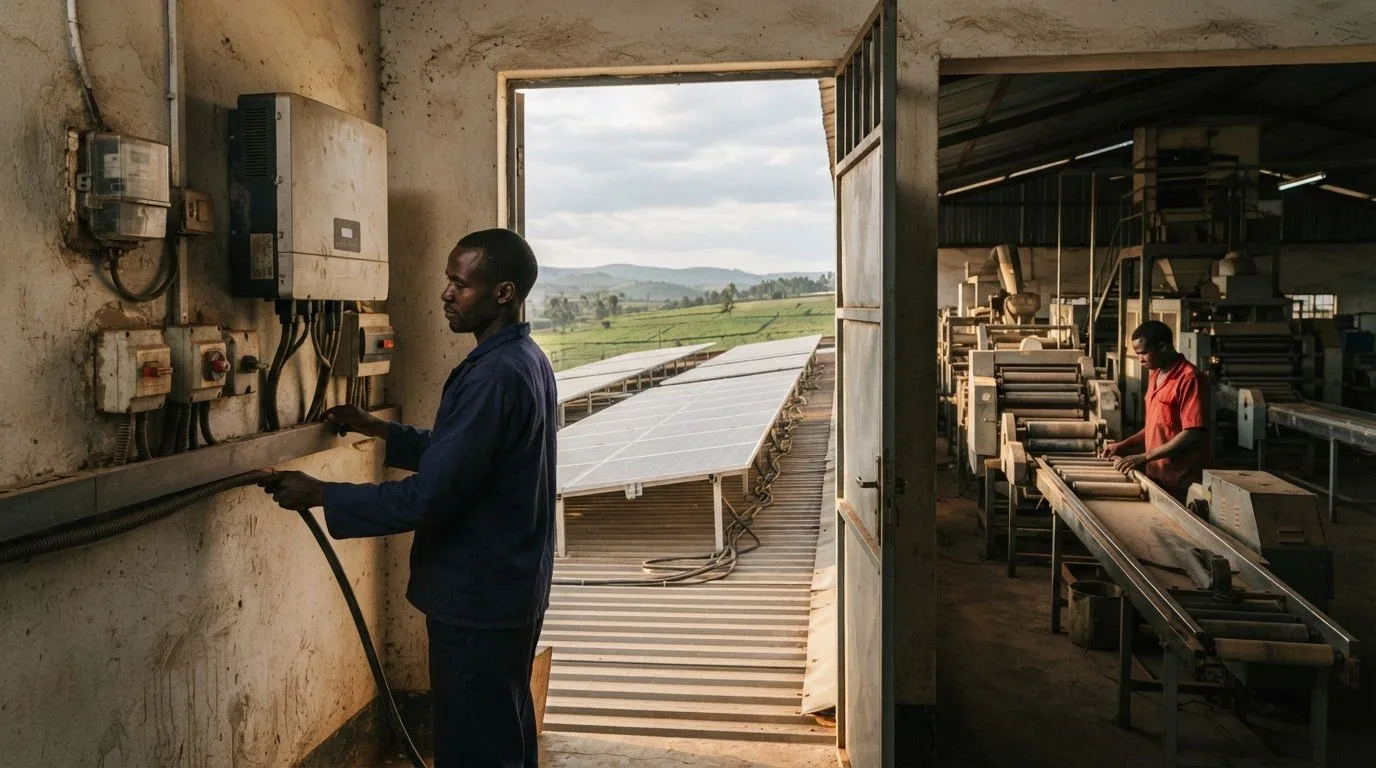
For commercial solar PPA financing options in Kenya, bank approval is not a universal requirement; it depends on the funding structure and agreement, while a business borrowing to purchase a system must meet its lender’s approval process.
It’s sensible to understand the payment commitment before adopting solar. Under a PPA, your business pays for the solar electricity it uses according to agreed terms. Assess the proposal against your production load profile, daytime electricity use and existing grid supply, rather than treating it as a standard equipment purchase.
This guide explains how PPAs and leases differ, what shapes payments, and how ownership, maintenance and end-of-term arrangements work. It also covers the information used to assess a project and the role of lender approval, helping you identify a structure that fits your facility’s operating requirements.
Key Takeaways
- Match a financing structure to your production load profile, daytime electricity use and appetite for system ownership.
- Understand how PPA, lease and purchase arrangements differ in payment structure and whether bank approval may apply.
- Assess a PPA by reviewing its payment terms, system responsibilities and provisions for maintenance and the end of the agreement.
- Use project examples and an assessment of your facility’s energy requirements to guide the next financing decision.
Commercial Solar Financing Options for Kenyan Businesses
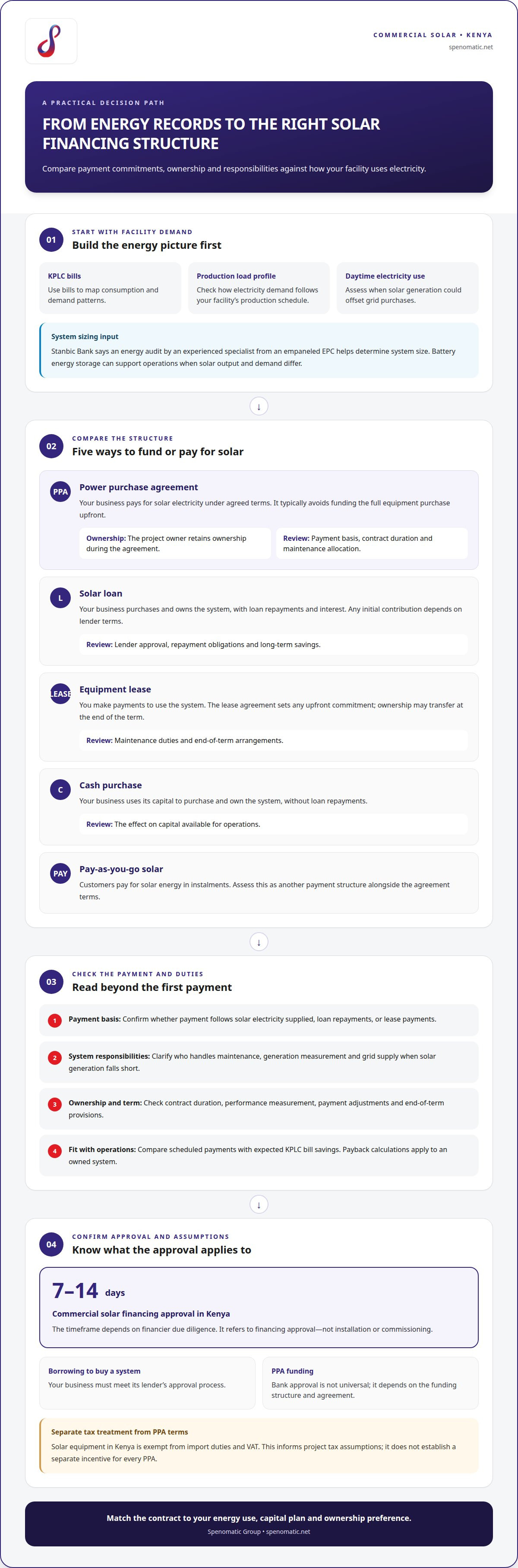
Choose a financing model by matching payment obligations to energy demand, available capital and your preference for system ownership. When comparing commercial solar PPA financing options in Kenya, weigh each contract structure against your operating needs and grid connection requirements.
Financing Models and Initial Funding
A power purchase agreement can reduce the need to fund equipment upfront: your business pays for solar electricity under agreed terms. A loan funds a system purchase, with repayments and interest, while a lease sets payments for using the system. Compare payment structure, ownership rights and maintenance responsibilities. Depending on the terms, a loan or lease may require an initial contribution. For a PPA, loan or lease, compare scheduled payments with expected KPLC bill savings. Payback calculations apply to an owned system.
Bills, Savings, and Payback
Use KPLC bills to map consumption, demand patterns and daytime electricity use before sizing a system. These records help estimate how solar energy could offset grid purchases. Stanbic Bank says an energy audit by an experienced specialist from an empaneled EPC helps determine system size. Battery energy storage systems can support operations when solar output and demand differ.
Tax Treatment and Import Duties
Solar equipment in Kenya is exempt from import duties and VAT. This affects project tax assumptions, but does not establish a separate incentive for every PPA. Kenya aims to achieve 100% renewable energy by 2030. Businesses comparing commercial solar PPA financing options in Kenya should distinguish tax treatment from the agreement’s payment terms.
Comparing Commercial Solar Financing Options in Kenya
Compare financing options by upfront cash commitment, ownership, payment structure and responsibility for maintenance. The best fit depends on your capital plan and how solar generation aligns with facility operations.
| Option | Upfront commitment | Ownership and payments | Key consideration |
|---|---|---|---|
| Power purchase agreement | Typically avoids funding the full equipment purchase upfront. | You pay for solar electricity under agreed terms; ownership rests with the project owner during the agreement. | Review the payment basis, contract duration and maintenance allocation. |
| Solar loan | Depends on the lender’s financing terms and borrower contribution. | Your business purchases and owns the system, with loan repayments and interest. | Assess lender approval, repayment obligations and long-term savings. |
| Equipment lease | Set by the lease agreement. | You make lease payments to use the system; ownership may transfer at the end of the term. | Clarify maintenance duties and end-of-term arrangements. |
| Cash purchase | Requires business capital for the purchase. | Your business owns the system without loan repayments. | Consider the effect on capital available for operations. |
Pay-as-you-go solar lets customers pay for solar energy in instalments, offering another payment structure to assess. Commercial solar financing approval in Kenya takes 7-14 days, depending on financier due diligence. That timing is relevant to financing approval, not installation or commissioning.
Compare the complete agreement, not just its first payment. A solar PV system must also match site conditions and electrical requirements. Check how the financing model treats generation, maintenance, grid connection and the system’s eventual ownership. This comparison helps identify which obligations fit your operating plan.
What Is a Power Purchase Agreement (PPA)?
A commercial solar power purchase agreement (PPA) lets your business buy solar electricity under contract without purchasing the generating equipment. In an onsite customer PPA, a project owner installs a system at your facility, and your business pays for the electricity supplied under agreed terms. This separates the electricity purchase from direct equipment investment.
When comparing commercial solar PPA financing options in Kenya, distinguish your customer agreement from the project’s funding structure. Your business is the power buyer, and the contract sets supply and payment terms. Separately, a lender may finance the solar asset and secure its loan against project assets or contracted payment receivables. These are different sides of a transaction, not necessarily competing PPA models.
Before assessing commercial solar PPA financing options in Kenya, review the proposed system, expected generation, payment basis and supply responsibilities. The agreement should explain how measured electricity determines payments, how grid supply works when solar generation falls short, and who maintains the equipment. These terms show how the PPA fits your production schedule and sustainability objectives. Check the contract duration, performance measurement, payment adjustments and end-of-term provisions. Make sure the project’s asset ownership, any lender security and your business’s obligations are also clear.
Which Kenyan Banks Finance Solar Projects?
KCB reported KES 48.8 billion in green financing disbursements during 2025. It also secured a KES 12.5 billion Green Climate Fund facility supporting SMEs and agricultural businesses investing in climate-resilient technologies, including solar energy. These figures describe financing activity, not automatic approval for an individual project.
For a solar installation, assess whether a bank loan, project loan or crowdfunding structure suits your business. A project loan finances a defined asset, with repayment terms set by the financing agreement. Crowdfunding pools contributions from multiple investors; the project structure should explain how funds are used and how investors are repaid. Compare repayment timing with expected monthly energy payments and available capital.
Kenyan projects illustrate different scales of clean energy investment. The planned Seven Forks solar photovoltaic installation is 42.5 MW and is expected to be operational by 2027. Thika Cloth Mills’ solar project has a capacity of 2.6 MWp and includes 2.9 MWh of battery storage. These examples show how project scale and storage can vary across commercial and utility installations.
Licences, approvals and regulations depend on project design and site conditions. Map the requirements for generation, electrical installation, environmental assessment and grid connection. These are separate from a bank’s credit review: lender due diligence assesses the financing, while project approvals cover the installation and its connection. Track both workstreams in the project schedule.
System Ownership, Maintenance and End-of-Term Options
Before signing a Kenyan solar PPA, review performance provisions, system risks and maintenance responsibilities. The contract should assign each duty and explain what happens when the agreement ends.
Ownership and Maintenance Responsibilities
Identify the legal owner of the solar system during the PPA and who controls its operation. The agreement should allocate inspection, cleaning, repairs and responsibility for reduced generation. Ask how maintenance access will be managed without disrupting facility operations. Quality solar panels often remain productive for 25 years or more, so align maintenance provisions with the system’s expected operating life. Under an equipment lease, ownership may transfer to the lessee after the lease term.
Contract Risks and End-of-Term Options
Check how the contract measures performance and handles generation below agreed expectations. Review the conditions that trigger termination and whether changes to facility operations affect your obligations. Depending on the contract, end-of-term options may include extending the agreement, purchasing the system or having it removed. Confirm the process and responsibilities in writing.
System configuration also affects continuity. A grid-tied system operates alongside KPLC supply; a hybrid system combines grid connection with battery storage; an off-grid system operates independently of the grid. Size battery capacity around the facility’s electrical load and backup requirements. The contract should explain how the chosen configuration supplies electricity when solar generation varies.
Spenomatic Group: Commercial & Industrial Solar
Spenomatic Group delivers commercial and industrial solar projects for businesses assessing on-site generation. Turn to its engineering, procurement and construction capabilities when your facility needs a system designed around operating demand, site conditions and grid connection requirements. The technical scope can inform your PPA discussions, but the financing agreement and payment terms remain matters for the contracting parties.
Project planning starts with electricity use and the production schedule. Spenomatic Group’s engineering team can assess whether a grid-tied, hybrid or off-grid configuration suits your facility. If you need continuity beyond solar production hours, battery energy storage systems can form part of the design. Layout, electrical integration, installation sequencing and safe maintenance access should also align with site operations.
For a PPA assessment, gather the facility’s KPLC bills, operating schedule and information about available rooftop or ground space. These details help establish the basis for system sizing and expected generation, supporting a financing proposal. Spenomatic Group provides EPC services across the project lifecycle, integrating engineering and installation in one delivery process. This is relevant when you need a commercial solar system planned around a wider industrial energy operation, rather than equipment selected without regard to site requirements.
Discuss your commercial solar project with Spenomatic Group and outline your facility’s energy requirements.
Frequently Asked Questions
Do I need bank approval for a PPA or PLA?
Not necessarily. Under a PPA, the project owner may arrange financing separately, while your business agrees to purchase solar electricity. If a loan funds the project or your business purchases the system, the lender assesses the borrower under its lending process. Before accepting an agreement, review whether your business must provide security, guarantees or other financial commitments.
How long are the financing terms?
The duration depends on the financing agreement. Review when the term begins, whether commissioning affects the start date, and how the agreement handles operational delays. Note any renewal process, notice period and conditions for an extension. Align these provisions with your facility’s planning horizon and operating schedule so the contract remains workable as business requirements change.
What happens at the end of a PPA or PLA?
The contract sets out the end-of-term process. It may provide for a system purchase, extension or equipment removal, while a lease may allow ownership to transfer under its terms. Check who arranges the handover, maintains the system during a transition and removes equipment if required. Record notice deadlines and any conditions your business must meet before expiry.
Which Kenyan solar developers and financiers offer commercial PPAs?
Spenomatic Group provides commercial and industrial solar solutions and lists structured PPAs among its financing pathways. KCB has reported green financing activity, but that does not establish that a particular PPA is available to your business. Treat the developer and financier as distinct project roles: one may deliver the solar system, while a lender assesses or funds the arrangement.
How are electricity payments handled under a commercial solar PPA?
The agreement defines how the system measures supplied electricity and how that measurement informs your payment obligations. Review the metering method, billing frequency, treatment of system outages and process for resolving measurement disputes. For example, confirm how the contract distinguishes solar electricity delivered to your facility from electricity supplied separately by the grid.
How should a business assess a PPA alongside Kenya Power supply?
Assess how solar generation aligns with your operating schedule and how much grid electricity your facility may still need. Review KPLC bills alongside production hours to understand demand during and beyond periods of solar output. System design, grid connection and battery storage affect how the two sources work together. Include expected operational changes in your assessment.