
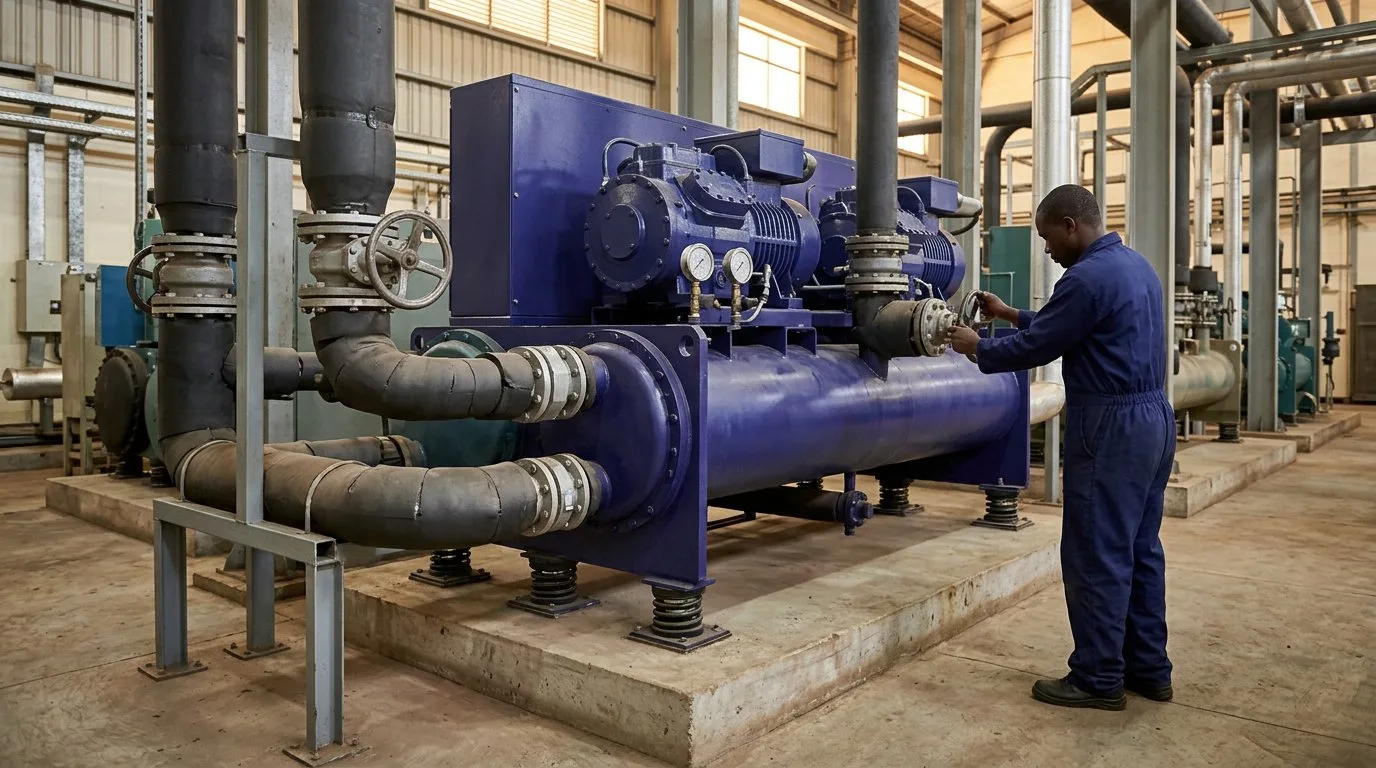
A successful industrial chiller installation in Nairobi starts with the process heat load, not a catalogue rating. Size the system to the process capacity, cooling requirements and operating environment, then match the refrigeration unit and controls to those conditions. An ice-water chiller removes heat from water or another liquid through a refrigeration cycle and supplies the chilled fluid to the process.
Reliable cooling depends on more than the chiller: unsuitable equipment selection or poor site planning can complicate operation and maintenance. This guide explains how to profile the load, calculate cooling duty, choose refrigeration equipment and controls, and plan safe maintenance access. It also covers site preparation and commissioning decisions for integrating an industrial ice-water chiller into a Nairobi facility.
Key Takeaways
- Plan maintenance routes, service clearances and safe access before equipment is positioned, so routine work can be carried out without obstructing plant operations.
- Match the refrigeration unit and control panel to the required cooling duty and site conditions; equipment capacity alone does not determine system performance.
- Calculate heat load using the process flow rate, temperature change and fluid properties to establish the chiller duty required.
- For industrial ice-water cooling, assess whether the process needs glycol in the water circuit, particularly where the required setpoint makes it relevant.
Maintenance access and operational safety
Common installation risks include restricted service access, unsuitable electrical connections, and safety controls that are bypassed or poorly integrated. For industrial chiller installation in Nairobi, plan these checks before placing equipment and verify them again during commissioning.
- Reserve clear access to service panels, filters, valves, and components requiring inspection. Position the chiller so technicians can open panels fully and remove parts without moving nearby equipment. Keep the maintenance route clear of stored materials and routine production traffic.
- Set a preventive maintenance schedule around actual operating conditions. Chiller maintenance is recommended at least quarterly, with frequency varying according to usage and environment. Include checks of the heat exchanger, electrical connections, refrigerant circuit, and control responses in the planned service routine.
- Design safe access for every person entering a cold room. According to Spinel Dynamics, cold-room doors should have safety release handles to prevent someone being trapped inside. Confirm the handle works from inside and that the exit route remains unobstructed during normal operation.
- Coordinate electrical work with the chiller’s equipment data and site supply. Have a qualified technician isolate the supply before servicing, verify isolation, and apply the specified protective devices. Route cables away from water, moving equipment, and areas where routine cleaning could damage them.
- Test the chiller’s safety systems during commissioning, rather than relying on a visual inspection. Verify that alarms, shutdown interlocks, and emergency-stop functions respond as designed. Record each test result, including the affected component and the corrective action taken.
- Control access during installation and maintenance by defining the work area and communicating isolation status to operators. Before restart, account for tools and personnel, restore guards, and confirm that the control panel indicates normal operation. Document any alarms that recur after the test.
At the Kimana site, the electrical supply was extended approximately 70 metres to reach the cold room. UK F-Gas regulations require an annual inspection of refrigeration systems, and bi-annual inspections of larger refrigeration systems, by an F-Gas-certified engineer.
Refrigeration units and controls
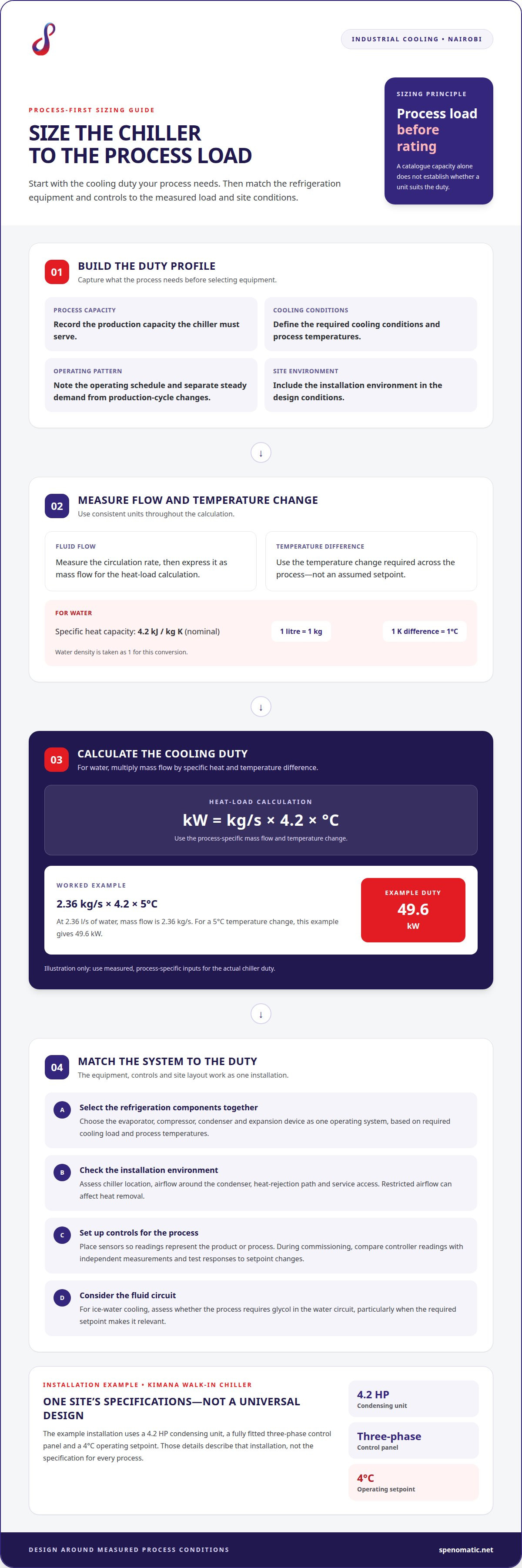
- Match the refrigeration unit to the duty. Select the evaporator, compressor, condenser, and expansion device as one operating system. The required cooling load and process temperatures determine the selection; unit capacity alone does not establish suitability. Record the design conditions so commissioning checks can compare actual operation with the intended duty.
- Account for the installation environment. Assess the chiller location, airflow around the condenser, heat rejection path, and service access. Restricted airflow can affect heat removal, while poor equipment placement can complicate inspection. Include the intended operating environment in the unit selection rather than treating it as a separate site detail.
- Specify a control panel that suits the electrical supply. The Kimana walk-in chiller provides a practical Kenyan installation example: it uses a 4.2 HP condensing unit and a fully fitted three-phase control panel. Its operating setpoint is 4°C. These details describe that installation, not a universal specification for other processes.
- Configure electronic temperature control around the process. Set the required temperature range and sensor locations so readings represent the product or process being cooled. During commissioning, compare controller readings with independent measurements, then confirm that the system responds correctly when the setpoint changes.
- Define monitoring and alarm responses. Specify which operating values the control system records, which alarms require operator attention, and who responds to them. Where remote monitoring is required, design the communications interface and access permissions around the facility’s operating procedures. Test alarm transmission and escalation during commissioning rather than assuming the connection works.
- Document the operating sequence. Record setpoints, alarm thresholds, shutdown conditions, and restart steps in the plant’s operating instructions. Train operators to distinguish a routine temperature adjustment from an alarm requiring technical intervention. A coordinated review of industrial cooling requirements can align the unit, controls, and process duty.
Chiller sizing and heat-load calculations
- Profile the process duty. Record process capacity, required cooling conditions, operating schedule, and environment. Chiller size depends on these factors, not simply the equipment footprint or an existing unit’s rating. Separate steady cooling demand from changes caused by production cycles.
- Establish the fluid flow and temperature difference. Measure the circulation rate and the temperature change required across the process. Use consistent units throughout the calculation. A temperature difference of 1 K equals 1°C, so either unit expresses the same temperature interval.
- Apply the water heat-load calculation. Water’s specific heat capacity is nominally 4.2 kJ / kg K. Its density is 1, meaning 1 litre of water equals 1 kilogram of water mass. Multiply mass flow in kilograms per second by specific heat and temperature difference to calculate kilowatts.
- Check the calculation against a worked example. At a water flow rate of 2.36 l/s, the mass flow is 2.36 kg/s. With a 5°C temperature change, the calculation is 2.36 × 4.2 × 5, giving a required chiller size of 49.6 kW. Use this as an illustration, not a substitute for process-specific inputs.
- Account for glycol in the circuit. Glycol changes the fluid properties used in the load calculation. Water containing glycol additives has a specific heat capacity of 4.8 kJ / kg. K. Use the appropriate fluid value rather than applying water’s figure to a glycol mixture.
- Reconcile the calculated load with operating conditions. Confirm the selected duty against process capacity, cooling requirements, and the operating environment. Check that the design reflects actual flow and temperature needs, then carry those conditions into equipment selection and commissioning records. This links the calculation to the installed system.
Where a site has varied heating and cooling needs, assess whether recovered heat could contribute to the overall system design. Heat recovery may suit mixed-use projects or large offices with diverse heat profiles. Include this opportunity when reviewing the calculated load and how the plant will serve the site.
Equipment choices can also affect refrigerant requirements. The guide states that aluminium microchannel condensers require 30% less refrigerant charge than other types of heat exchanger. Consider this alongside the process duty and operating conditions when comparing condenser options, rather than treating chiller capacity as the only selection criterion.
Industrial ice-water chillers
- Define the installation scope and approvals. In Kenya, establish which site and building approvals apply to the planned works with the relevant authorities. Requirements depend on the premises and installation scope, so identify them during project planning rather than assuming one permit covers every installation.
- Trace the cooling circuit from chiller to process. A water chiller removes heat from water or another liquid through a refrigeration cycle, then supplies cooled fluid to process equipment. Map supply and return lines, isolation points, pumps, and heat exchangers so the installed system serves each cooling load.
- Choose the fluid for the operating setpoint. Where low or high chiller setpoint temperatures are required, the guide recommends mixing 10 to 50% ethylene or propylene glycol with water. Account for the selected mixture when sizing flow and heat transfer, since glycol changes fluid properties.
- Assess heat rejection and the installation environment. Allow the condenser to reject heat without obstructed airflow or recirculation. For indoor installations, consider how rejected heat affects surrounding areas and ventilation. In mixed-use buildings, heat recovery can capture cooling heat to reduce heating requirements elsewhere.
- Sequence installation around site readiness. The process runs from load assessment and design through equipment selection, site preparation, mechanical and electrical installation, and commissioning. The timeline depends on design scope, equipment procurement, access, utility readiness, and required integration. Resolve site constraints before delivery to avoid disrupting the installation sequence.
- Commission the complete water circuit. Confirm circulation, flow direction, temperature control, alarms, and process response under operating conditions. Record the readings and operating settings as commissioning references, then document shutdown and restart procedures for operators.
- Connect the system design to the process requirement. Industrial ice-water cooling is suited to processes that need controlled cooling through a circulating liquid, rather than direct air cooling. Discuss an industrial chiller project to align the chiller, circuit, and site plan with the facility’s cooling duty.
Spenomatic Group: Commercial & Industrial Solar
Spenomatic Group supplies and installs chillers as part of its Boilers, Chillers and Biomass Systems offering for facilities planning process cooling. Its Commercial & Industrial Solar solutions can also be considered alongside cooling equipment when assessing a site's energy infrastructure. Discuss these requirements together so the chiller duty, site conditions and wider energy needs inform project planning. This can be useful when developing cooling capacity or reviewing thermal systems as part of a broader infrastructure project. Spenomatic Group also offers Grid-Tied, Hybrid & Off-Grid Solar and Home & Small Business Solar. Contact Spenomatic Group to discuss your industrial cooling requirements in Nairobi and across Kenya.
Turn the cooling plan into an operational brief
Agree on an operating plan before installation begins. For industrial chiller installation in Nairobi, document process requirements, site interfaces, control expectations and commissioning responsibilities in a single brief. This gives engineering, maintenance and production teams a shared reference as the project moves from preparation to operation. It also records design assumptions for future troubleshooting, equipment changes and capacity reviews.
Set out who owns each handover, how operating records will be maintained, and how changes to the process will be reflected in system settings. Clear ownership supports consistent decisions throughout the chiller’s service life. Spenomatic Group’s engineering offering can be considered where the cooling project aligns with its industrial systems work. Contact Spenomatic Group for chiller advice and take the next step with a clearer project plan.
Frequently Asked Questions
What factors affect the price of installing an industrial chiller in Kenya?
The project scope determines the price, including chiller capacity, refrigeration configuration, pipework, electrical work, site access and commissioning requirements. A plant needing long pipe runs or substantial electrical modifications may require different work from a straightforward equipment replacement. Define the process duty and site scope for a project-specific proposal; any pricing is indicative until confirmed in a written proposal.
How do I choose the right industrial chiller capacity for a Nairobi facility?
Choose capacity according to the facility’s actual cooling demand throughout its production cycle, not only its peak output or existing equipment. For industrial chiller installation in Nairobi, map which processes run simultaneously and how demand changes during start-up, steady production and shutdown. Include the fluid, required temperatures and planned process changes in the design brief so capacity reflects real operating conditions.
What electrical, plumbing, and space requirements should I plan for?
Plan site requirements around the selected chiller and its connection points. Electrical design must suit the equipment supply and provide a safe isolation point. Plumbing plans should show pipe routes, flow direction, valves, drainage and connections to process equipment. Allow space for condenser airflow, service-panel access and component removal. For example, a narrow plantroom route can complicate equipment delivery and future maintenance, even when the chiller fits in its final position.