
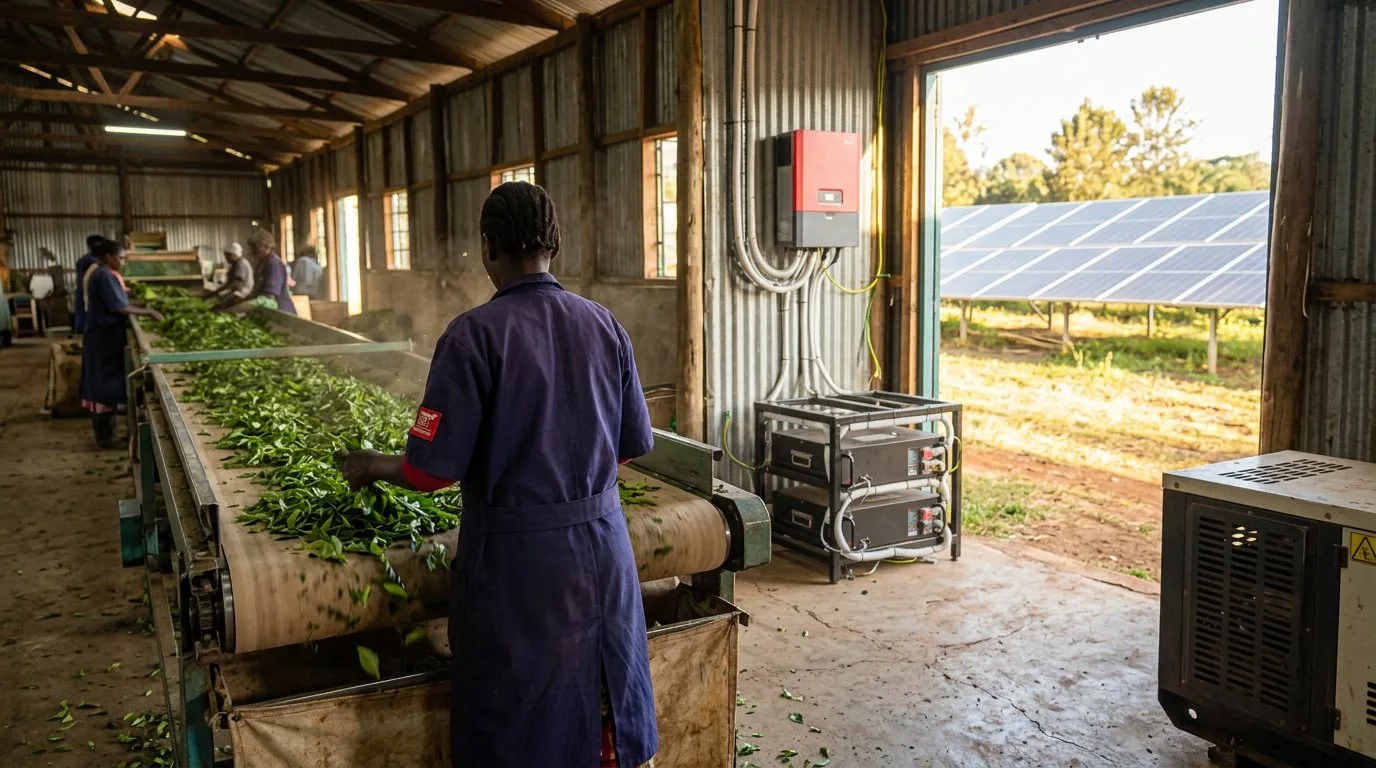
The cost of an off-grid solar system for a business depends on its load profile, battery storage needs, backup arrangements, and site conditions. Planning therefore starts with the facility’s operating demands, not a standard package. Battery capacity and the required level of continuity are central: the system must store enough energy for use when solar generation is unavailable.
For businesses without reliable grid access, or where interruptions threaten production, an off-grid system can provide independent power. A generator can help during extended cloudy periods or when batteries run low. This article explains the factors that shape system costs, when generator backup may support continuity, and how to plan capacity for future growth. It also outlines potential applications, from remote manufacturing and agricultural operations to telecom infrastructure, hotels, and construction sites, so you can assess whether the configuration suits your facility’s loads and operating conditions.
Key Takeaways
- Assess how battery storage, power demand, and backup requirements shape an off-grid system’s overall cost.
- Distinguish fully independent systems from hybrid configurations to match power continuity needs with grid access.
- Plan for changing production loads and future expansion when evaluating energy independence and commercial solar payback.
- Identify whether remote operations, manufacturing, agriculture, or other business sites are suited to off-grid power, and what installation and maintenance involve.
What is the cost of an off-grid solar system for a business?
Project pricing depends on solar capacity, battery storage, backup requirements, and site conditions, so one figure cannot describe every Kenyan business. Applicable permits and standards depend on the site and system design. Although an off-grid system has no utility-grid connection, electrical and site approvals still require project-specific assessment.
Matching Systems to Energy Demand
Matching a solar system to demand means aligning generation and storage with the business’s operating schedule. A workshop that uses most of its power during daylight, for example, has different storage needs from a cold room that operates overnight.
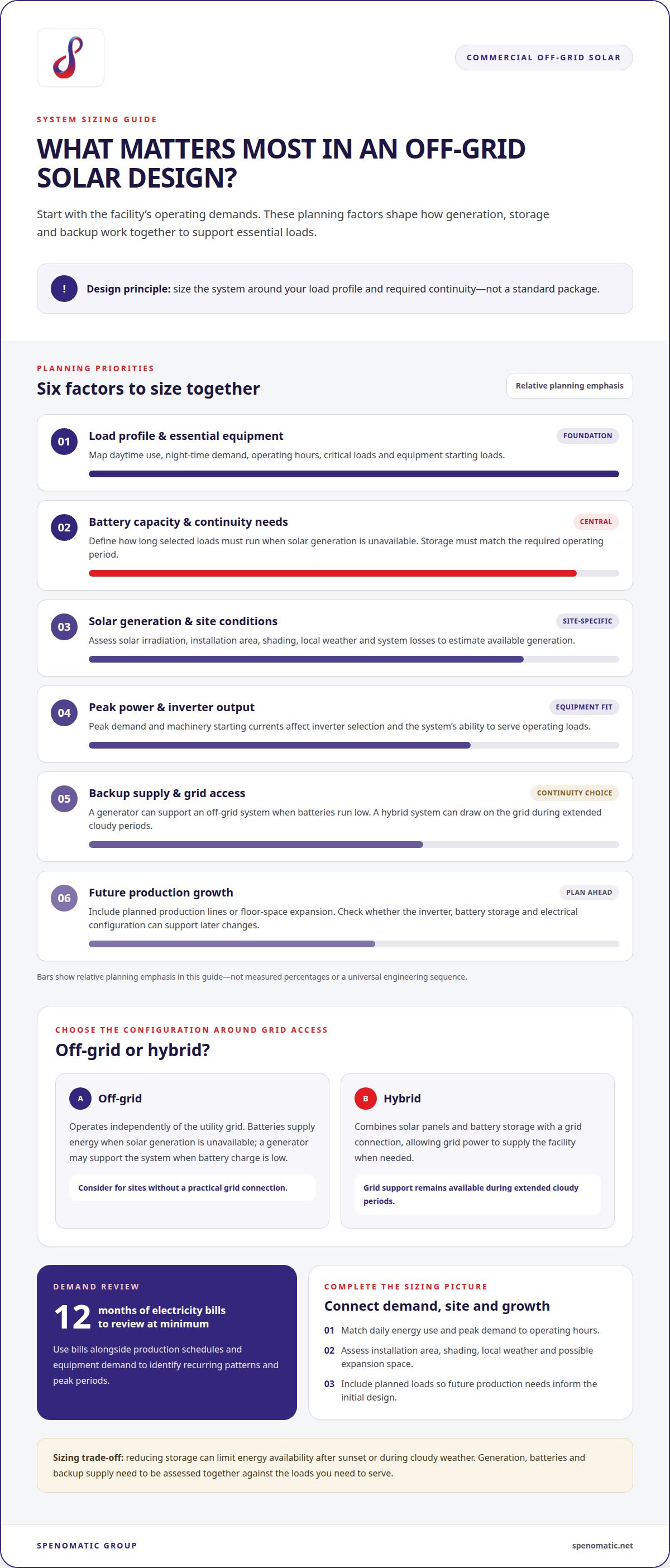
Review the production load profile, including daytime electricity use, night-time demand, and equipment starting loads. Solar panels generate electricity during daylight, while batteries shift stored energy to later hours. This can reduce reliance on a grid connection or generator, but the battery must be sized for the required operating period and loads.
An off-grid system operates independently of the utility grid and relies on batteries when solar generation is unavailable. A hybrid system combines solar panels and battery storage with a grid connection, allowing the grid to supply power when needed. Hybrid configurations retain grid support during extended cloudy periods, while off-grid designs suit sites without a practical grid connection. A generator can support an off-grid system when battery charge is low. Greater energy independence requires careful sizing of generation, batteries, and backup supply. Available energy depends on solar production, storage, and demand.
Commercial System Sizing and Capacity Planning
Capacity planning matches solar generation, inverter output, and battery storage to present loads and expected growth. This matters because an undersized system can restrict operations, while excess capacity can add equipment that does not serve useful demand.
Design should account for daily energy consumption, peak power demand, operating hours, critical loads, weather, system losses, and future expansion. If a facility plans to add a production line, for example, its projected load should be included, not just current consumption. Peak loads and machinery starting currents also affect inverter selection. Together, these factors shape the system configuration and the storage needed for periods without generation.
For a project quote, the main cost drivers are solar capacity, battery requirements, inverter and electrical equipment, site conditions, and backup configuration. Assess these together: reducing storage may lower the initial project scope but limit energy availability after sunset or during cloudy weather. This is a core design trade-off for commercial off-grid solar.
Is it possible to scale the system as the business grows?
Yes, system capacity can be planned around current demand and future business energy needs. In Kenya, include tax incentives, grants, or financing in your investment case only if the project meets the applicable terms. Assess their impact separately from operating savings.
Analyzing Business Energy Consumption
Energy-consumption analysis maps a facility’s electricity demand against its operating schedule, and it matters because load timing shapes system design. Reviewing at least 12 months of electricity bills helps identify recurring patterns, while production schedules and equipment demand reveal when peaks occur. For an industrial facility, include operating hours, critical loads, and seasonal changes to build a usable demand profile.
A site assessment examines solar irradiation, available installation area, shading, local weather, and possible expansion space. An energy audit links these conditions to business demand, helping determine whether generation, storage, or another configuration best supports operations. The analysis also gives you a basis for comparing projected energy savings with the project’s capital requirements.
Scaling for Growing Energy Needs
Scalability means designing components to accommodate future demand. It matters when production or floor space may increase. A planned production-line addition, for example, should inform the initial design rather than become an unforeseen load. The assessment considers whether the inverter, battery storage, and electrical configuration can support later changes.
Energy independence and return on investment depend on how well system output matches actual use. A model should compare expected solar generation with electricity demand across operating periods, then account for how batteries shift excess energy to later use. This clarifies which loads the system can serve and where grid supply may still be necessary.
Budget planning should weigh the proposed system scope against expected savings, site conditions, and continuity requirements. Greater storage needs can change a project’s financial profile, while a system designed around daytime consumption may offset a different share of electricity use. Use the energy audit and growth forecast to assess these trade-offs before fixing capacity.
Business uses for off-grid solar
Off-grid solar suits businesses without reliable grid access or that need power independent of a grid connection. Businesses in Kenya experience up to four power outages per month, making continuity a practical planning consideration. Solar panels generate electricity during daylight, while batteries can supply selected loads after production hours. Suitability depends on the site’s demand, operating schedule, and essential equipment.
At a remote manufacturing site, off-grid solar for businesses can supply defined loads such as machinery, lighting, and process controls. The system can prioritize essential equipment rather than treating every load equally. For example, a plant can identify critical production machinery, then assess how its operating schedule aligns with solar generation and battery capacity.
Agricultural farms can use solar energy for site operations where grid access is limited, unstable, or unavailable. A remote irrigation or processing facility, for example, can use daytime power directly and store excess energy for later demand. Mining and oil and gas operations may also assess off-grid supply for remote facilities where distance from grid infrastructure affects practical power options.
Telecom towers are another potential application because equipment must operate at sites that may be far from utility infrastructure. Hotels, resorts, and construction sites can assess solar power for remote operations and defined site loads. The configuration matters: an off-grid system operates independently, while a hybrid arrangement retains a grid connection where available and useful.
When considering off-grid solar for a business, group loads by function and timing: critical equipment, daytime operations, and loads that can pause. Then assess how solar generation, storage, and backup supply serve each group. This helps distinguish a site suited to energy independence from one where hybrid supply better matches operations. Solar generation is unavailable overnight, so battery capacity and demand determine which business loads the system can support.
What are the installation and maintenance steps for commercial off-grid solar?
Commercial installation proceeds from site assessment to system design, equipment installation, commissioning, and ongoing maintenance. At each stage, check that generation, storage, and electrical protection match the facility’s loads.
- Assess the site and loads. The engineering team examines installation areas, shading, access, and the facility’s electrical loads. Production schedules and critical equipment help define which operations the system must support.
- Design the system. Engineers size solar panels, batteries, inverters, and distribution equipment for expected energy use, peak loads, and equipment starting currents. They also account for cloudy periods and define how backup generation will operate, if included.
- Install and integrate components. Mounting structures, panels, batteries, inverters, and electrical protection are installed and connected according to the design. Equipment placement must allow safe access for inspection and maintenance.
Commissioning tests the installed system before operational handover. The team checks connections, inverter operation, battery charging and discharging, monitoring, and the response of connected loads. For example, testing a critical production circuit confirms whether its supply follows the intended configuration.
Routine maintenance keeps key equipment under observation through targeted checks:
- Clean solar panels to remove dirt that can obstruct sunlight.
- Inspect electrical connections for visible deterioration or looseness.
- Monitor battery status and inverter operation for faults or abnormal performance.
Schedule a professional system inspection annually. Technicians assess panels, electrical connections, batteries, and inverters, then investigate faults shown by system monitoring. Regular monitoring matters because off-grid systems rely on coordinated generation and storage. A developing fault in one component can affect the supply available to connected equipment.
Keep maintenance records of inspection findings, cleaning dates, and identified faults. These help the operating team track recurring issues and relate system performance to changes in production demand. Before deployment, use a site-specific engineering assessment to define the installation scope and maintenance requirements.
Spenomatic Group: Home & Small Business Solar
Spenomatic Group provides Home & Small Business Solar for smaller operations and Commercial & Industrial Solar for facilities with larger or more complex electrical loads. For sites that need independent supply, its Grid-Tied, Hybrid & Off-Grid Solar solutions help align system configuration with grid access and continuity requirements.
Battery Energy Storage Systems can be part of a design when storing solar energy for use outside generation hours matters. The right system depends on your operating schedule, critical loads, site conditions, and growth plans. Share these requirements with Spenomatic Group to support an assessment of a suitable configuration.
Contact Spenomatic Group to discuss your business’s solar requirements.
Set the next project decision in motion
The next step is to turn your operating priorities into a defined engineering brief. Identify which processes must stay powered, how production schedules may change, and how much energy independence the site requires. These decisions give the design team a practical basis for assessing system configuration and future capacity.
For off-grid solar for a business, the key is not simply adding generation. It is matching the power system to the facility’s operating conditions, critical equipment, and continuity requirements. Spenomatic Group’s engineering team can help translate those needs into a solar project scope, whether you are planning a smaller commercial installation or a larger industrial system.
Start a technical discussion about your site and operating needs. Contact Spenomatic Group to take the next step toward a solar system planned around your business.
Frequently Asked Questions
How does the system handle peak demand?
Peak demand is managed by sizing the inverter and storage around the facility’s highest simultaneous electrical loads. A production line that starts several motors together can create a short surge above its normal running demand. Engineers assess starting currents and identify priority loads. If battery capacity alone cannot cover the required operating profile, the design may include a backup generator or load controls.
What size off-grid solar system does a business in Kenya need?
There is no single system size for every Kenyan business. Capacity depends on the energy required and the equipment operating at the same time. Separate daily energy consumption, measured in kilowatt-hours, from peak power demand, measured in kilowatts. A shop with refrigeration and lighting has a different profile from a workshop using machinery. Seasonal weather and night-time operation also influence the required generation and storage.
How much does commercial off-grid solar cost in Kenya?
Commercial off-grid solar costs in Kenya depend on project design, so a general figure cannot reliably represent your installation. Main cost drivers include solar array capacity, battery storage, inverter requirements, electrical protection, site conditions, and backup configuration. A facility that needs extended operation without sunlight has different storage requirements from one serving mainly daytime loads. Compare the project scope with actual operating requirements, not panel capacity alone.
What are the best off-grid solar options for Kenyan businesses?
The right option depends on grid access and the consequences of supply interruptions. A remote agricultural site without a practical grid connection may need an off-grid arrangement with storage and planned backup. A business with a usable grid connection may prefer a hybrid configuration combining solar, batteries, and grid supply. Telecom equipment, cold storage, and production machinery have different continuity requirements, so define priority loads before selecting the system type.
How do you calculate a business's daily electricity load and battery capacity?
Estimate daily electricity use by listing each appliance or machine, its power rating, and operating hours, then adding the energy figures. For example, multiplying a water pump’s rating by its daily runtime gives its energy demand before system losses. To size storage, total the loads that must operate when solar generation is unavailable and the required backup period. List critical equipment separately so essential operations guide battery capacity.
How does off-grid solar compare with grid power, generators, and hybrid solar for businesses in Kenya?
Grid power supplies connected businesses through the utility network, while generators provide dispatchable, fuel-based backup. Off-grid solar combines panels and batteries without a grid connection; a hybrid system combines solar and storage with grid supply. Grid-tied solar without batteries generally shuts down during an outage unless paired with backup. Excess grid-tied generation may be exported under applicable net metering or power purchase arrangements.