
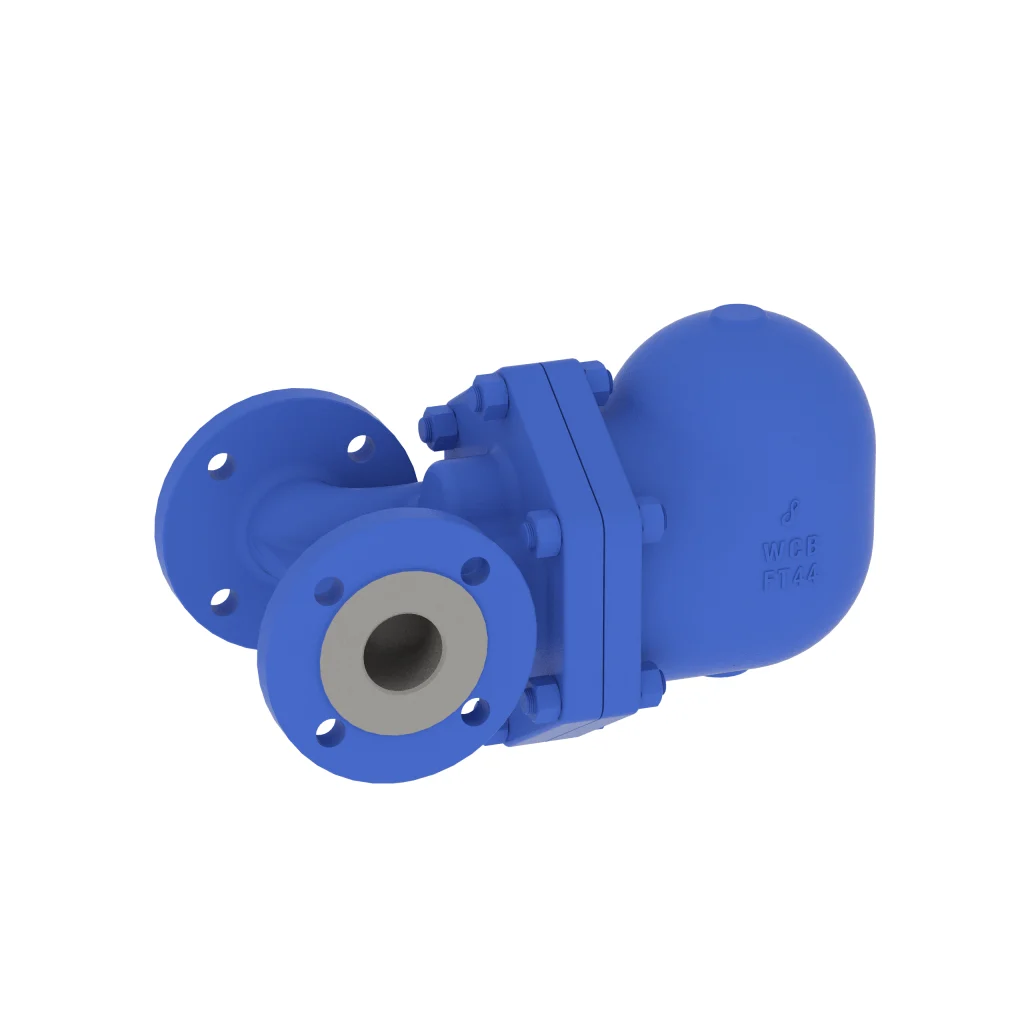
The right steam trap depends on what it drains. Choose by condensate load, how quickly the equipment must be cleared of condensate and air, the available differential pressure and the back pressure in the return line. Ball-float traps generally suit heat exchangers with changing loads, thermodynamic traps suit steam mains and tracing, thermostatic traps suit duties that can tolerate cooler condensate, and inverted-bucket traps suit steady, rugged service.
Key takeaways
- A trap has three jobs: discharge condensate, vent air and other non-condensable gases, and limit the loss of live steam.
- Start from the equipment and its load pattern, not from the pipe size or the trap that was there before.
- Size on differential pressure at the worst operating point, including start-up and low-load conditions.
- Confirm every limit against the data sheet for the specific model.
What information do you need before selecting a trap?
- Equipment: steam main, tracing line, coil, heat exchanger, jacketed kettle or process heater.
- Condensate load: running and start-up, because start-up is often the higher figure. Our condensate load calculator gives a preliminary estimate.
- Pressure: inlet pressure and back pressure, including any lift after the trap.
- Control: whether a temperature control valve modulates the steam supply.
- Installation: connection type, orientation, space and maintenance access.
How do the four trap types compare?
| Type | How it works | Strengths | Watch for | Typical duties |
|---|---|---|---|---|
| Thermodynamic | A disc opens and closes on the velocity and pressure of the fluid | Compact, simple and robust | Intermittent discharge; high back pressure; limited air handling at start-up | Steam mains, branch lines, heat tracing |
| Thermostatic | An element responds to condensate temperature | Strong air venting at start-up | Holds condensate back until it cools | Heating pipelines, coils, selected exchangers |
| Inverted bucket | A submerged bucket rises and falls on steam and condensate | Rugged in steady industrial service | Needs its water seal; slower air venting | Steam distribution, jacketed kettles, exchangers |
| Ball float | A float opens the valve as the condensate level rises | Continuous discharge at saturation temperature; follows load changes | Larger body; orientation and available pressure difference | Heat exchangers, process heaters |
Which trap suits a heat exchanger?
Heat exchangers need condensate removed as it forms, or it floods the heat-transfer surface and reduces output. A ball-float trap with a thermostatic air vent is often the first option, since it discharges continuously as the load changes.
Check for stall as well. When a control valve throttles the steam, the pressure in the exchanger can fall below the back pressure and the trap can no longer discharge. In that case the return arrangement must change, for example with a mechanical condensate pump, because a larger trap will not solve it.
Which trap suits steam mains and tracing?
Mains and tracing lines usually carry small, steady condensate loads. A thermodynamic trap is often a practical choice, and some models include an integral strainer. Where tracing can tolerate cooler condensate, a thermostatic trap can also use some of the sensible heat in the condensate.
What does a ball-float data sheet tell you?
Our SKLFT ball-float data sheet shows the kind of limits to check. Models SKLFT212, SKLFT218 and SKLFT218HC have a maximum operating pressure of 14 bar, while the SKLFT218SHC has 32 bar. Compare your own conditions with the figures for the exact model, including allowable temperature at your operating pressure.
Frequently asked questions
Can one trap type be used across the whole plant?
It simplifies spares, but no single principle suits every duty. Standardising on a small number of models for defined applications is usually more practical.
Should a trap be sized to match the pipe?
No. Size it on condensate load and differential pressure. The connection size does not establish capacity.
What do I need to replace an existing trap?
Provide the model or nameplate, fluid, pressure and temperature, connection details, process duty and any operating problems.
Talk to the steam accessories team
Spenomatic supplies thermodynamic, thermostatic, inverted-bucket and ball-float steam traps. Explore our industrial steam systems and accessories, or request a steam system assessment for your site.