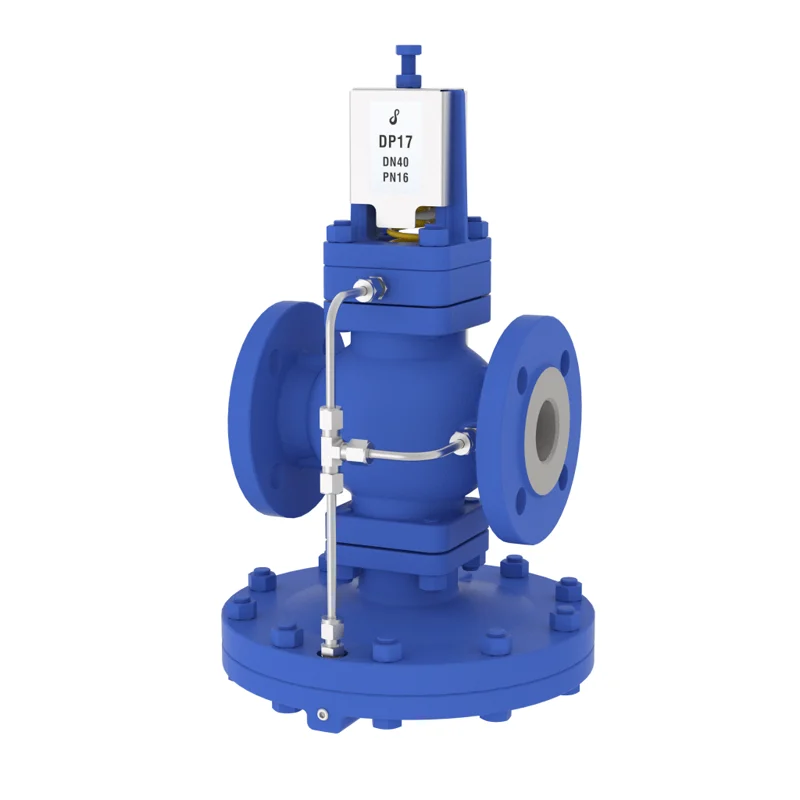
A steam pressure-reducing station delivers a stable lower pressure to a process. A sound station is sized on steam flow rather than line size, and it usually includes isolation, condensate removal, a strainer, pressure gauges, the reducing valve and a safety valve where downstream equipment cannot withstand the supply pressure.
Key takeaways
- Size the valve from inlet pressure, outlet pressure and the full range of steam demand.
- Self-acting valves are simple. Pilot-operated valves suit duties that need closer outlet pressure control.
- A reducing valve regulates pressure. It is not a safety device.
- Steam expands at lower pressure, so downstream pipework is often larger than the inlet.
Why reduce steam pressure at all?
Boilers often generate steam above the pressure a process needs. Distributing at higher pressure allows smaller mains, and reducing near the point of use gives the process the pressure and temperature it was designed for. Lower-pressure steam also has more latent heat per kilogram.
Self-acting or pilot-operated?
| Factor | Self-acting | Pilot-operated |
|---|---|---|
| Operating principle | A diaphragm and spring respond to downstream pressure | A pilot senses downstream pressure and positions the main valve |
| Best fit | Simpler duties with a moderate range of demand | Varying demand where outlet pressure must stay close to set point |
| Maintenance | Fewer parts | Pilot passages need clean, dry steam |
If the process needs automated or remote control, a pneumatic or electric control valve may fit better. Check the actuator, control signal and required position on loss of supply.
What should the station include?
- Upstream isolation valve for safe maintenance.
- Condensate removal with a separator or drain point and steam trap, to keep the valve seat clear of wet steam.
- Strainer to catch scale and debris, placed where it can be cleaned.
- Upstream pressure gauge.
- Reducing valve, with straight runs as the manufacturer specifies.
- Downstream pressure gauge and isolation valve.
- Safety valve where the system design requires one.
How should the valve and pipework be sized?
Size the valve on the maximum and minimum flow at the actual pressures. An oversized valve spends its life barely open, which can cause hunting and seat wear, so a valve matching the line size is often too large.
Check velocity on both sides, too. Dry saturated steam at 3 barg occupies about 2.6 times the volume of the same mass at 10 barg (about 0.46 m³/kg against 0.18 m³/kg), so the same pipe size would run much faster downstream. Our steam pipe sizing calculators give preliminary figures.
Where does the safety valve fit?
If a reducing valve fails open, the downstream system can see full supply pressure. Where the downstream equipment is not rated for that pressure, a safety valve is typically needed, and its capacity must be established in the system design for that failure case. Any bypass must be included in that assessment, because an open bypass can overpressurise the system too. Follow the pressure equipment rules that apply at your site.
Frequently asked questions
Why does downstream pressure hunt or fluctuate?
Common causes are an oversized valve, wet steam, a dirty pilot or strainer, or a sensing line in the wrong place.
Can a reducing valve replace a safety valve?
No. The reducing valve regulates working pressure, while the safety valve provides pressure relief.
What information is needed for a quotation?
Provide the inlet and outlet pressures, minimum and maximum flow, steam condition, connection details and the equipment served.
Talk to the steam accessories team
Spenomatic supplies self-acting and pilot-operated reducing valves, control valves, safety valves and strainers, with system design, installation and performance testing services. Explore our industrial steam systems and accessories, or request a steam system assessment for your site.