
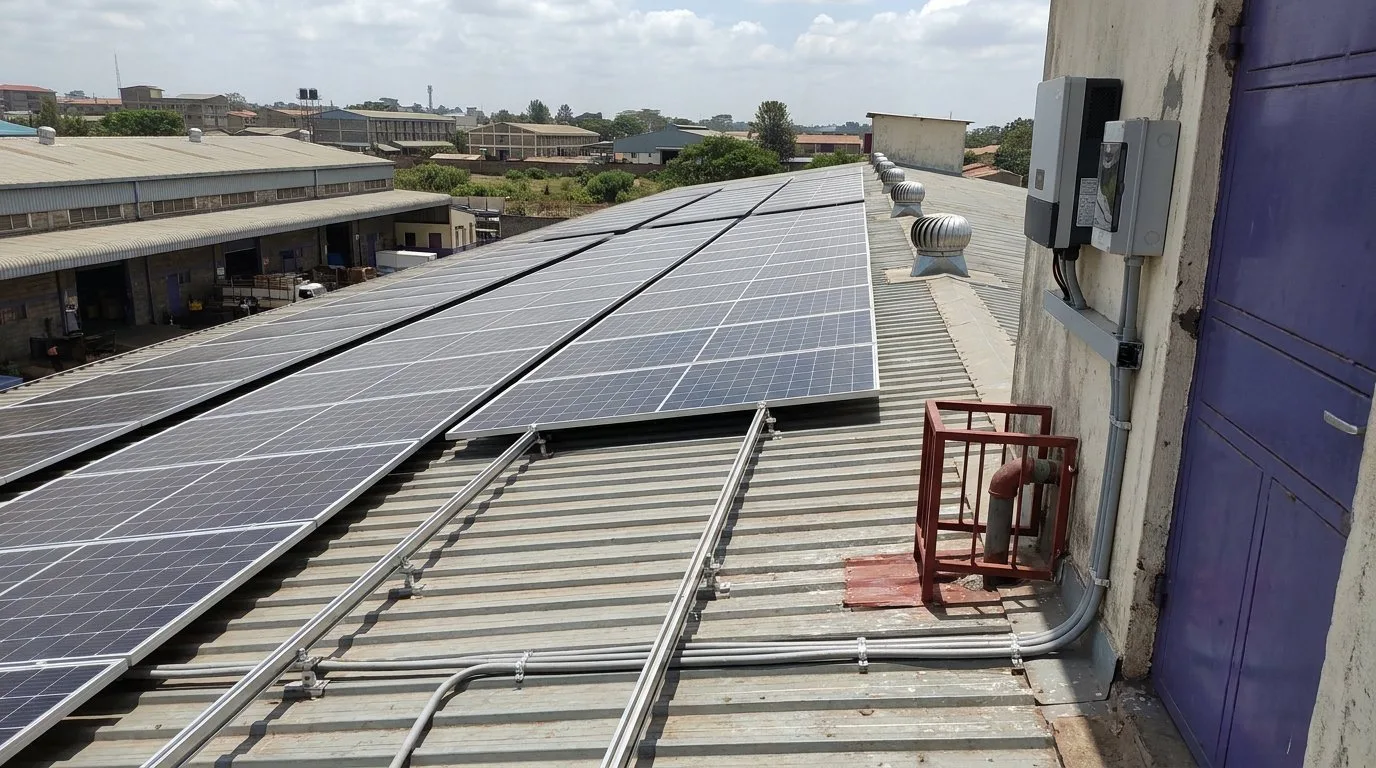
Commercial solar installation in Kenya can reduce electricity bills, depending on system size and usage. For businesses, factories, and institutions, solar can offset daytime electricity demand and reduce reliance on grid power. The right system depends on how a facility uses energy and whether it needs battery storage.
Electricity is a major operating cost, so assess a solar system against actual consumption, site conditions, and operating schedules. This guide explains why Kenyan organisations install solar, how grid-tied, hybrid, and off-grid systems differ, and what to consider when planning a commercial solar installation in Kenya.
You’ll also learn how installation is approached and which factors shape system design. The aim is a practical basis for deciding whether solar fits your facility’s energy requirements.
Key Takeaways
- Build maintenance, performance monitoring, and troubleshooting into the project plan to support dependable operation after commissioning.
- Match grid-tied, hybrid, or off-grid system design to your facility’s energy use, operating schedule, and backup-power requirements.
- Understand Kenya’s net-metering limits and regulatory requirements, and plan them alongside technical design.
- Define your site’s needs early, whether in Nairobi or elsewhere in Kenya, so the system is designed around them.
Table of Contents
- Why Choose Commercial Solar Panels in Kenya?
- Commercial solar systems for businesses, factories and institutions
- Why Install Solar Energy?
- Planning a commercial solar project in Nairobi and across Kenya
- Spenomatic Group: Commercial & Industrial Solar
Why Choose Commercial Solar Panels in Kenya?
Commercial solar performance depends on system output, facility demand, and ongoing maintenance. In Kenya, cleaning, tariff analysis, and warranty planning help businesses assess operating value.
After-Sales Monitoring and Maintenance
After commissioning, monitoring compares inverter output with expected generation and recorded site consumption. Review production trends and outage records routinely; investigate sudden drops before they persist. Troubleshooting should trace faults across panels, wiring, inverters, protection equipment, and grid connections. In dusty areas, panels need regular cleaning, so record cleaning and inspection dates. Include equipment checks and fault-escalation steps in written after-sales support.
Tariffs and Commercial Solar Savings
Kenya Power tariffs determine the value of each unit of grid electricity that solar generation displaces. Where applicable, peak-demand charges reflect a facility’s highest load. Solar reduces that charge only when generation overlaps with the facility’s peak. Before sizing a system, compare bills by time, energy use, and billed peak. Model daytime loads against expected system output, rather than relying on total consumption alone. This distinction matters at a medium-sized site with evening-heavy operations.
Payback Period and Return on Investment
Payback and ROI depend on system investment, self-consumed generation, maintenance, and tariff displacement. Use interval consumption and tariff bills to model savings against investment. Stress-test lower daytime usage and production interruptions before approving forecasts. Separate bill savings from any credit earned on exported electricity.
Warranties and Insurance
Commercial solar maintenance should cover panel cleaning, inverter condition, electrical connections, and protection devices. Document inspection intervals, fault reporting, repair responsibilities, and service scope in a maintenance agreement. Distinguish panel coverage from inverter coverage, since component terms differ. Review exclusions, claim procedures, and required maintenance records before commissioning. Assess insurance for installed equipment, weather damage, theft, and site-specific exposures. Keep asset schedules and commissioning records accessible for claims.
Commercial solar systems for businesses, factories and institutions
Start system selection with the facility’s load, operating hours, and power-continuity requirements. A commercial solar installation in Kenya should match these demands, not be sized by roof space alone.
System Design, Sizing, and Applications
Map electricity use across shifts, equipment, and seasonal production. Compare daytime demand with expected solar supply and usable installation space. Actual load profiles guide sizing. Design coordinates panels, inverters, connections, and monitoring.
Hybrid, Off-Grid, and Battery Backup Systems
A grid-tied system supplies solar electricity alongside the utility connection, without battery storage. A hybrid system combines grid access with storage for selected loads. An off-grid system operates without a grid connection, so its design must meet the site’s full energy demand. Identify which equipment must stay powered during outages. Battery capacity and operating priorities determine backup duration and configuration.
Component Quality and System Customization
Choose components to suit the site’s electrical load, environment, and operating requirements. Panels, inverters, batteries, mounting structures, and protection equipment need to function as an integrated system. A tailored design can account for roof or ground mounting, phased expansion, and critical production equipment. Specify monitoring access and commissioning records at handover to support performance reviews and future maintenance.
Solar Installation Costs and Site Requirements
The cost per kWp for a commercial solar installation in Kenya depends on project scope and is provided after a quote request. Capacity, mounting method, electrical integration, battery storage, and site works shape project requirements. Assess roof condition, shading, available space, access routes, and electrical infrastructure before installation. A factory roof with obstructions may need a different layout from an open institutional site. Integrated solar system design can inform project planning.
Why Install Solar Energy?
Solar energy can reduce a facility’s reliance on purchased electricity, while regulation shapes project delivery. In Kenya, plan compliance alongside investment, site assessment, and expected savings.
Net Metering and Approvals
Kenya’s Energy (Net-Metering) Regulations, 2024 allow a commercial or industrial customer to export surplus renewable electricity and receive a bill credit of 50% of each exported unit. The system must be under 1 MW, no larger than the site’s maximum demand over the previous twelve months, and covered by a signed agreement with the distribution licensee.
Permits and approvals depend on the project. Before planning construction, document the site, proposed capacity, electrical integration, and grid connection. Keep design documents and approval records together, and assign responsibility for each approval step. Licensing checks do not replace project-specific approvals.
Photovoltaic and Solar Water Heating
Solar photovoltaic systems convert sunlight into electricity, while solar water heating systems provide heat. Treat them as distinct technologies when defining project scope and confirming applicable requirements.
For a facility with substantial hot-water demand, assess that use separately from electrical consumption. Identify the equipment served, operating schedule, and existing heating arrangement before reviewing the investment. This keeps energy-savings estimates tied to the correct system and use.
Certification and Project Checks
Review equipment documents, system design, warranties, and commissioning records as separate project checks, and confirm current requirements with EPRA where they apply. A site assessment should document roof or ground conditions, shading, electrical infrastructure, and the proposed connection. Together, these records help facility managers track compliance, performance, and savings after installation.
Planning a commercial solar project in Nairobi and across Kenya
A commercial solar installation in Kenya is more than panel supply. For a business in Nairobi or elsewhere in Kenya, plan the complete delivery. Start with a site assessment covering electricity use, operating hours, shading, mounting area, and grid connection. These details help shape a system around the facility’s operating conditions.
Define how the project will be managed from assessment through commissioning. A clear scope connects the design to the facility’s load data and sets out responsibilities for electrical integration, monitoring, handover, and maintenance. A factory with daytime production, for example, has different priorities from an office with changing occupancy, including how a hybrid system will serve priority loads.
- Project scope: Identify who manages assessment, design, installation, commissioning, and system documentation.
- Technical fit: Match the proposed system to actual consumption, operating schedules, and site conditions.
- Compliance: Confirm the approvals and net-metering requirements that apply to the proposed work.
- After-sales plan: Clarify monitoring, fault reporting, maintenance tasks, and escalation responsibilities.
For sites in Nairobi, include roof access, shading, electrical infrastructure, and operating constraints in the assessment. For projects in Kiambu, Mombasa, Kisumu, Nakuru, Thika, Naivasha, Machakos, Kericho, or elsewhere in Kenya, plan site coordination and maintenance around the facility.
Use the assessment to resolve design questions early. Keep the operations team involved, especially where outages can interrupt production or essential services. For a commercial solar installation in Kenya, align the project scope with the facility’s energy priorities. Discuss your solar project with the technical team.
Spenomatic Group: Commercial & Industrial Solar
Spenomatic Group has 27+ years of engineering experience and has installed 278 MWp of solar PV across 150+ sites in Africa, with 53.22 MWh of battery storage deployed. It delivers commercial and industrial solar solutions for businesses, factories, and institutions looking to reduce grid dependence or integrate solar into existing operations. Its team can help when a project calls for a system designed around facility demand, site conditions, and operating priorities.
Available configurations include grid-tied, hybrid, and off-grid solar systems. Battery Energy Storage Systems can also support defined operational needs. Home and small businesses can choose solar solutions suited to their scale, while larger facilities can discuss commercial and industrial requirements through a project-focused conversation.
Share your site requirements and energy objectives with Spenomatic Group, or visit spenomatic.net.
Set Your Facility’s Solar Project in Motion
The next step in a commercial solar installation in Kenya is to turn operational priorities into a clear project brief. Record the loads that matter most, site constraints, and how solar should work alongside your existing electricity supply. This gives the design discussion a practical starting point based on your facility’s requirements.
Spenomatic Group offers Commercial & Industrial Solar and Home & Small Business Solar, with Grid-Tied, Hybrid & Off-Grid Solar options. These configurations provide a starting point for discussing an energy setup that fits your site and operational needs. Share your project objectives and facility context to begin a focused technical conversation.
Contact Spenomatic Group about solar to discuss your requirements. A clear brief is a strong first step toward a well-planned project.
Frequently Asked Questions
Can I export excess solar power to the grid in Kenya?
Yes, as a bill credit rather than a cash sale. Solar generation first serves the facility’s active loads; surplus can then be exported under a net-metering agreement, earning a credit of 50% of each exported unit. Model exports separately from avoided grid purchases, because onsite consumption and exported electricity are distinct parts of the project’s energy balance.
What maintenance do commercial solar systems require?
Commercial systems need planned cleaning, equipment inspections, and reviews of operating records. Keep a maintenance log of service dates, observed faults, corrective work, and monitoring alerts. For example, a facility manager can compare inverter event records with production logs to identify recurring interruptions. Schedule maintenance around operating requirements, and retain commissioning and maintenance documents for troubleshooting and warranty claims.
What commercial solar system sizes and components are common in Kenya?
Commercial capacity depends on site demand, available installation area, and the intended operating mode. Typical system components include panels, inverters, mounting structures, electrical protection, and, where required, battery storage.
Where does Spenomatic Group install commercial solar in Kenya?
Spenomatic Group provides commercial and industrial solar solutions, including grid-tied, hybrid, and off-grid projects, with EPC and turnkey delivery. It serves locations including Nairobi, Kiambu, Mombasa, Kisumu, Nakuru, Thika, Naivasha, Machakos, and Kericho.
What are Kenya's net-metering rules for commercial solar systems?
Kenya’s Energy (Net-Metering) Regulations, 2024 allow a commercial or industrial customer to export surplus renewable electricity and receive a bill credit of 50% of each exported unit. The system must be under 1 MW, no larger than the site’s maximum demand over the previous twelve months, and covered by a signed agreement with the distribution licensee. Because exports earn half-value credits, size the system mainly for on-site use.
What is the process and timeline for installing commercial solar in Kenya?
A project typically progresses through load review, site assessment, system design, approvals, procurement, installation, and commissioning. The timeline depends on system scale and site conditions. For smoother coordination, assign a site contact, gather electricity records, and identify operational constraints before design begins. Factories should also plan installation access around production schedules and equipment requirements.