
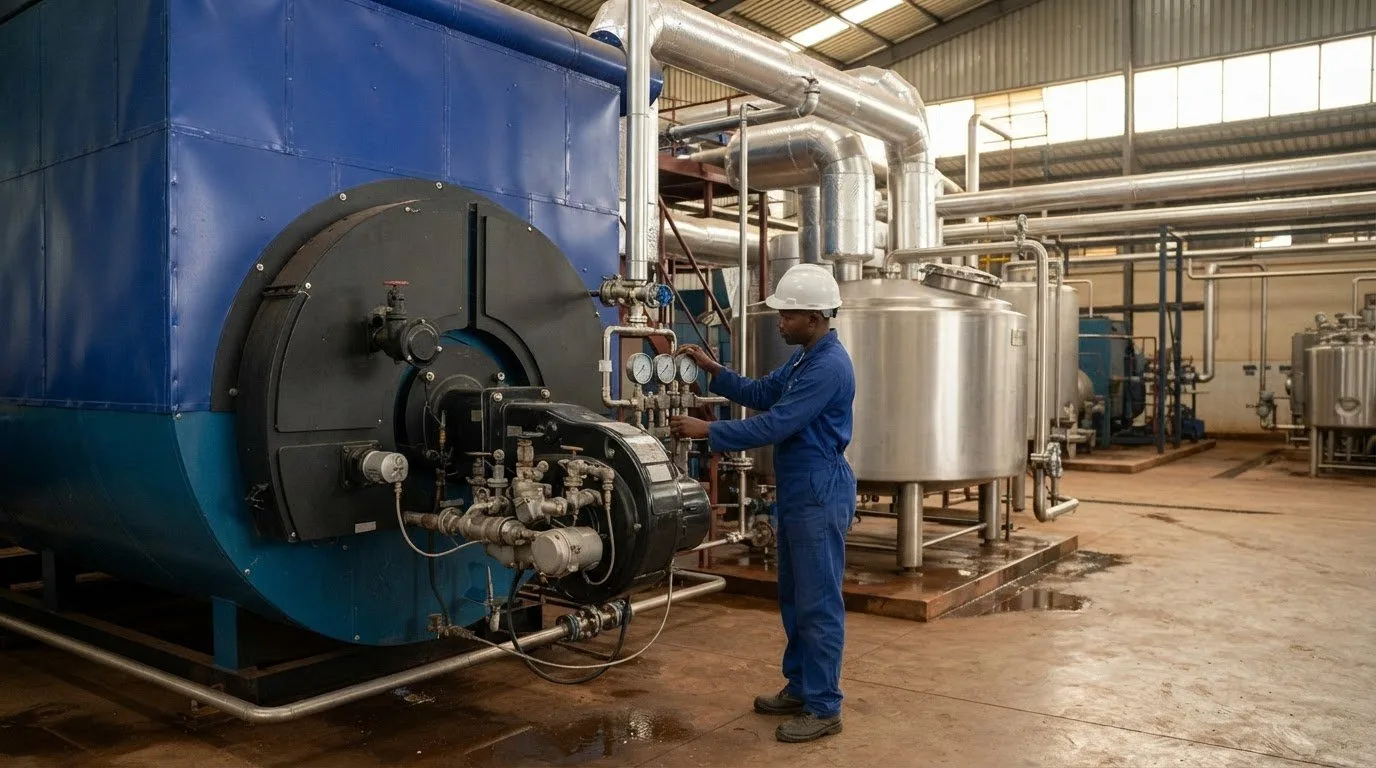
Industrial boiler installation in Kenya means matching a boiler and its supporting systems to a facility’s steam or process-heat needs, then integrating and commissioning the equipment. The scope depends on the production process, fuel arrangement, controls, pipework and connections to existing plant equipment.
For plant managers, dependable heat requires treating installation as an integrated engineering project, not a stand-alone equipment delivery; this guide explains new and replacement systems, commissioning, project scope and boiler applications across Kenyan industries, including manufacturing, tea processing, food processing and chemical operations.
Key Takeaways
- Map steam demand, fuel supply, controls and plant connections before defining an installation scope.
- Plan replacement work around the existing system’s condition and the production changes needed during the transition.
- Match boiler configuration to the process: steam requirements differ across tea, food, chemical and other manufacturing operations.
- Assess whether an integrated boiler, steam and biomass system fits your facility’s thermal-energy requirements.
Industrial and commercial boiler installation and commissioning
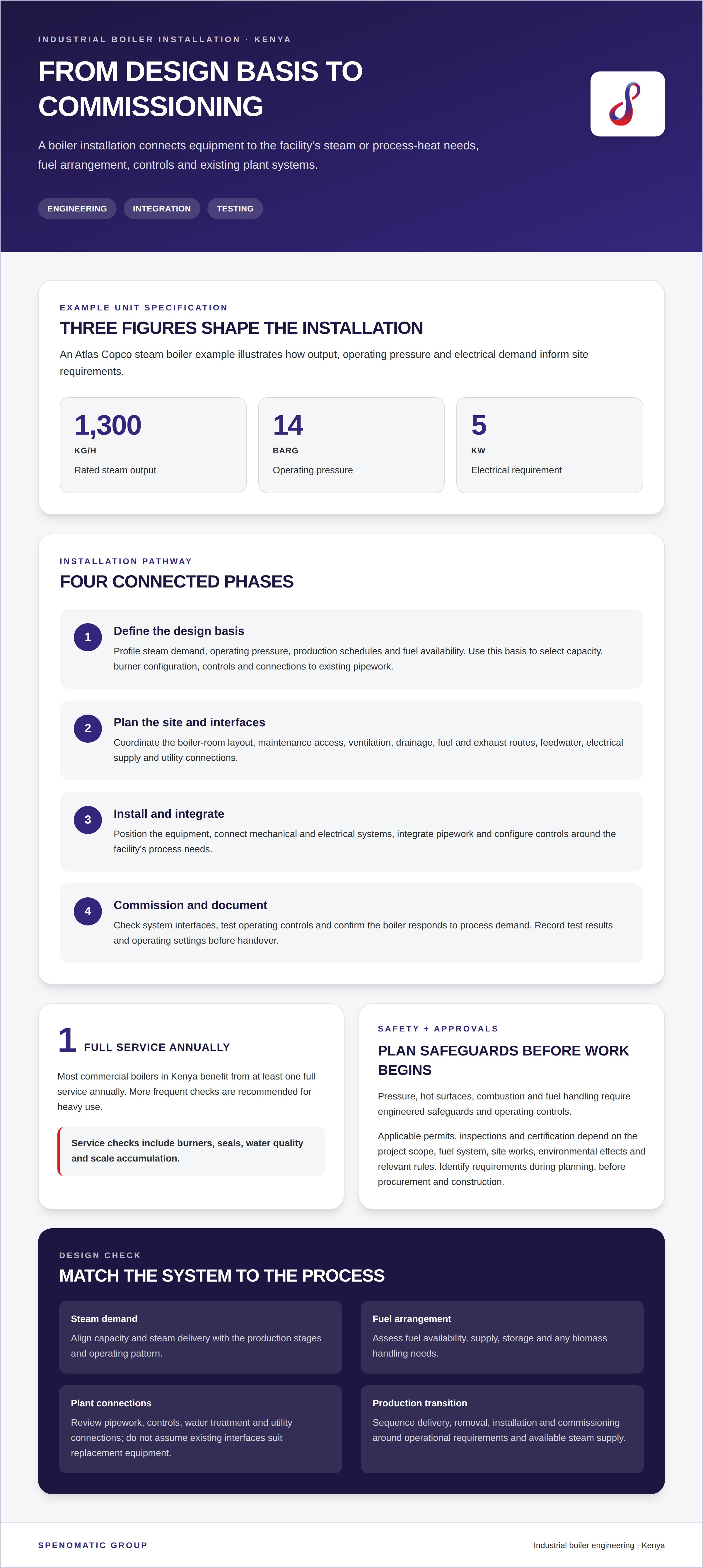
Industrial boiler installation in Kenya starts with profiling steam demand, operating pressure, production schedules and fuel availability. Engineers use that design basis to select capacity, burner configuration, controls and connections to existing pipework. They then plan the boiler room layout, maintenance access, ventilation, drainage and safe routes for fuel and exhaust. For example, an Atlas Copco steam boiler rated at 1.300 kg/h, 14 barg and 5 kW has specific output and utility requirements that shape its installation.
For a new industrial boiler installation in Kenya, the project team positions the equipment, connects mechanical and electrical systems, integrates pipework and configures controls. Commissioning checks these interfaces, tests operating controls and confirms that the boiler responds to process demand. Engineers document test results and operating settings before handover, since a mismatch with the design basis can affect steam delivery.
Permit and regulatory requirements in Kenya depend on the project scope, fuel system, site works and environmental effects. The project team identifies applicable approvals during planning, before procurement and construction. Inspection and certification requirements also depend on the applicable rules and installation. Commissioning records system checks and test results, but does not replace approvals required for the project.
Installation scope is shaped by boiler capacity, fuel storage and supply, site modifications, water-treatment equipment, controls and utility connections. The site needs suitable space, dependable feedwater, drainage, fuel access and electrical supply for controls and auxiliary equipment. Where electrical resilience is part of the facility’s wider design, battery energy storage systems may support other electrical loads, but do not replace boiler-specific utility design.
Pressure, hot surfaces, combustion and fuel handling require engineered safeguards and operating controls. Maintenance planning should include inspection of burners, seals, water quality and scale accumulation. Most commercial boilers in Kenya benefit from at least one full service annually, with more frequent checks recommended for heavy use. Planned servicing helps identify conditions that can affect heat transfer and burner performance.
New and replacement boiler installation
For a new plant, the installation team starts by assessing the production process, required steam conditions and operating pattern. This establishes the design basis for boiler capacity, fuel configuration, controls and system interfaces. Engineers then coordinate the equipment layout with pipe routes, feedwater treatment, fuel delivery and site utilities. A tea processor, for example, needs steam supply aligned with production stages, not just the boiler’s rated output. Early coordination defines the installation scope before equipment is positioned.
Replacing an existing boiler calls for a separate assessment of how the system connects to plant operations. Engineers review available drawings, pipework, controls, water treatment and equipment proposed for reuse. They also consider how to remove the old unit and move the replacement into the boiler room. These findings shape the changeover plan, including interface modifications and how commissioning fits the production schedule. Existing connections should not be assumed to suit a new boiler.
An upgrade can involve more than replacing the boiler. It may also address burner controls, steam distribution, feedwater treatment or fuel arrangements that affect process performance. Fuel flexibility, or the ability to use multiple fuel types, must suit the equipment and site configuration. Biomass handling also requires space and a practical route for receiving, storing and supplying fuel. Each change affects system integration and operating procedures.
Before installation, the project team sequences delivery, removal, mechanical work, electrical connections and commissioning against the plant’s operational requirements. Clear handover records capture equipment settings, test results and operating instructions for the replacement system. Where the plant needs to retain production during the transition, the sequence must account for the available steam supply and the work required at each interface. Use the boiler and biomass system options as a starting point for defining the thermal equipment scope.
Boiler applications across Kenyan industries
In Kenyan tea factories, boilers supply steam for processes that depend on controlled heat. The required duty varies with the product, equipment and operating sequence. Engineers should therefore match boiler capacity to the plant’s actual steam demand, rather than choosing equipment by industry label alone. Steam delivery also needs to fit the factory’s production flow.
Food processors use boilers for process heat and steam in operations such as cooking, heating and cleaning. Each duty has its own temperature, pressure and timing requirements. A system serving batch production, for example, must respond to changing demand at different production stages. Engineers assess those patterns alongside feedwater quality, fuel supply and distribution when designing the thermal system.
Chemical plants may use steam for heating, processing and other controlled thermal operations. The process determines the required steam conditions, while the plant layout shapes pipe routing and system interfaces. Boiler design needs to account for steam delivery to production equipment and controls that respond to demand. Requirements vary between facilities, even within the same sector.
Across manufacturing, boilers provide process heat and support steam-dependent equipment. Biomass may form part of the fuel strategy when a facility can manage fuel receiving, storage and supply. Plan biomass handling around available site space and boiler operation. Engineers align the thermal system with production schedules, fuel characteristics and existing utilities.
Tax incentives and import-duty treatment depend on equipment classification and the provisions that apply at importation, so they should not be assumed to apply universally; companies managing cross-border equipment procurement often consult trade compliance and IOR specialists like Global4PL to navigate customs clearance and regulatory hurdles. Financing terms depend on the project arrangement and the facility’s operating plan. Include these considerations in procurement and financial planning alongside equipment selection, installation scope and production requirements.
Which Kenyan companies supply and install industrial boilers?
Industrial boiler projects in Kenya may involve manufacturers, local suppliers, mechanical contractors and engineering, procurement and construction companies, each with different responsibilities. A supplier may provide the boiler, while installation also requires coordinated mechanical, electrical, pipework and commissioning work. For a tea factory or food processor, define the steam duty and system boundaries before comparing scopes. This clarifies whether equipment supply and installation are integrated or managed separately.
Assess the proposed delivery scope against your plant’s requirements. It should identify the boiler configuration, fuel arrangement, feedwater treatment, controls, steam distribution interfaces and commissioning activities. An equipment-only quotation can leave installation boundaries unresolved. A project proposal should explain how design decisions relate to the site layout, production demand and existing utilities, and show who coordinates each connection.
Technical documentation is another useful basis for comparison. Review the design basis, equipment specifications, installation drawings, test records and handover materials included in the project. For replacement work, distinguish new equipment from existing items intended for reuse. For biomass installations, check how fuel will reach the boiler and how the system will connect to production. These details make project scopes easier to compare consistently.
Commissioning responsibilities should also be clear. The installation team needs to coordinate system checks, control settings and handover with the plant’s production requirements. Include maintenance access, operator instructions and service planning in the completed project scope. Ask for the work sequence and handover records, rather than comparing boiler specifications alone. The right fit is a company whose defined engineering and installation scope matches your process, site interfaces and operating needs.
Spenomatic Group: Boilers, Chillers and Biomass Systems
Spenomatic Group supplies and installs industrial boilers, biomass boiler systems and related thermal equipment for facilities in Kenya planning new installations, replacements or process-heat changes. Its engineering scope can align equipment with production requirements, fuel arrangements and existing plant interfaces. For biomass projects, planning also addresses the practical requirements of supplying fuel to the boiler. This helps connect equipment selection with installation and commissioning needs.
If your facility is also reviewing its energy supply, Spenomatic Group provides Commercial & Industrial Solar and grid-tied, hybrid and off-grid solar systems. These are distinct options to assess alongside thermal plant, according to site requirements. Share your process needs and project scope to start an engineering discussion.
Contact Spenomatic Group to discuss your boiler, chiller or biomass system requirements.
Set the next project phase in motion
Prepare a defined engineering brief before procurement begins. Set out process demand, operating schedule, fuel arrangements, site constraints and connections to existing plant systems. This gives the project team a practical basis for planning industrial boiler installation in Kenya around your facility, rather than treating equipment selection as a stand-alone decision.
Spenomatic Group’s engineering team can discuss your boiler, chiller or biomass system requirements. If your planning also covers electricity supply, the company provides Commercial & Industrial Solar, Home & Small Business Solar, and Grid-Tied, Hybrid & Off-Grid Solar options. Consider these alongside thermal requirements when developing a wider facility energy plan.
Move your project toward a defined scope. Contact Spenomatic Group about boiler installation to start an engineering discussion.
Frequently Asked Questions
What types of industrial boilers are available for installation in Kenya?
Kenyan industrial facilities can specify steam boilers, biomass boiler systems, fuel-oil or gas-fired process boilers, thermic-fluid heaters and hot-water boilers. The right type depends on the heat-transfer medium required by production equipment. A process requiring steam cannot use a hot-water unit without changing the process design. Define the required medium and operating conditions before comparing boiler types.
What steps do professionals follow, and what timeline should you expect, when installing an industrial boiler in Kenya?
Installation timelines vary by project. The schedule depends on equipment configuration and sourcing, design decisions, site readiness, transport arrangements and modifications to existing systems. Finalized specifications and a prepared boiler room can help avoid delays from late design changes or incomplete site works. Agree on milestones and dependencies before setting a production changeover date.
How do biomass, diesel, LPG and electric industrial boilers compare in Kenya?
Biomass, diesel, LPG and electricity each create different operating dependencies. Biomass performance is affected by feedstock characteristics and fuel-preparation consistency. Diesel and LPG systems rely on dependable fuel supply, while electric boilers draw substantial power from the facility’s electrical system. Compare fuel availability, supply continuity, electrical capacity, emissions priorities and operating controls against your plant’s process needs before choosing a configuration.