
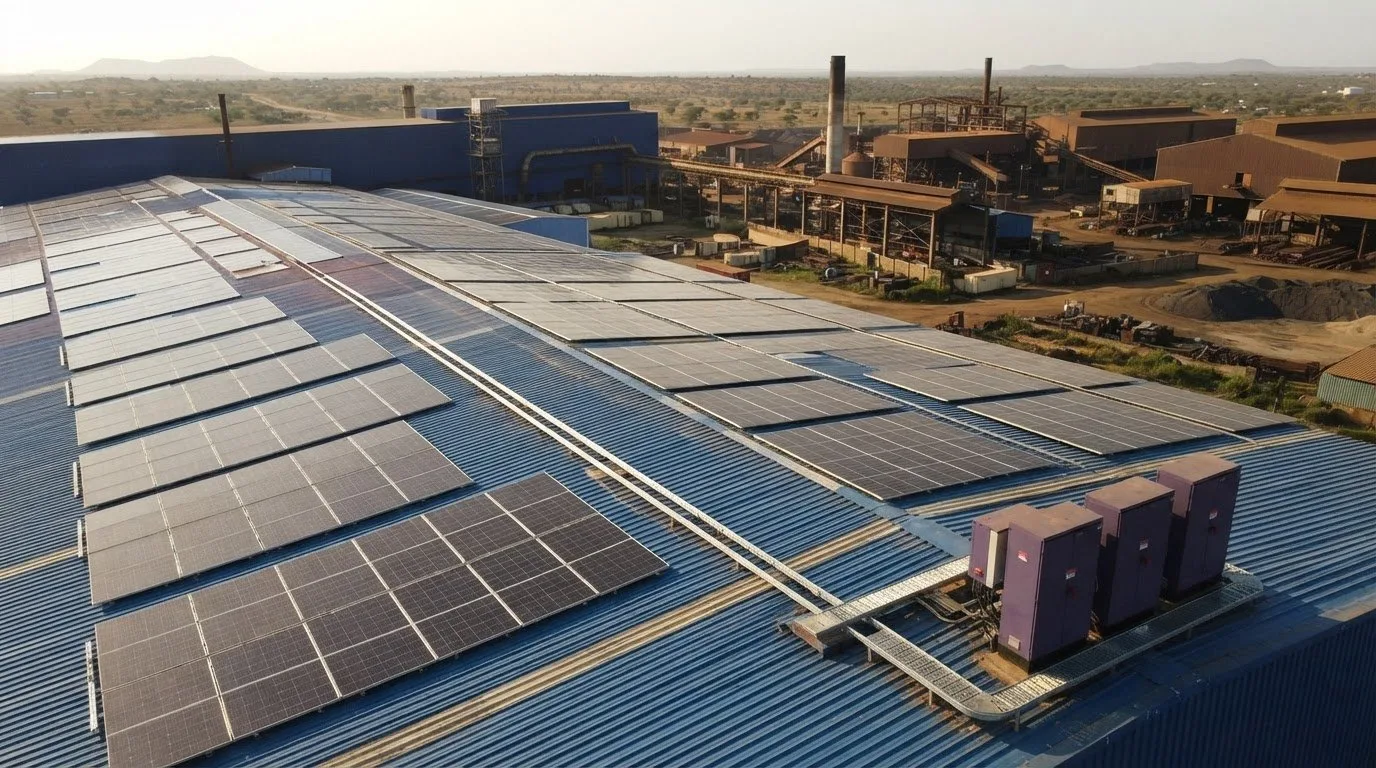
Solar power can supply a meaningful share of a manufacturing plant’s electricity, but its contribution depends on when the plant uses power and how the system is engineered. Solar power for manufacturing plants converts sunlight into electricity for daytime operations, while the grid can continue supplying power after dark and when solar output falls.
Assess more than panel capacity when considering solar power for manufacturing plants. Production schedules, available roof or land area, electrical demand, and integration with existing infrastructure all affect whether a system fits your operations. This guide explains how industrial solar works, what shapes project scope and requirements, and how solar can complement grid electricity, including at night.
It also covers the project stages, from site assessment and load profiling to system design, installation, commissioning, and ongoing support, so you can see what goes into a practical solar project for your facility.
Key Takeaways
- Use your production load profile, operating schedule, roof or land conditions, and electrical infrastructure to shape the system design.
- Understand how photovoltaic panels produce direct-current electricity and how inverters convert it for plant equipment.
- Match grid-tied, hybrid, or off-grid system architecture to your requirements for grid connection, storage, and continuity of supply.
- Plan for daytime solar output and nighttime grid use, with installation stages covering assessment, design, commissioning, and maintenance.
How to Plan Solar for a Manufacturing Plant
Plan a manufacturing solar project around production demand, site conditions, electrical infrastructure, maintenance access, and required approvals. Together, these factors shape the system design and how it integrates with plant operations.
Capital and Operating Planning
Capital planning sets the project scope and how the installation supports operational priorities. Operating planning covers inspections, cleaning, monitoring, and repairs. Schedule maintenance access and service activities around production to limit disruption. The operating plan should also assign responsibility for system monitoring and fault response, so staff know how solar equipment fits existing plant procedures.
Factors Shaping Solar Design
System scale, location, technology, roof or ground conditions, and grid connection shape the engineering design. Raw material availability can affect equipment sourcing, while existing electrical infrastructure informs connection planning. A production load profile helps align system capacity with plant demand. Include safe access to panels and equipment in the layout, alongside cable routes and clearances around operating machinery.
Financing and Tax Incentives
Project financing can be planned through company capital or borrowing, with the chosen approach aligned to the facility’s investment process. Kenya’s Finance Act No. 8 of 2021 amended the VAT Act to exempt specialized solar and wind energy equipment from taxation. Permits and approvals depend on the site, system configuration, and grid connection; identify applicable requirements during design. For Kenya-based planning, solar project planning accounts for site and connection factors.
Can Solar Panels Power Industrial Plants Effectively?
Yes. Photovoltaic generation can supply manufacturing operations when system output aligns with production demand. The suitability of solar power for manufacturing plants depends on site conditions and when equipment uses electricity.
Industrial Solar Electricity Generation
Photovoltaic cells convert sunlight into direct-current electricity; an inverter converts it into alternating current for factory equipment. The system connects generation to the facility’s electrical distribution and operating requirements. Because solar output varies with sunlight and weather, the plant may draw additional electricity from the grid when generation falls short.
Electricity Tariffs and Grid Arrangements
Tariff arrangements affect how a factory accounts for grid electricity and any exported solar generation. During project assessment, compare utility records with the daytime production schedule to estimate how much electricity the plant can use directly. Consider the applicable grid arrangement for exported power alongside the facility’s consumption pattern.
Factory Electricity Use and System Sizing
Engineers size a system by assessing the factory’s electrical load, equipment use, and operating schedule. Utility records help reveal demand patterns across production shifts, while site conditions inform the available array area. As a reference, a 100 kW grid-connected system using 400 Wp modules requires 250 panels. The suitable capacity for your facility follows its assessed load profile.
Payback Period and Return on Investment
Assess a solar project’s return on investment against the facility’s operational objectives over time. The evaluation should consider expected generation, daytime self-consumption, and the plant’s electricity use. These inputs help manufacturers compare system configurations and judge whether the expected contribution fits their investment criteria.
Daytime solar generation and nighttime grid use
Solar output follows sunlight, so daytime generation can rise or fall with weather and changing conditions. Manufacturing facilities draw power according to production schedules, machinery, and process requirements. Aligning solar energy with daytime consumption determines how much generated electricity serves the plant directly and how much may flow elsewhere.
Photovoltaic panels stop generating at night, so a grid-connected factory draws electricity from the utility supply. A battery can store some daytime generation for later use, but its contribution depends on storage capacity, discharge settings, and after-dark demand. Set battery controls around operational priorities, such as critical equipment or demand peaks. Stored power can be directed to selected loads rather than every production line.
Grid-tied systems use the utility connection; hybrid systems combine a grid connection with battery storage; off-grid systems operate without grid supply and rely on planned generation and storage. Each option serves different continuity needs. A manufacturing site with a stable grid connection may prioritize daytime energy use, while a facility seeking independent supply needs a design matched to nighttime consumption.
Surplus electricity can be exported where the grid arrangement permits it. Net metering is a billing arrangement that credits electricity exported to the grid under an agreement. Export treatment affects how the plant manages excess generation, so it belongs in system planning. For operational resilience, model solar output, battery dispatch, and grid supply together. Battery energy storage systems can form part of that design, alongside grid supply and renewable generation’s associated environmental benefits.
Industrial solar installation process
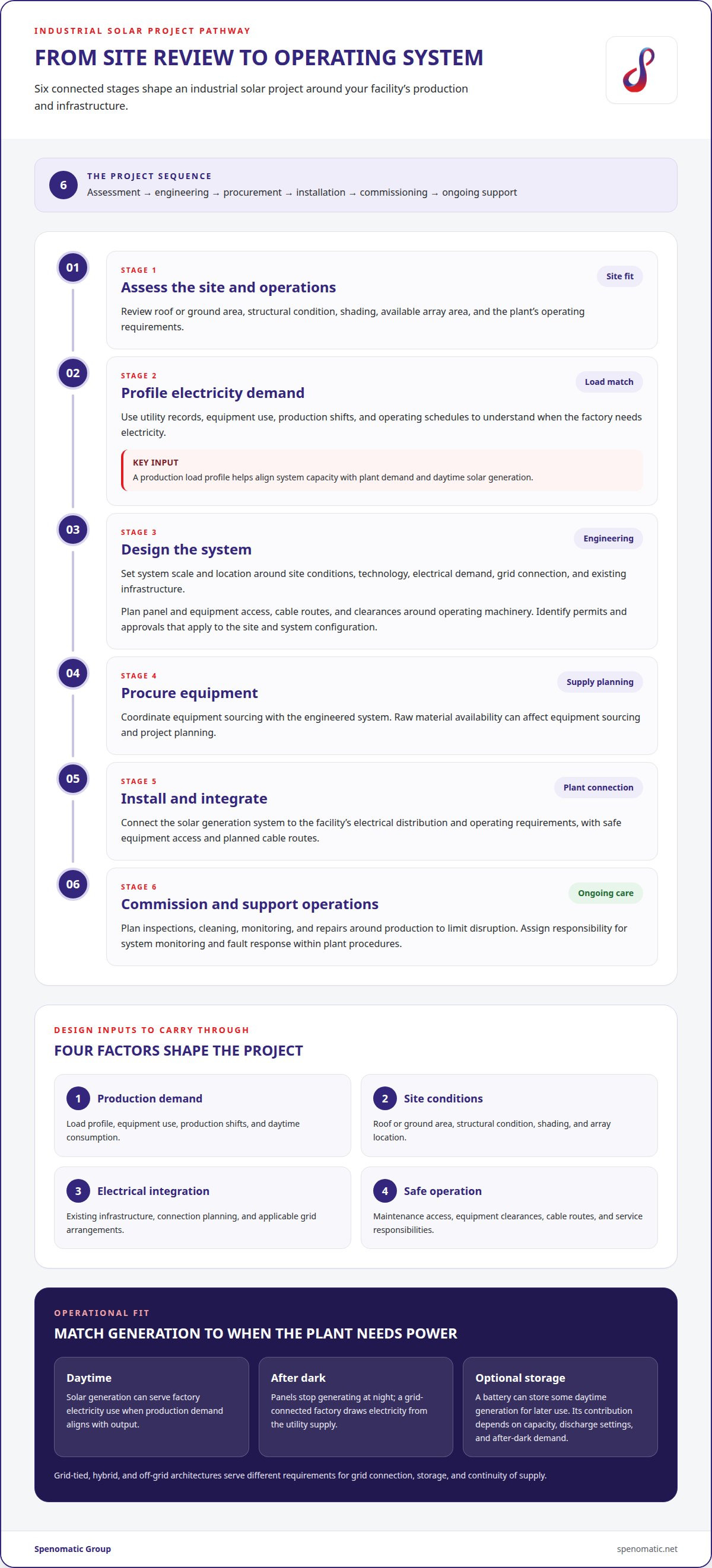
An industrial solar project typically moves through assessment, engineering, procurement, installation, commissioning, and ongoing support. Each stage connects the generation system to production while accounting for the plant’s operating requirements.
Engineers first assess the roof or ground area, structural condition, shading, electrical infrastructure, and production load profile. Reviewing utility records and operating schedules helps map demand against solar availability. The assessment identifies suitable panel locations, cable routes, inverter positions, and maintenance access before installation.
System design defines the array layout, electrical configuration, inverter capacity, protection, and grid connection. Procurement then sources panels, inverters, mounting structures, and electrical components to match the design. Installation covers mounting, wiring, and integration with the facility’s distribution system. Panels produce direct current, which the inverter converts to alternating current for plant equipment.
During commissioning, engineers test system operation, protection settings, monitoring, and coordination between solar generation and grid supply. These checks confirm that the installed equipment works as an integrated system before routine operation. The maintenance plan should define inspections, cleaning, fault response, and rooftop access to support reliable operation alongside production.
Project timing varies with scale and complexity, from a few weeks to several months. A clear sequence limits clashes with production, while early coordination aligns site work, electrical isolation, and commissioning windows. Treat engineering, installation, and lifecycle maintenance as one connected project, not separate tasks.
Comparing Grid-Tied, Hybrid and Off-Grid Solar Systems
Choose the system architecture by matching grid access, continuity requirements, and production demand. These distinctions determine how your factory uses solar generation and manages electricity supply when sunlight fades.
| System type | Grid connection | Storage and supply | Manufacturing fit |
|---|---|---|---|
| Grid-tied | Connected to the utility grid | Usually supplies daytime solar generation alongside grid electricity. Battery storage is not inherent to this configuration. | Fits facilities that retain grid supply and primarily want to offset daytime consumption. Grid supply serves demand when solar output is low. |
| Hybrid | Connected to the grid | Combines solar, grid electricity, and battery storage. Controls can direct stored energy to selected loads. | Supports facilities seeking to manage solar use and provide backup to prioritized equipment. |
| Off-grid | Operates independently of the utility grid | Relies on on-site generation and storage planning to supply loads beyond sunlight hours. | Suited to sites without a usable grid connection, where generation and storage must meet operational demand. |
With an available grid connection, a grid-tied system can use the utility supply outside solar production hours. A hybrid design adds storage, but battery capacity and controls need to match the loads selected for backup. An off-grid system requires careful coordination of generation, storage, and production schedules.
Compare the options against your facility’s continuity priorities, daytime electricity use, and grid access. Design the system to support essential processes without assuming every machine needs backup power.
Spenomatic Group
Spenomatic Group helps manufacturers assess how on-site generation fits production demand, grid connection, and continuity requirements. Its engineering approach translates operating conditions into a solar system design, rather than treating panel capacity as a standalone decision.
Spenomatic Group provides end-to-end EPC services, including feasibility assessment, system design, equipment procurement, installation, commissioning, and ongoing support. Coordinated delivery connects the generation design with operating constraints, electrical infrastructure, and safe maintenance access.
A project can use a grid-tied, hybrid, or off-grid configuration, with battery energy storage where it fits the operating requirements. Spenomatic Group’s engineering team aligns the arrangement with daytime demand, grid dependence, and priority loads, keeping system selection focused on the plant.
A 17.2MWp solar power system project for steel manufacturing demonstrates industrial-scale application. Spenomatic Group also delivered a rooftop solar project for an integrated steel plant. For your project, engineering scope follows site conditions and production requirements, with quality and compliance management across the EPC lifecycle.
To establish a project basis, prepare operating schedules, utility consumption records, electrical diagrams, and planned expansion details. These inputs support load modelling, system selection, and technical coordination before the installation sequence is set.
Discuss your solar project with Spenomatic Group.
Frequently Asked Questions
How Does Solar Plant Installation Work for Manufacturing Industries?
Spenomatic Group coordinates installation with the factory’s production calendar, so work areas, access routes, and electrical interfaces fit site operations. Before work begins, plan site access, equipment deliveries, and any production areas that must remain clear. These details help the project team avoid unnecessary conflicts with active manufacturing processes.
What Are the Challenges of Switching to Solar Power Plants for Manufacturers?
Integrating solar with a factory’s electrical systems requires coordination with its operating pattern. Production changes, machinery upgrades, and shifts in operating hours can alter demand after system design. Assign clear responsibility for operating data, technical decisions, and future changes to help keep the solar system aligned as plant processes evolve.
What factors affect the design of a commercial solar system for a manufacturing plant in Kenya?
No single project scope suits every manufacturing plant. It depends on the facility’s required generation capacity, site layout, electrical arrangement, and system configuration. Accurate operating information and a site assessment allow the proposed design to reflect the actual factory rather than a generic assumption.
How much can solar reduce manufacturing electricity bills in Kenya?
There is no uniform percentage for the effect on every Kenyan factory’s electricity bill. It depends on how much solar electricity the plant uses directly, its operating schedule, and the applicable utility billing arrangement. A facility with production concentrated in daylight may use a different share of its generation than one with substantial evening or overnight operations.
What are the main risks and challenges of installing solar at a manufacturing plant?
Common project risks include clashes between site work and production, design assumptions that no longer reflect plant operations, and inadequate equipment access planning. Machinery changes or revised operating schedules can also affect system fit. Clear project controls, documented design decisions, and coordination between engineering and plant operations help manage these risks.
How long does factory solar installation take, and what are the implementation steps?
Implementation timing depends on project scale, site complexity, and the facility’s ability to accommodate scheduled work. Planning should cover equipment delivery access, production constraints, installation sequencing, and commissioning. Agreeing on handover criteria before work begins helps plant teams understand what must be tested and documented before routine operation.