
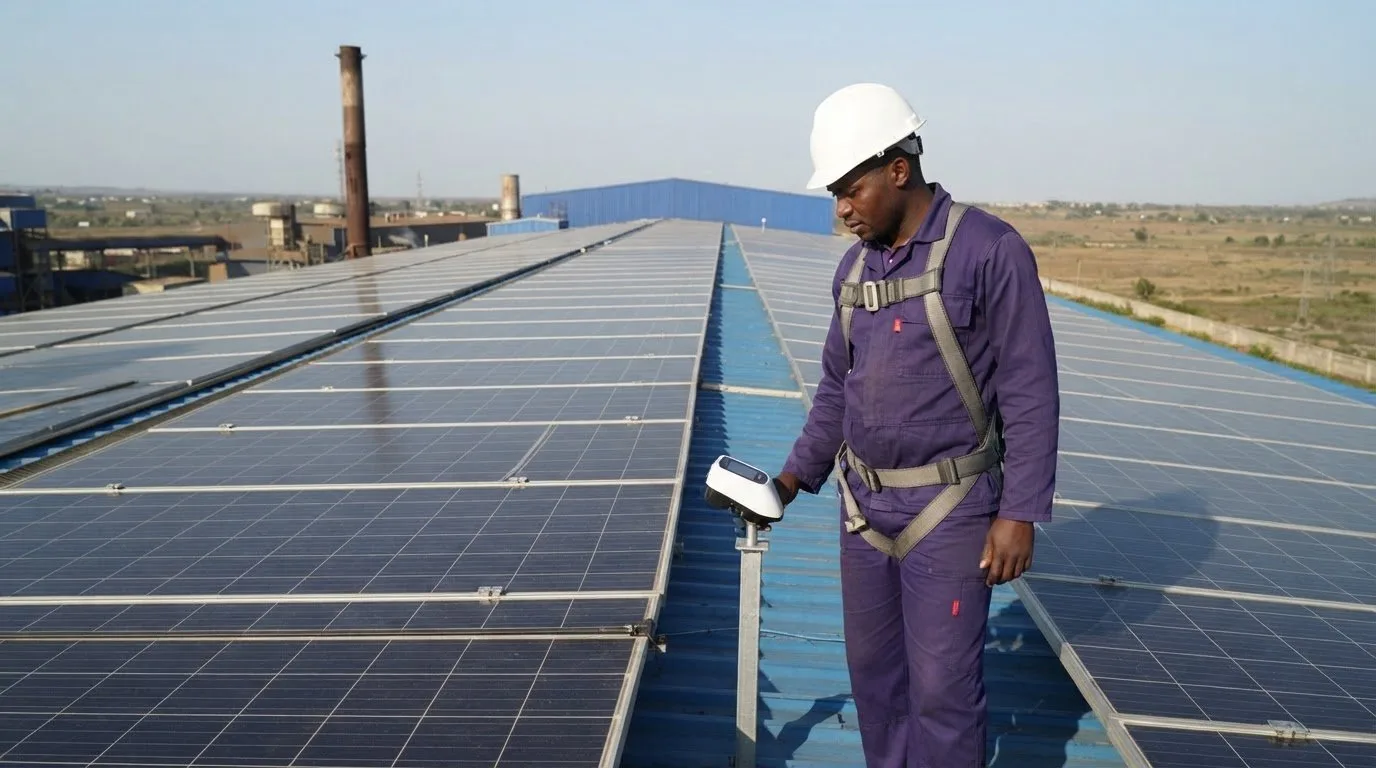
Industrial solar project engineering estimates energy yield by combining a site-specific solar resource assessment with system capacity and expected losses; for example, a 500 kWp system at an assumed specific annual yield of 1,200 kWh/kWp would generate approximately 600,000 kWh annually. That estimate is only useful when it reflects the facility’s production load profile, shading and roof conditions, panel soiling, electrical conversion losses, and the match between daytime electricity use and solar generation. In this guide, you’ll see how engineers model yield and performance, design DC and AC infrastructure around industrial demand, and plan commissioning and EPC delivery in Kenya, so you can assess what a project needs before it is built.
Key Takeaways
- See how electrical design connects the PV array, inverters and facility infrastructure, with attention to protection, earthing and maintenance access.
- Understand how commissioning tests and handover records help establish that equipment is installed, tested and ready for operation.
- Learn how monitoring can distinguish expected system losses from performance issues that may need investigation.
- Follow how EPC delivery coordinates site assessment, design, installation and commissioning around your facility’s operating requirements.
How Should a Professional Design DC and AC Electrical Infrastructure for Your Industrial Solar Project?
Design starts with the facility’s electricity demand, site conditions and operating objectives. Engineers then coordinate the PV array, protection, inverters and grid connection as one system.
Auditing Loads and Sizing Solar
An industrial electricity-load audit profiles demand against production schedules to size solar around actual consumption. Engineers use 12 months of half-hourly or 15-minute demand data when available, then assess daytime electricity use, peak loads and planned operational changes. Roof assessments consider structural condition, shading, orientation, usable area and safe access; ground-mounted sites require suitable space and access planning. These checks expose sizing mismatches early, before equipment selection and installation design are fixed.
Planning Grid Connection and System Configuration
System configuration determines how a solar installation interacts with the grid and any energy storage. Grid-tied systems operate alongside the network, hybrid systems integrate batteries, and off-grid systems operate without a grid connection. The right option depends on supply conditions, continuity requirements and the facility’s load profile. In Kenya, approvals depend on the connection arrangement, site works and environmental scope, so these requirements should be addressed during project planning.
DC design connects modules through strings and protection components to inverters; AC design connects inverter outputs to facility distribution and, where applicable, the grid. A typical 500 kW commercial configuration uses four to five 110 kW or 125 kW three-phase string inverters, with a 600 kWp to 700 kWp array. Cable sizing should limit voltage drop to 1.5% on the DC side and 1% on the AC side. Relevant technical standards can help guide the design of grid-connected PV systems and low-voltage PV installations.
Installation planning also addresses earthing, lightning protection and electrical protection; earthing resistance is typically below 1 ohm. A professional assesses roof capacity and mounting conditions alongside access, shading and existing electrical infrastructure. Technical risks include faults or poor system integration; financial exposure follows incorrect sizing or underestimated losses, while operational risks include disruption during installation. For rural agricultural fields, a solar electric fence uses PV panels to charge batteries. Related off-grid design principles also apply to home and small business solar systems.
Commissioning tests and handover documentation
Commissioning follows construction and checks that installed equipment matches its approved design and intended operating sequence. On a rooftop solar project, testing and records establish a technical baseline for operation and future fault investigation.
Conducting Commissioning Tests
Commissioning is the structured inspection and functional testing of a completed solar system before operational handover. It helps identify installation defects and integration issues before the facility relies on the system.
Engineers inspect module mounting, cable routes, labels, isolators and inverter connections against the design. They test string polarity, continuity, insulation resistance, earthing and protective-device operation, recording results for each relevant circuit. They then start the inverters and check settings, alarms, grid synchronisation and responses to operating conditions. Where the system connects to facility distribution, the team checks the integration and confirms that equipment operates as intended. Test results are compared with design documents and equipment requirements; defects are recorded for correction and retesting.
Documenting Commissioning and Handover
Handover documentation records installed equipment, test evidence and operating information. Clear records help your maintenance team understand the system and trace changes in performance over time.
The handover package should include approved as-built drawings, equipment schedules, inverter settings, test results, commissioning records and relevant operation and maintenance instructions. It should also list open defects and document their resolution before final acceptance. For example, circuit labels on drawings should match those at the array, inverter and distribution board. Record initial operating readings as a baseline, then compare later monitoring data with them. Keep digital and site copies accessible to the personnel responsible for maintenance and incident response.
Construction sequencing matters: complete mounting and electrical installation before testing, then resolve recorded defects before handover. A coordinated solar project delivery approach can align technical checks, documentation and operational readiness.
How Does a Professional Estimate Energy Yield, Losses, and System Performance?
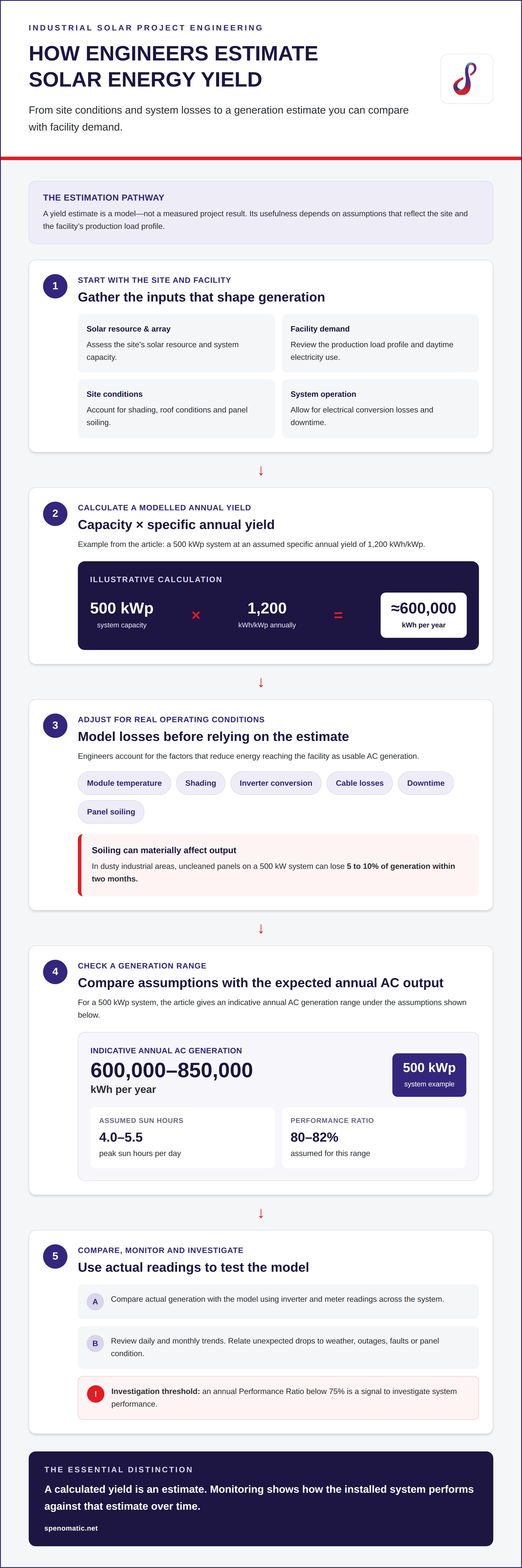
A professional yield estimate combines solar resource, array capacity and expected system losses. For example, a 500 kWp array at a specific annual yield of 1,200 kWh/kWp would generate approximately 600,000 kWh annually. The estimate is a model, not a measured result; its value depends on assumptions matching the facility and site.
For a 500 kWp system, an indicative annual AC generation range is 600,000 to 850,000 kWh, assuming 4.0 to 5.5 peak sun hours per day and an 80% to 82% Performance Ratio. Engineers account for module temperature, shading, inverter conversion, cable losses, downtime and soiling. They compare projected generation with the facility’s production load profile to assess how much electricity may align with daytime demand.
Monitoring compares actual generation with the model, using inverter and meter readings across the system. Engineers review daily and monthly trends, then relate unexpected drops to weather, outages, faults or panel condition. In dusty industrial areas, uncleaned panels on a 500 kW system can lose 5 to 10% of generation within two months. If annual Performance Ratio falls below 75%, investigate the cause rather than treating reduced output as normal.
Maintenance records help explain performance changes over time. Track cleaning, alarms, shutdowns and repairs alongside generation data to make recurring losses easier to isolate. Compare like-for-like periods and account for operating conditions before deciding whether intervention is needed. Monitoring should also distinguish changes in array performance from changes in facility electricity demand.
Where solar electricity powers water treatment or pumping, PV generation monitoring does not measure water quality. Record relevant water-process readings separately and compare them with treatment operating records. This distinction helps identify whether a production change relates to solar supply or the water process. Water and effluent treatment systems have their own process performance requirements, so keep those records aligned with the solar operating log.
Commercial and industrial solar EPC services
Commercial and industrial solar EPC coordinates feasibility, engineering, procurement, construction and commissioning under one delivery plan. For your facility, this connects energy analysis and site constraints to an installed system and documented handover.
Understanding Commercial and Industrial EPC Services
EPC services integrate technical design, equipment sourcing, installation and commissioning from the initial assessment through handover. This matters because an industrial solar system must fit electricity consumption, roof or ground conditions, existing infrastructure and operating schedules. For a 100-500 kW project, the typical overall timeline is 8-14 weeks, while electrical installation typically takes 2 to 4 weeks. Scope and site conditions shape project sequencing.
A sound feasibility analysis considers the facility’s production load profile, daytime demand, shading, structural condition and grid connection. Procurement aligns selected components with that design rather than treating equipment sourcing as a separate decision. During construction, mounting, electrical works and operational access must meet the facility’s requirements. Integrated project control coordinates these dependencies and prepares for commissioning, helping prevent avoidable gaps at handover.
Choosing a Qualified Solar EPC Contractor
A capable EPC team should demonstrate experience across assessment, engineering, procurement, installation and commissioning. In Kenya, assess whether the team can explain how its analysis connects your consumption data and site conditions to the system design. Review relevant industrial project experience, quality and compliance management, equipment sourcing, construction sequencing and handover documentation. These are practical indicators that technical decisions will stay coordinated through implementation.
Ask for a project scope that defines responsibilities, interfaces with existing infrastructure, construction phases and acceptance records. For example, a rooftop project needs plans that account for structural findings and safe maintenance access, not just the mounted array. The schedule should distinguish design, procurement and site installation, with commissioning requirements defined before work starts. This gives your operations team a clear basis for assessing EPC proposals against facility needs.
For a project-specific EPC assessment, discuss your industrial solar requirements.
Spenomatic Group
Spenomatic Group can help translate yield estimates, site conditions and operational requirements into a coordinated solar project. Its Commercial & Industrial Solar offering supports businesses assessing on-site generation, while Grid-Tied, Hybrid & Off-Grid Solar options address different connection and continuity needs. Battery Energy Storage Systems can also be integrated where storage fits the facility’s operating requirements.
Bring your production load profile, facility drawings, available site information and project objectives to the engineering discussion. These inputs connect system sizing and configuration with electrical integration, commissioning and handover planning. Spenomatic Group also offers Home & Small Business Solar for smaller-scale requirements.
Contact Spenomatic Group to discuss the solar requirements for your facility.
Move Your Solar Project Toward a Defined Scope
The next step is to turn the engineering assumptions into a project brief that reflects your facility’s priorities. Set out operating requirements, preferred system configuration, site constraints and the decisions your internal teams need to make. This gives the engineering discussion a clear starting point and keeps design choices connected to operational objectives.
Industrial solar project engineering must account for different scales and operating contexts. Spenomatic Group offers Commercial & Industrial Solar and Home & Small Business Solar, with Grid-Tied, Hybrid & Off-Grid Solar configurations. Its engineering team brings more than 27 years of experience in Africa’s energy and environmental engineering sector to project discussions.
Bring your project priorities into a direct discussion with the team and establish the appropriate scope and next decisions. Contact Spenomatic Group to discuss your solar project and take the next step with clarity.
Frequently Asked Questions
How Does an EPC Contractor Estimate Space Requirements for a 500kW Solar Array?
A 500 kWp array typically needs approximately 2,500 to 3,500 m² of usable rooftop or ground space. The EPC assessment maps module layout against shading, roof condition, access routes, orientation and obstructions. Ground-mounted layouts also need allowance for equipment and maintenance access. Usable area can differ from the gross roof footprint, especially where skylights, plant rooms or walkways interrupt mounting zones.
How Should an EPC Contractor Configure PV Strings and Inverters for a 500kW+ System?
For a typical 500 kW commercial AC system, a configuration may use four to five 110 kW or 125 kW three-phase string inverters. The corresponding DC array capacity is 600 kWp to 700 kWp, a 1.2x to 1.4x DC-to-AC ratio. Engineers check string lengths and inverter allocation against module electrical limits, operating temperatures, shading patterns and equipment specifications.
What Factors Affect the Financial Performance and ROI of a 500kW Solar Project?
Financial performance depends on how much solar generation the facility can use and how closely production aligns with electricity demand. Key factors include daytime consumption, system yield, shading, downtime, maintenance and operating schedules. Greater daytime use can increase the share of generation consumed on-site, while excess generation may affect returns. Compare projected output with the facility’s operating patterns and electricity tariff.
What Engineering Checks Should Your EPC Contractor Complete Before Commissioning?
Before commissioning, the EPC team should confirm that installed equipment matches approved drawings and schedules. The review should cover cable routes, labels, isolators, inverter settings, protection devices, earthing and system interfaces. Record each defect, correct and retest it, then retain the results in the handover file. Matching as-built drawings to installed circuit labels also gives your maintenance team a practical reference for tracing faults.
What Transformer and Grid-Connection Requirements Apply?
For a 500 kW AC plant, an example step-up transformer rating is 630 kVA or 800 kVA; the rating accounts for a 15% to 20% thermal safety margin. Example medium-voltage grid levels are 10 kV, 20 kV and 35 kV. These are design examples, not universal connection approvals. A Grid interconnection study assesses transformer, protection and connection requirements against the facility and local network.
What Does Industrial Solar Project Engineering Include?
Industrial solar project engineering coordinates site and load assessment, yield modelling, system design, equipment selection, electrical integration, construction planning, commissioning and handover. It also aligns these disciplines with production schedules and facility constraints. In Nairobi, Thika, Kiambu, Nakuru, Athi River, Naivasha, Machakos, Kisumu and Mombasa, roof conditions, existing infrastructure and grid arrangements all inform project design and implementation.