
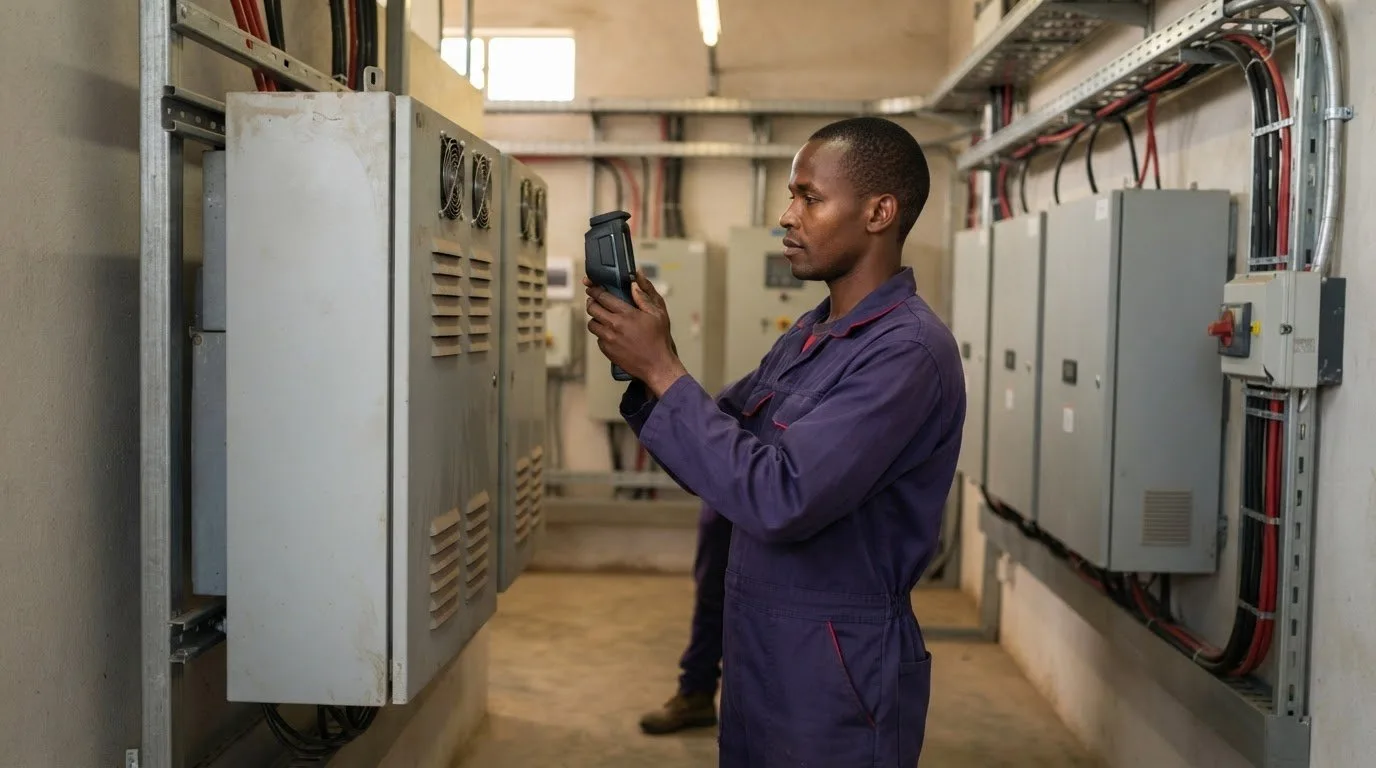
Inspect commercial solar inverters quarterly for visual and thermal conditions, complete electrical and mechanical preventive maintenance semi-annually, and carry out deep preventive maintenance annually.
This commercial solar inverter troubleshooting guide explains how technicians use status and performance records to distinguish faults in the inverter, PV array, grid supply, cooling, settings, monitoring and communications. An alarm or low-output reading alone does not identify the failed component.
Learn what can support repair rather than replacement, which warning signs call for qualified intervention, and how technicians assess fault codes, electrical readings, thermal conditions, grid behaviour and equipment history. This helps define corrective work and protect operational continuity at commercial sites in Kenya.
Key Takeaways
- Use fault codes alongside inverter, array, grid, and monitoring evidence to pinpoint where a performance issue originates.
- Distinguish a grid-voltage or ground-fault condition from an inverter failure before planning corrective work.
- Assess recurring faults, equipment condition, and operational impact to guide repair or replacement decisions.
- Trace communications issues across the inverter, network, monitoring platform, and SCADA interface to locate signal loss.
Distinguishing inverter, array, grid and monitoring faults
Separate equipment alarms from generation and data-transfer issues before assigning a cause. A commercial solar inverter troubleshooting guide should consider physical conditions, production records, grid behaviour and remote alarms together.
-
How a professional inspects inverter enclosures and monitors temperature
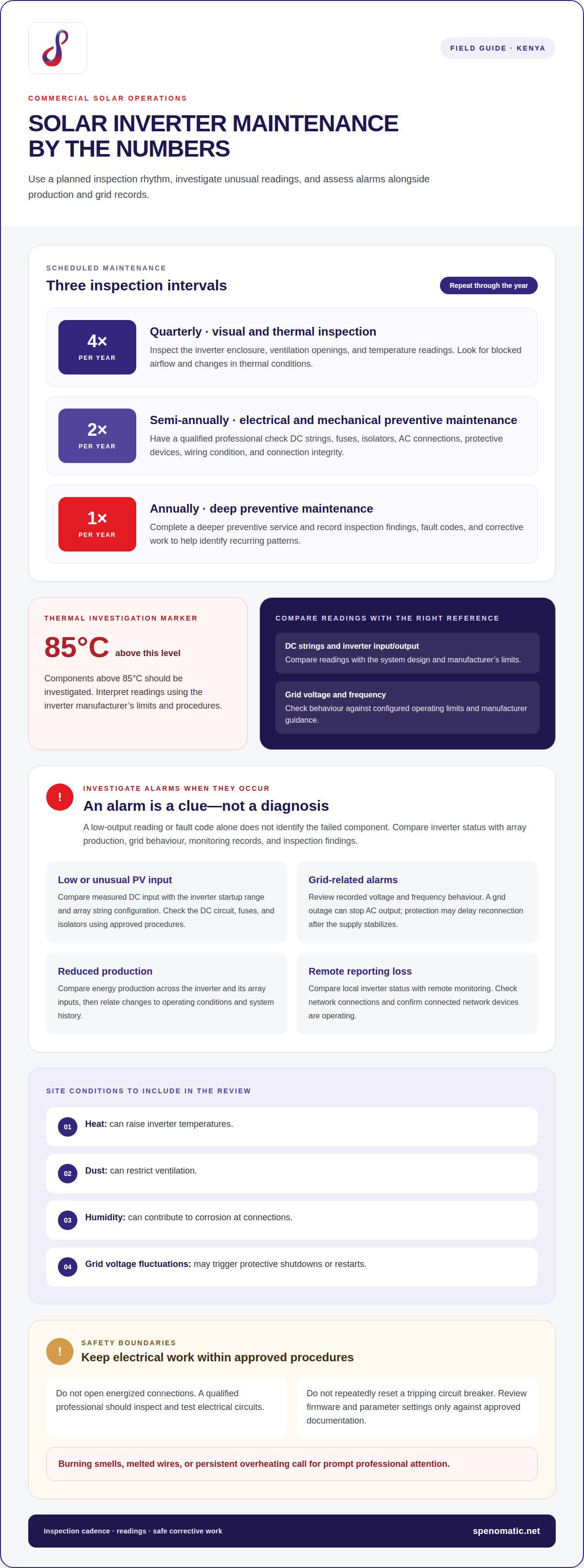
Inspect the enclosure, ventilation openings and temperature readings before interpreting voltage alarms. A weatherproof enclosure helps shield equipment from rain and dust, but blocked airflow can still contribute to overheating. Temperature fluctuations can also contribute to high or low input-voltage alarms. Components above 85°C should be investigated; use the inverter manufacturer’s limits and procedures to interpret readings.
-
How a professional reviews production and system performance
Compare energy production across the inverter and its array inputs, then relate changes to operating conditions. System-wide low output differs from reduced production on one input, which may indicate an array-side issue. Check performance against the installation design and operating history. For smaller commercial sites, the solar system offering for homes and small businesses provides relevant system context.
-
How a professional checks monitoring software and communications
Separate a data connection failure from an electrical failure by comparing local inverter status with remote monitoring. Error code 302 indicates a communication error in this guide, while communication-module defects can interrupt remote reporting. The technician checks network connections and confirms connected network devices are operating. Monitoring software can track performance over time and flag output drops or unusual activity.
-
How a professional reviews remote alarm history
Review alarm timestamps alongside production and grid records to identify recurring patterns. Alarm codes can indicate grid-related issues, but their meanings vary by inverter and should be checked in its manual. A self-protection state can also stop AC output without proving inverter failure. Interpret each code using the specific inverter manual, then compare repeat alarms with system events and inspection findings.
How often should solar inverters be inspected?
Set a routine inspection schedule and investigate alarms or performance changes as they occur. Recommended intervals are quarterly for visual and thermal inspections, semi-annually for electrical and mechanical preventive maintenance, and annually for deep preventive maintenance.
- Have a qualified professional test DC strings, fuses, isolators and AC connections during electrical maintenance. The technician compares string readings and inverter input and output voltage with the design and manufacturer’s limits, then checks protective devices, wiring condition and connection integrity.
- Assess site conditions during scheduled inspections. In Kenya, heat can raise inverter temperatures, while dust can restrict ventilation and humidity can contribute to corrosion at connections. Grid voltage fluctuations may trigger protective shutdowns or restarts. A professional distinguishes these from equipment failure by reviewing recorded voltage and frequency behaviour.
- For high or low PV input voltage alarms, compare measured DC input with the inverter’s startup range and the array’s string configuration. Incorrect string design, a failed fuse or an isolator problem can affect readings. The technician checks the DC circuit and insulation using the equipment’s approved procedure, without opening energized connections.
- For grid faults, compare AC voltage and frequency at the inverter with its configured operating limits and manufacturer guidance. A grid outage can stop AC output; after supply stabilizes, protection may delay reconnection. Review firmware and parameter settings only against approved documentation, and don’t repeatedly reset a tripping circuit breaker.
- Record inspection findings, fault codes and corrective work to expose recurring patterns. Low or no production can stem from input voltage, grid conditions, protection settings or damaged wiring, so readings must be assessed together. A qualified technician can also assess commercial solar PV system design when configuration and operating requirements need review.
Inverter repair-versus-replacement decisions
- Base the decision on fault records, production impact and inspection findings. A single alarm does not establish that an inverter needs replacement. A technician should identify the failed component, determine whether the fault recurs and assess whether ventilation, wiring or operating conditions contributed.
- Compare the inverter’s age with its condition and service history. String inverters typically have a lifespan of 10-15 years, but age alone does not prove failure. Repeated shutdowns, persistent fault codes and declining output help indicate whether repair can restore reliable operation.
- Leave internal electrical repairs to a professional technician. Inverter capacitors may retain dangerous electrical charge after disconnection, so don’t open the casing or attempt component-level repair. Stop maintenance and seek prompt professional attention if you notice burning smells, melted wires or persistent overheating.
- Assess repair versus replacement by examining fault recurrence, production interruption, parts availability and equipment compatibility. Repair may address a specific component failure, while recurring faults across the inverter may support replacement planning. Correct underlying ventilation or installation issues before commissioning replacement equipment.
- Review the warranty before authorizing repair. Typical product warranty periods for most inverter manufacturers are 5-12 years, but the applicable terms depend on the specific equipment. Provide the manufacturer with the model, serial number, fault code, service history and evidence of the failure.
- After repair or replacement, ask the technician to document the work and test system operation. Confirm that the inverter starts, produces expected output under operating conditions and reports status correctly through monitoring. Record replaced parts, settings and commissioning results to support future diagnosis and warranty requests.
Compare annual repair costs plus lost-energy value with replacement cost: if they exceed 30% of replacement cost, replace the inverter. Keep service records for future repairs and warranty claims. Persistent overheating may indicate an internal fault requiring professional repair.
Communications, SCADA, and protocol faults
A professional uses isolation procedures, inverter diagnostics and electrical measurements to locate faults safely. Provide the inverter model, fault codes, alarm history, production data and details of recent site changes.
- Compare local inverter status with the monitoring platform and SCADA records. Code 302 indicates a communication error; technicians trace the data path through network connections, gateways and protocol settings. If local generation continues while remote readings stop, investigate communications before diagnosing an energy-conversion failure.
- Interpret every fault code against the specific manufacturer’s manual. Fault codes can indicate different problems depending on the inverter model, so interpret them using the relevant manual. Record the code and its timestamp, then compare related alarms before selecting a test or update.
- For insulation, ground or arc alarms, have a qualified technician isolate and assess the affected circuit. Some PV inverters may alarm below approximately 1 MΩ, but the inverter’s threshold and test procedure govern interpretation. A professional checks strings individually and examines terminals, wiring and components for damage.
- Diagnose startup and low-power faults by comparing DC input, AC output and grid status with equipment requirements. Low PV input can prevent startup, while grid disconnection or voltage fluctuations can interrupt AC output. The technician also checks whether temperature, incorrect settings or a battery-related alarm explains the generation pattern.
- Triage faults by matching alarm timing with generation changes. A single affected string suggests a localized array issue, while simultaneous inverter shutdowns may point to shared grid conditions. Temperature trends and alarm sequences help distinguish thermal derating from communications failures or electrical faults.
- Give the technician recent production records, inspection findings and any changes to the installation. For coordinated commercial solar troubleshooting support, arrange a professional assessment.
Spenomatic Group: Commercial & Industrial Solar
Spenomatic Group provides Commercial & Industrial Solar solutions for Kenyan facilities assessing inverter faults, system performance or equipment replacement. If troubleshooting points to wider system-design issues or a need to review the site’s solar configuration, its commercial solar offering is a practical next step. Spenomatic Group also offers Battery Energy Storage Systems and Grid-Tied, Hybrid & Off-Grid Solar for sites considering how storage or operating mode fits their system.
Prepare the inverter model, fault codes, alarm history and production records for a focused technical discussion. Contact Spenomatic Group to discuss your commercial solar system requirements.
Turn diagnosis into a maintenance plan
Use this commercial solar inverter troubleshooting guide to start a site-specific maintenance plan. Assign responsibility for reviewing inverter alerts, recording corrective actions and tracking whether production returns to expected operation. Clear records help your operations team connect technical decisions to plant priorities and plan future system changes around actual site requirements.
For a new or expanded installation, Spenomatic Group offers Commercial & Industrial Solar, Home & Small Business Solar, and Grid-Tied, Hybrid & Off-Grid Solar. Its engineering team can help align the solar system approach with your facility’s operating needs.
Share your project priorities and discuss the appropriate next step with Contact Spenomatic Group. A structured plan gives your team a practical basis for moving forward.
Frequently Asked Questions
TL;DR: Use inverter records, array design documents and operating data together. The comparison below shows how each record can support fault diagnosis.
| Record | What it helps assess | Useful detail |
|---|---|---|
| String schedule | Array configuration | Module and tracker assignments |
| Production log | Output changes | Time and affected inverter |
| Maintenance record | Recurring issues | Previous corrective work |
What does MPPT maintenance involve?
MPPT maintenance checks tracker operation against the array design and measured operating data. A technician compares inputs assigned to equivalent strings and investigates unexplained differences, including possible shading or configuration changes. Acceptable MPPT string-yield tolerance depends on the system design, operating conditions and manufacturer guidance; it should not be treated as a universal 2% limit against modeled yield. Comparing like-for-like conditions helps identify tracker performance changes rather than normal variation.
What are the most common commercial solar inverter faults and error codes?
Common fault categories include overload, output short circuit, abnormal output voltage, insulation problems and grid disturbances. A code matters only in the context of the inverter model and its operating state. For example, an overload alarm calls for a different diagnosis from an array-side input problem, even if both reduce generation. The technician interprets the displayed code using the relevant manufacturer’s documentation.
What do common inverter alarms and fault codes mean, and how does a service technician clear them?
Alarm text and codes show what conditions the control system has detected; they do not prove which component failed. The technician records the original alarm, corrective work and post-service operating state. Clear an alarm only after addressing its cause, and note whether it returns during subsequent operation.
What tools and personal protective equipment should a service technician use for inverter troubleshooting?
The diagnostic task determines which instruments are needed. A technician may use a multimeter for electrical measurements, an insulation resistance tester for insulation checks, and the inverter’s monitoring interface for operating data. Tools must suit the equipment and the manufacturer’s procedure. The technician selects personal protective equipment, such as insulated gloves and eye protection, based on the site risk assessment.
When should a commercial solar inverter fault be handled by a licensed electrician or service technician?
Use qualified electrical personnel for tests involving live or potentially energized circuits, protective-device operation, insulation assessment or internal inverter components. Site staff can preserve alarm logs and note when production changed without opening equipment or disturbing wiring. This keeps diagnostic evidence available while leaving electrical testing and corrective work to personnel with appropriate training and equipment.