
Surplus power from small business solar systems in Kenya is not automatically sold to the grid. Export depends on the applicable grid connection and agreement under Kenya’s feed-in tariff and net metering arrangements.
Upkeep for small business solar systems in Kenya includes panel cleaning, inspections and electrical checks. The maintenance routine depends on site conditions and operating demands.
TL;DR: This guide explains grid export, system maintenance, the differences between grid-tied, hybrid and off-grid configurations, and how professional solar support can meet your business needs.
Key Takeaways
- Grid export depends on the applicable agreement and interconnection requirements; plan for it as part of system design, not as an automatic benefit.
- Maintenance needs vary by site and system configuration, including whether the installation is grid-tied, hybrid or battery-backed.
- After-sales support can help keep inspections, cleaning and system checks aligned with operating conditions and energy needs.
- Match the solar configuration to your business’s electricity use, grid connection and continuity requirements before selecting a solution.
Can I sell excess solar power back to the grid in Kenya?
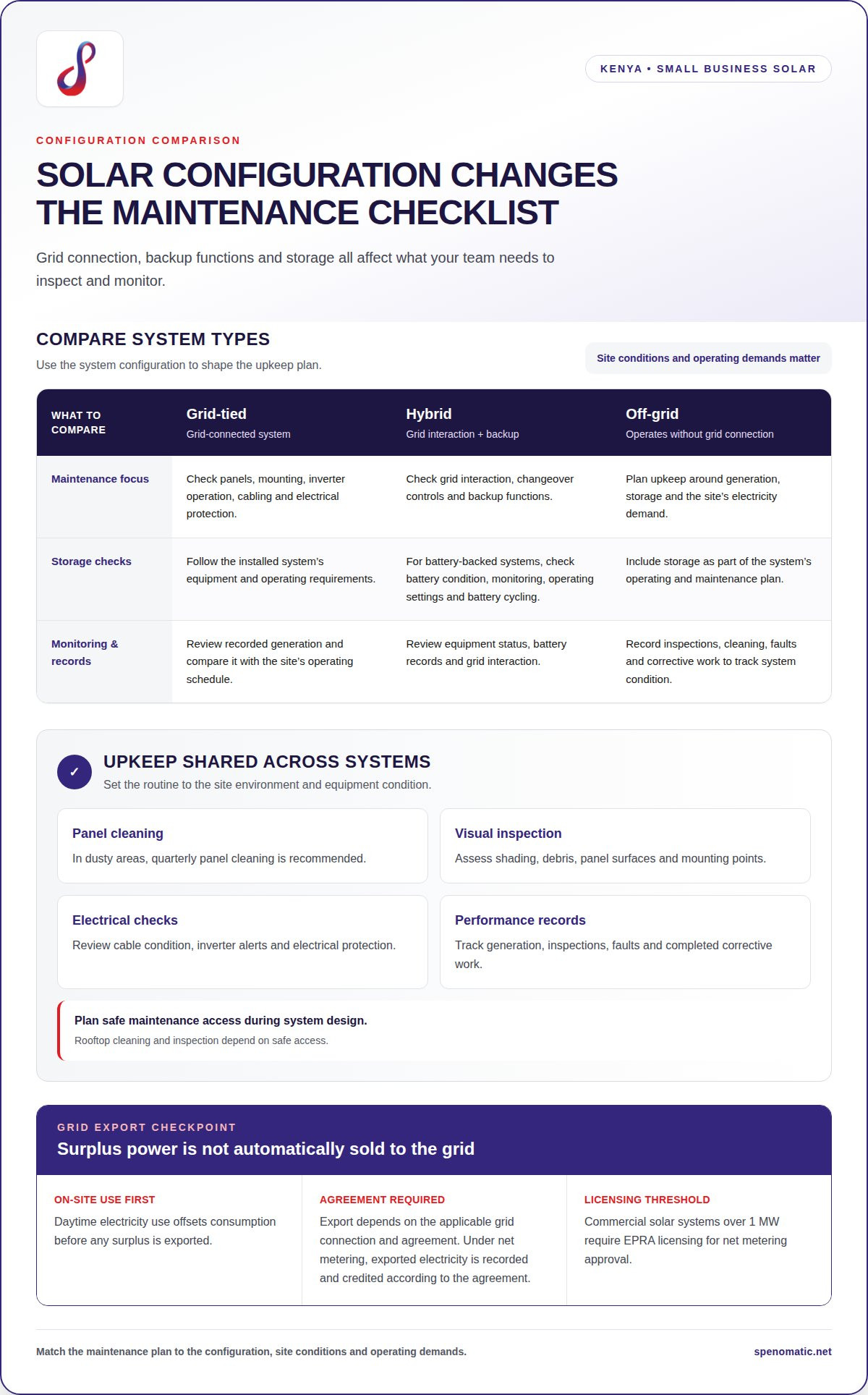
Kenya supports solar projects through feed-in tariff and net metering systems. Surplus electricity may be exported under an applicable arrangement, but export is not automatic. Under net metering, exported electricity is recorded and credited according to the agreement. Electricity used on site during the day offsets consumption before any surplus is exported.
Commercial solar systems over 1 MW require EPRA licensing for net metering approval. Design must account for grid connection, export controls, electrical protection, and the utility interface. Even smaller systems need compatible connections and proper commissioning. Surplus generation alone doesn’t create a sale agreement.
Feed-in tariffs and net metering are Kenya’s stated solar support mechanisms. They do not, by themselves, establish a general grant, tax incentive or financing entitlement. Financing arrangements are separate from permission to export power.
Before installation, engineers assess the site, electrical load, production schedule and grid connection. Commissioning tests generation, inverter response, electrical protection, monitoring and export controls. Customer training should cover system indicators, safe shutdown, fault reporting and routine upkeep. At handover, operating settings are recorded and the way solar supplies electricity during normal operations is explained.
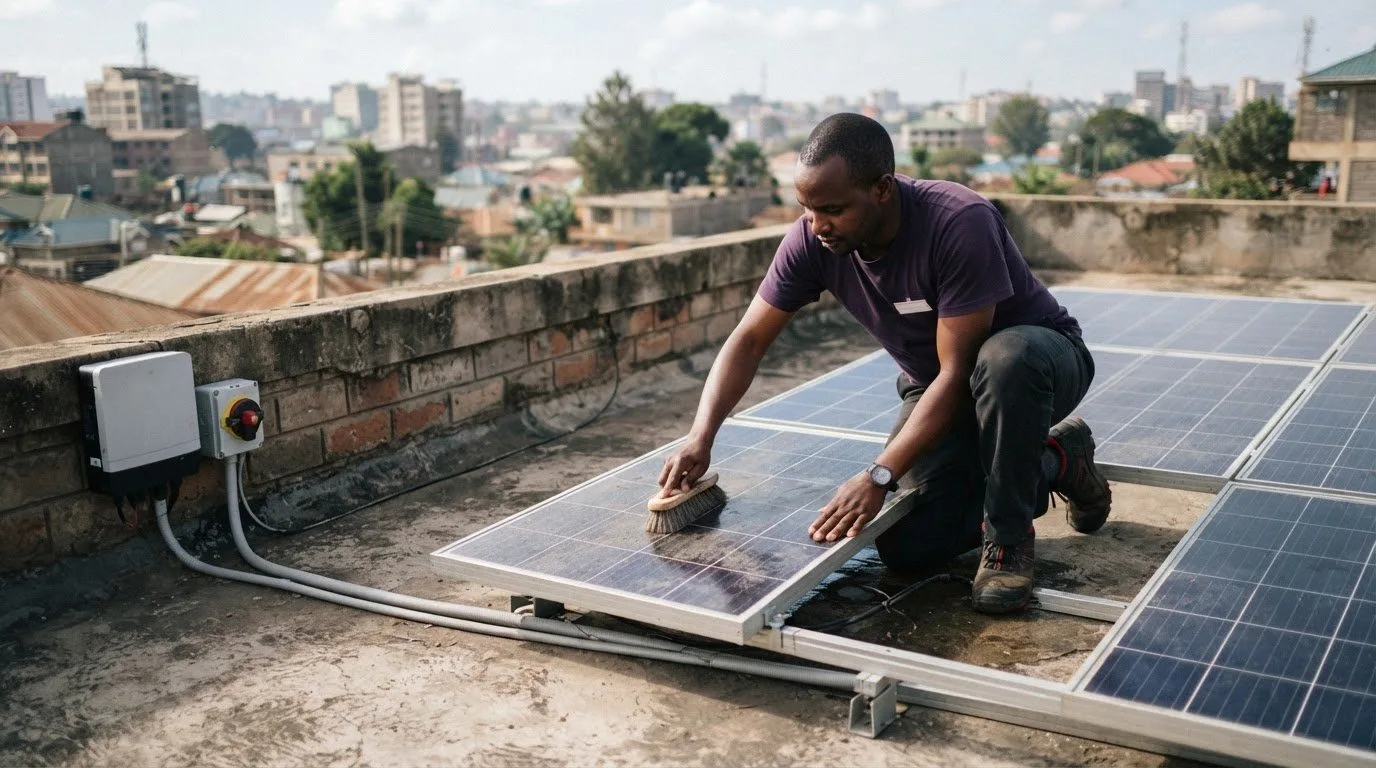
Warranty documents should distinguish panel, inverter, battery, and installation coverage; maintenance records preserve service history. For example, a home system and a shop system may need different equipment layouts, access arrangements, and load assumptions. Design requirements for solar installations at homes and small businesses reflect those differences. Commercial solar installation also needs planned maintenance access, since rooftop cleaning and inspection depend on safe access.
What maintenance do commercial solar systems require?
Maintenance depends on whether the site uses grid-tied, hybrid or battery-backed solar power. A grid-tied system needs checks of its panels, mounting, inverter operation, cabling and electrical protection. A hybrid system also needs checks of changeover controls and backup functions. Battery-backed equipment requires checks of battery condition, monitoring and operating settings. These checks can identify faults before they disrupt supply or reduce solar output.
Set cleaning and inspection routines according to the site environment. In dusty areas, quarterly panel cleaning is recommended. Inspections should also assess shading, debris, mounting points, cable condition, inverter alerts and recorded generation. For example, a production site can compare monitoring records with its operating schedule to investigate an unexpected drop in solar output. Plan for safe maintenance access when designing a rooftop system.
Grid connection and export arrangements affect maintenance checks. Net metering means exported electricity is credited under an agreement, so monitoring should distinguish exported power from on-site use. For commercial systems over 1 MW, EPRA licensing is required for net metering approval. That is the stated licensing requirement for this grid-export arrangement; it is not a general list of permits for every installation.
Off-grid systems at rural Kenyan sites operate without a grid connection, so maintenance must account for generation, storage, and demand. Hybrid systems need checks of grid interaction alongside battery cycling. For battery-backed installations, battery energy storage systems form part of the system’s operating and maintenance plan. Service records should track inspections, cleaning, faults, and corrective work, rather than assume 100% availability. This record also informs future equipment purchase decisions and helps assess whether the system continues to meet the site’s electricity needs.
Maintenance contracts and after-sales support
A maintenance contract should define scheduled inspections, fault reporting, repair responsibilities and service records. In Kenya, set panel-cleaning frequency according to site conditions, including dust exposure.
System Maintenance and Repairs
Solar maintenance and repairs involve inspecting equipment, diagnosing faults and restoring normal operation. Soiling, damaged cabling or inverter faults can reduce generation or interrupt supply, making timely attention important.
In dusty areas, quarterly solar-panel cleaning is recommended. During a service visit, technicians can also assess panel surfaces, mounting points, wiring, inverter alerts and electrical protection. A fault log can help connect a drop in output with a specific repair or inspection finding.
Monitoring System Performance
System monitoring records generation and equipment status. Maintenance teams can use those records to identify faults and distinguish a change in production from a system issue before planning corrective work.
Review monitoring data alongside electricity use and operating schedules. A commercial site can compare daytime generation with production shifts, while a residential installation can track household consumption. For battery systems, records of charging, discharging and alerts help reveal operating patterns without assuming every fault has the same cause.
Define the service scope in writing, including inspection tasks, reporting, repair approval and how warranty claims are documented. Keep commissioning records, equipment details, maintenance reports and repair history together. These records help technicians diagnose recurring faults and show which work has been completed.
After-sales support should explain how to report an issue and what operating information to provide. A useful report can identify the affected equipment, any visible alert and when the fault appeared. For commercial solar, coordinate site access with operations; for residential systems, note any change in electricity supply. Schedule upkeep according to equipment condition and site demands.
Solar solutions for businesses and industries
Effective solar energy solutions start with a facility’s production load profile, not a standard panel count. Engineers assess operating schedules, equipment demand, available installation space and how the business handles interruptions. These factors shape the system configuration and the roles of inverters, storage and grid supply.
The comparison below shows how common configurations suit different operating conditions. The right option depends on your site’s connection and the level of continuity your business requires.
| Configuration | Business use case | Key design consideration |
|---|---|---|
| Grid-tied | Connected premises using solar during business hours | Coordinate inverter operation with the site’s electrical supply and grid connection. |
| Hybrid | Businesses combining grid supply with solar and battery storage | Set controls around which loads need backup and when the battery should charge. |
| Off-grid | Sites operating without a grid connection | Size generation and storage around operating demand and periods without solar output. |
For example, a workshop with predictable daytime shifts may prioritize using solar directly for machinery. A business with critical refrigeration may need a configuration that accounts for backup loads and battery operation. An off-grid site must plan for its full operating pattern rather than assume the grid can cover periods of low generation.
In every case, system design should account for electrical protection, future changes in demand and safe maintenance access. First define which operations solar must support. This gives engineers a clear basis for modeling generation, inverter capacity, storage needs and the expected contribution to electricity savings.
Spenomatic Group recommends monitoring a commercial facility’s energy-use patterns over 2-4 weeks to inform system design. For planning schedules, Spenomatic Group says a 200-500 kW industrial solar installation in Kenya typically takes 4-8 weeks.
Costs and returns also shape investment decisions: Spenomatic Group estimates a 100 kW commercial solar system in Kenya costs around KES 8-10M, with commercial solar installations in Kenya typically achieving payback within 3-5 years.
Spenomatic Group: Home & Small Business Solar
Spenomatic Group provides Home & Small Business Solar for homes and smaller business sites with distinct electricity needs. Design should reflect the equipment you operate, when you use it and how important supply continuity is. A shop with daytime refrigeration has a different demand pattern from a home that uses more electricity in the evening. These operating details guide system configuration and capacity decisions.
For larger facilities, Commercial & Industrial Solar addresses business and production requirements. Design starts with the site’s electrical load and production schedule, then considers available installation space, grid connection and maintenance access. This assesses solar generation against actual operating demand, rather than using panel count as the starting point.
Grid-Tied, Hybrid & Off-Grid Solar configurations suit different connection and supply needs. Grid-tied systems connect to the electricity grid; hybrid systems combine solar with another supply arrangement; off-grid systems operate without a grid connection. The right configuration depends on site conditions and how the business needs electricity delivered. Exporting surplus power remains subject to applicable grid arrangements.
Battery Energy Storage Systems can store solar electricity for use when generation and demand do not coincide. Their role depends on the facility’s consumption pattern and backup requirements. Battery capacity, charging and system controls need to be considered together, especially when equipment must keep operating beyond solar production hours. Storage is a design choice, not an automatic part of every solar installation.
To scope a suitable system, prepare your site location, electricity-use information, operating hours and any grid or backup requirements. Spenomatic Group’s solar project work connects system design and installation with commissioning and maintenance planning. Contact Spenomatic Group to discuss your solar requirements.
Frequently Asked Questions
What’s in it for you?
A structured solar assessment can help you decide whether a project fits your business priorities before committing to installation. It can clarify key operational requirements, such as planned expansion, continuity for critical equipment or coordination with site works. Decision-makers can then review the proposed system scope and identify unresolved engineering requirements before approval.
Why Choose Commercial Solar Panels in Kenya?
Commercial solar is designed around business facilities and their operating requirements, rather than household-scale use. The installation may need to account for roof or ground conditions, electrical infrastructure and safe access for future servicing. For a warehouse or workshop, these details help determine whether the proposed layout fits the site and its operations.
What types of solar systems are suitable for small businesses in Kenya?
Small businesses can consider rooftop or ground-mounted solar, depending on available space and installation requirements. A premises with suitable roof space may accommodate a rooftop arrangement, while a business with usable land may consider ground mounting. The electrical configuration should match the intended use, including whether storage or grid interaction is part of the design.
How does a professional calculate the solar system size a small business needs in Kenya, and what information should you provide?
Alongside electricity records, provide a site layout, details of available roof or ground space, and information about any existing generator or switchboard connections. Note planned equipment additions or changes to the premises. These details help an engineer assess installation constraints and future needs, rather than sizing a system only for equipment currently in service.
How much can a small business save on electricity bills with solar in Kenya?
For a 100 kW system generating 400 kWh daily at KSh 20/kWh, an estimate gives savings of approximately KSh 240,000 monthly and KSh 2.88 million annually. This is a scenario calculation, not a forecast for every business. Your bill reduction depends on your tariff and how much generated electricity your business consumes.
How do on-grid, off-grid, and hybrid solar systems compare for Kenyan businesses?
Compare these configurations by the operational risk each must address. A grid-connected business may prioritize coordination with its existing supply, while a site without grid access must plan around its own generation and storage. A business that needs backup can assess how a hybrid arrangement would support selected operations. This approach helps weigh continuity requirements alongside installation and maintenance implications.