
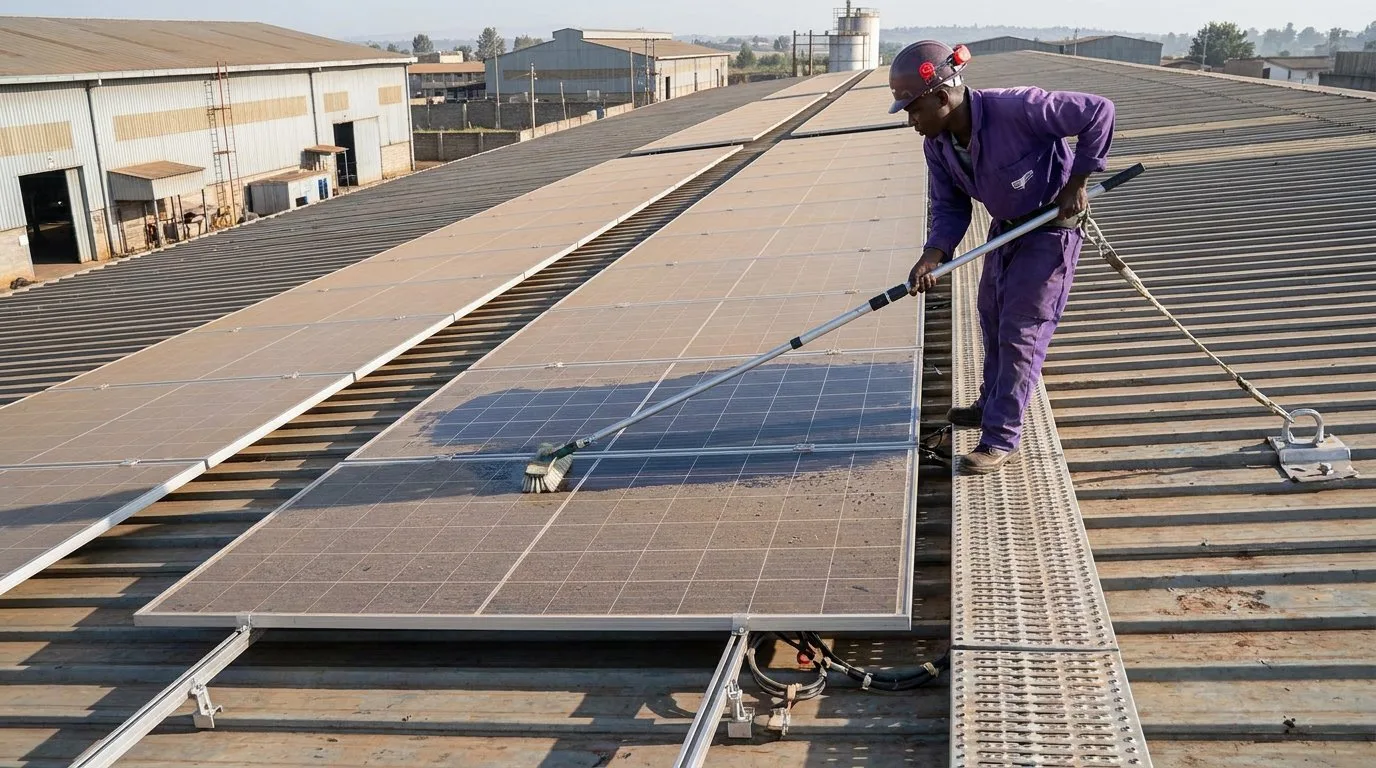
Solar maintenance is an operating requirement, not an afterthought. In dusty areas, regular panel cleaning can help limit dust-related output losses. For industrial solar solutions in Kenya, a maintenance plan should also track system performance and keep the installation operating as designed.
It makes sense to focus on upfront cost and expected savings, but performance over time matters just as much. This guide explains routine care for commercial solar systems, how to assess electricity savings and payback, and what to consider when a system produces excess power for the grid.
It also covers the decisions involved in planning an industrial solar system in Kenya, from system configuration to ongoing maintenance. The aim is to help plant managers and business leaders assess solar as part of their facility’s energy infrastructure.
Key Takeaways
- Build panel cleaning and performance monitoring into the maintenance plan, with cleaning frequency set by local dust exposure.
- For grid export, understand Kenya’s net-metering limits: the system must be under 1 MW, and exported units earn a 50% bill credit.
- Assess savings against your facility’s operating profile, using your own bills and load data rather than a headline payback figure.
- Match system design, configuration and ongoing care to your facility’s energy requirements.
Table of Contents
- Can I export excess solar power to the grid in Kenya?
- What maintenance do commercial solar systems require?
- Business electricity savings and payback
- Spenomatic Group: Commercial & Industrial Solar
Can I export excess solar power to the grid in Kenya?
Yes, as a bill credit rather than a cash sale. Kenya’s Energy (Net-Metering) Regulations, 2024 allow a commercial or industrial customer to export surplus renewable electricity and receive a bill credit of 50% of each exported unit. The system must be under 1 MW, no larger than the site’s maximum demand over the previous twelve months, and covered by a signed agreement with the distribution licensee.
Site Surveys and Grid Connection
A site survey establishes usable roof or ground area, shading, electrical infrastructure, and the facility’s demand profile. These findings inform the custom solar system design and whether grid connection suits the site. Map the connection point and existing distribution equipment, then plan approvals and connection requirements before installation, checking the net-metering size limits early.
Grid-Tied, Hybrid, and Off-Grid Options
Grid-tied systems operate alongside the utility supply, making them relevant when a facility wants to use solar energy and manage excess generation through an approved connection. Hybrid systems combine grid supply with battery storage, supporting continuity during grid interruptions. Off-grid systems operate independently and require storage planned around the facility’s load profile. Compare these options against operating hours, critical equipment, and export objectives.
Solar engineering and consulting translate site survey findings into component choices. Designers model the facility’s load, roof or ground layout, inverter capacity, protection equipment, and battery requirements where applicable. Industrial energy solutions in Africa must account for local site conditions. For example, an institutional facility with daytime demand may need a different configuration from a factory running evening shifts.
Grid reliability, theft, and weather can affect project performance in Kenya. Grid interruptions influence how much a grid-tied site relies on utility supply, while physical security planning helps protect panels, cables, and inverters. Weather and dust affect exposure and generation patterns, so include site conditions in both design and maintenance plans.
Use the site survey, load profile, connection point, and export objective as design inputs. Together, they help determine whether grid-tied, hybrid, or off-grid equipment best fits the facility.
What maintenance do commercial solar systems require?
Commercial solar maintenance includes cleaning, visual inspections, electrical checks, and performance monitoring. These tasks can identify soiling, loose connections, damaged cables, or inverter alerts before they disrupt generation. Record maintenance findings alongside system output so facility teams can distinguish equipment issues from changes in site demand.
In dusty areas, clean panels regularly to control soiling. Set the cleaning frequency according to local dust exposure and visible buildup, and use safe access procedures to protect staff and equipment. During each service visit, document panel condition and review inverter readings. Consistent records help maintenance teams identify recurring faults and track cleaning’s effects.
System capacity also shapes maintenance planning. A larger array means more modules and electrical connections to inspect, so teams should schedule checks around the installation layout, access routes, and critical operating periods.
Commissioning records and continued performance tracking matter on every project. Keep component details, fault reports, and maintenance actions together as one service history.
Commercial and industrial solar EPC services bring together engineering, procurement, installation, commissioning, and system care. After commissioning, assign responsibility for monitoring output, reviewing inverter alerts, cleaning panels, and documenting corrective work. Hybrid systems also need battery performance monitoring and a clear view of how storage works with solar generation and facility loads.
Residential maintenance routines may not translate directly to a factory roof or ground-mounted array. Site access, operating schedules, system capacity, and dust exposure shape the maintenance plan. For coordinated commercial solar system maintenance, align engineering records and service activities with the facility’s operating requirements.
Business electricity savings and payback
Solar savings depend on how closely generation matches a facility’s electricity demand. Compare daytime consumption, system output, and imported power to assess the financial effect.
Business Electricity Cost Savings
Solar generation offsets grid electricity most directly when business operations use power during daylight hours, so load timing has a direct effect on savings.
Start with electricity bills and interval consumption records. Identify daytime loads, such as production equipment, pumps, or cooling systems, and compare them with expected solar generation. Inverters convert panel output for facility use, while system sizing determines how much demand solar can serve. A tailored assessment should distinguish power consumed on site from generation the facility cannot use immediately.
Payback Periods
A payback estimate is a planning tool, not a substitute for project modelling. The calculation compares installation investment with the value of grid electricity displaced over time. Daytime operating schedules, electricity consumption, system capacity, and self-consumption all influence the result. If production shifts outside solar hours, the financial model should reflect that demand pattern.
Use a consistent method: establish the facility’s baseline electricity use, model solar generation against operating hours, and estimate bill reductions. Then compare projected savings with project costs, including ongoing system care in the financial assessment. This lets finance and engineering teams test different system sizes without assuming every unit generated offsets a unit of purchased power.
Spenomatic Group: Commercial & Industrial Solar
Spenomatic Group has 27+ years of engineering experience and has installed 278 MWp of solar PV across 150+ sites in Africa, with 53.22 MWh of battery storage deployed. It provides Commercial & Industrial Solar for businesses assessing generation against facility demand, grid connection, and operating schedules. Its Grid-Tied, Hybrid & Off-Grid Solar options support different supply configurations. Battery Energy Storage Systems can also be considered when storage is part of the system design.
Turn to Spenomatic Group when a commercial or industrial site needs an integrated solar project rather than a panel-only purchase. Project planning can align the system configuration with electricity use and whether the facility stays grid-connected, combines solar with storage, or operates off-grid. Home & Small Business Solar is also available for smaller sites.
Share your facility’s energy requirements and discuss an industrial solar system with Spenomatic Group.
Turn energy priorities into a defined project
Planning industrial solar solutions in Kenya starts with turning the facility’s energy priorities into a clear project brief. Bring operations, facilities, finance, and electrical teams together, then document critical loads, operating schedules, and current supply constraints. This gives design discussions a practical basis grounded in how the site runs.
Record site limitations, preferred system configuration, expansion plans, and decision criteria in one working document. Identify which equipment needs continuity, when the facility uses the most power, and how solar should fit with existing infrastructure. A shared brief helps technical and finance teams assess the same requirements instead of working from separate assumptions.
Use the brief to structure the next engineering conversation and identify the information needed to progress from initial assessment into project planning. Spenomatic Group can discuss the facility’s requirements and the solar configuration under consideration. Set out your priorities and contact Spenomatic Group to start the conversation. A well-defined scope gives your team a clear foundation for moving forward.
Frequently Asked Questions
What is the cost of installing solar in Nairobi?
The cost of installing solar in Nairobi depends on system capacity, site conditions, equipment selection, grid connection requirements, and whether battery storage is included. Commercial installations also vary according to operating schedules and the facility’s electrical infrastructure. The project price depends on its design and equipment requirements and is provided after a quote request.
What industrial solar solutions are available in Kenya for factories and warehouses?
Factories and warehouses in Kenya can use grid-tied, hybrid, or off-grid solar configurations, with battery energy storage included where the design calls for it. Grid-tied systems work alongside utility supply, while hybrid systems combine solar, grid connection, and storage. Off-grid systems operate independently. Commercial and industrial solar options are available in Nairobi, Kiambu, Mombasa, Kisumu, Nakuru, Thika, Naivasha, Machakos, and Kericho.
How much does a commercial or industrial solar system cost per kW in Kenya?
There is no single per-kW price for every commercial or industrial solar project in Kenya. Capacity is only one cost factor; the design also accounts for mounting conditions, electrical integration, grid connection, and battery storage where required. A project quote depends on the site and specified system scope.
What is the typical payback period and ROI for industrial solar in Kenya?
Payback and ROI depend on how much solar generation the facility uses directly, its electricity consumption pattern, and the project’s total costs. For a useful model, compare expected generation with operating hours, then estimate the value of grid electricity displaced. Include system care and battery requirements in the financial assessment.
What are Kenya's regulations and permits for commercial solar installations?
Project planning must account for the system configuration, grid connection, and applicable approvals. For grid export, the Energy (Net-Metering) Regulations, 2024 require a system under 1 MW, no larger than the site’s maximum demand over the previous twelve months, with a signed agreement with the distribution licensee. Confirm the intended export arrangement and system scale early, then include the relevant approval steps in the project schedule.