
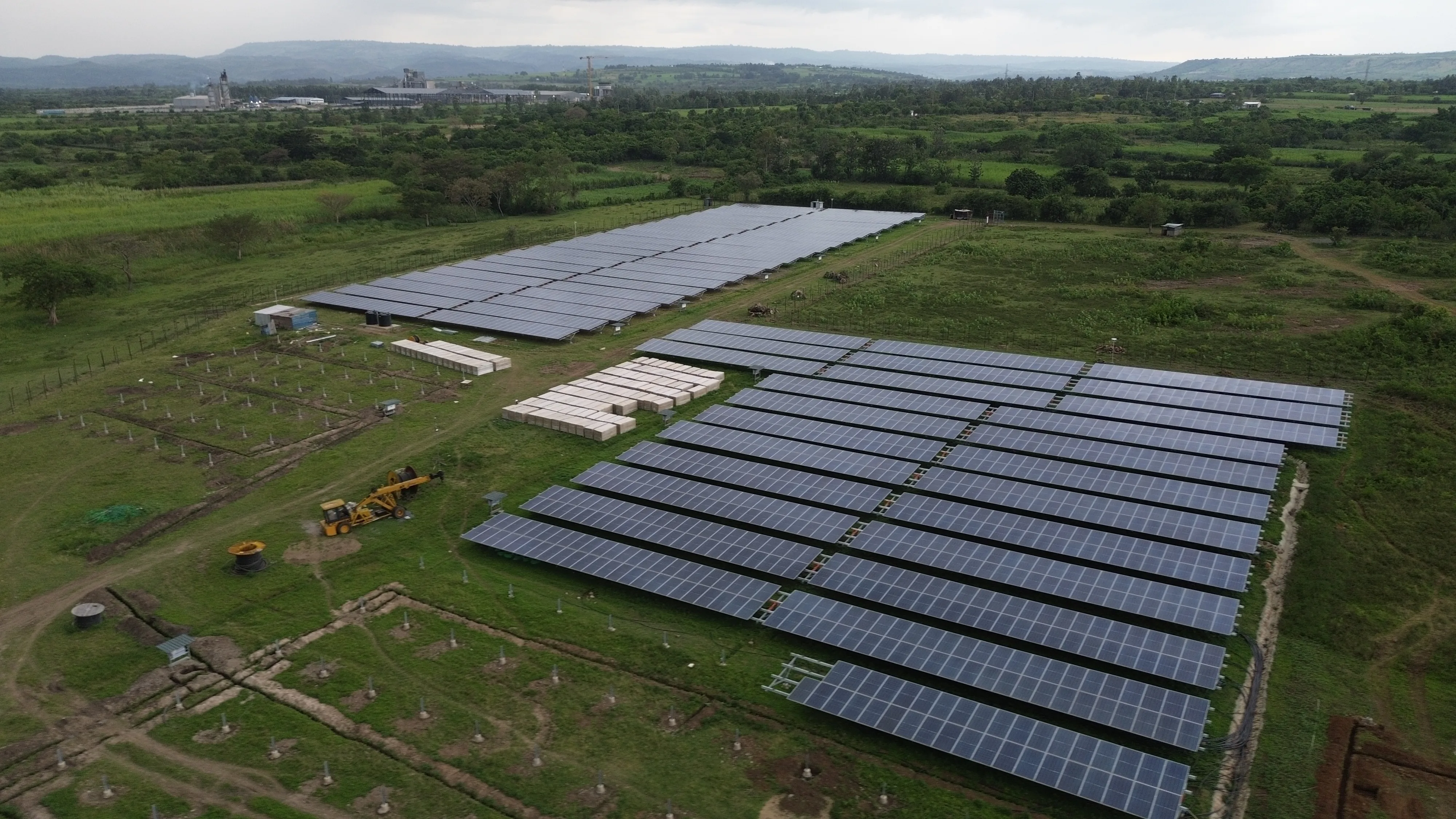
Off-grid solar is a practical way to supply electricity where a site needs to operate independently of the national grid: off-grid solar systems in Kenya can serve individual homes, businesses and community facilities, while the World Bank’s Kenya Off-Grid Solar Access Project targets 14 counties for solar electrification of households, enterprises, community facilities and water pumps. That independence depends on engineering the system around actual electrical load, daytime electricity use, essential equipment and the hours of stored power required, not panel capacity alone; site conditions and demand patterns also shape the role of battery storage. This article explains how residential systems differ from installations for firms and shared facilities, the design and operating challenges to account for, and how system planning, storage and maintenance can support energy independence across Kenya.
TL;DR: Off-grid solar can supply Kenyan homes, businesses and community facilities when generation, storage and operating demand are designed to work together. Site conditions, maintenance planning and the choice between standalone and hybrid configurations all affect performance.
Key Takeaways
- Match system design to the site’s purpose, electrical load and required hours of service, whether it serves a home, business or shared facility.
- Account for battery storage, equipment performance and maintenance needs when planning for reliable operation beyond sunlight hours.
- Assess how solar generation aligns with your daily demand to understand where it can reduce reliance on other energy sources.
- Compare standalone systems, mini-grids and regional project approaches to identify the configuration that best fits your site and community.
Solar electrification for households, enterprises and community facilities
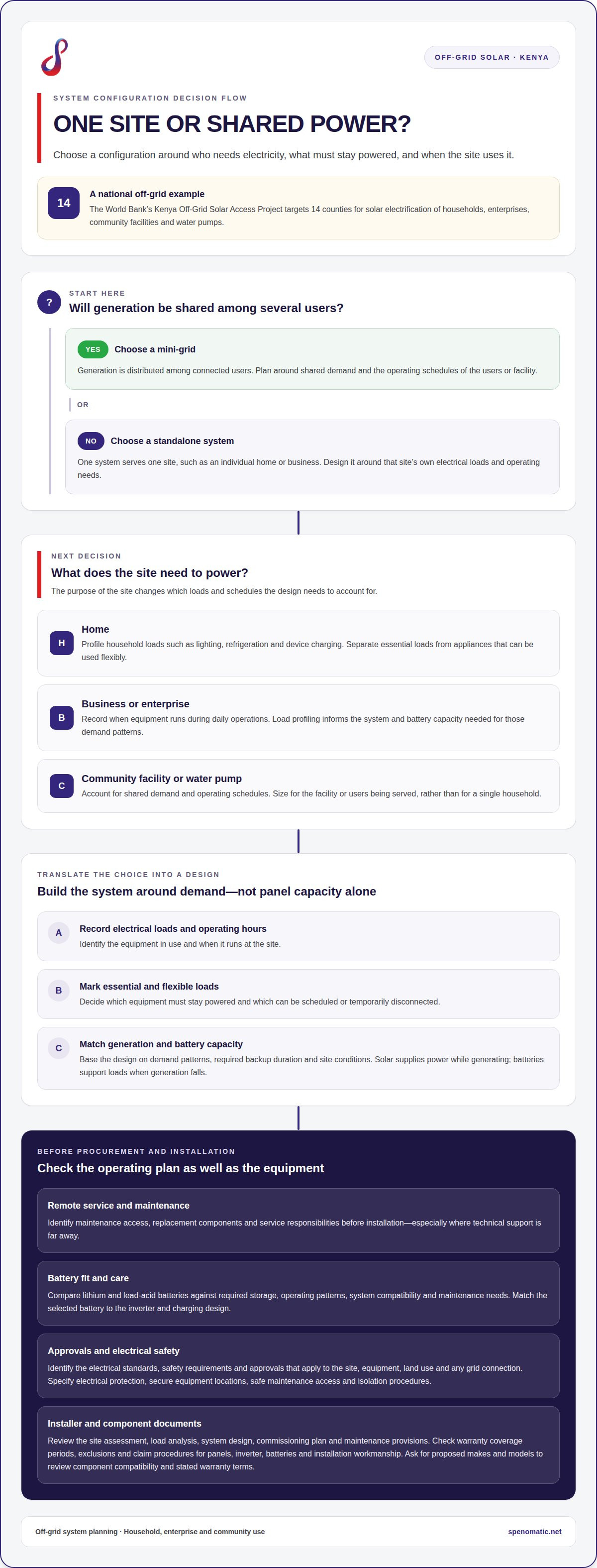
According to the World Bank, Kenya's Off-Grid Solar Access Project (KOSAP) targets 14 counties to support solar electrification of households, enterprises, community facilities and water pumps. The project illustrates how off-grid solar systems in Kenya can serve individual sites and shared services with distinct operating requirements.
Options include standalone systems for individual homes, larger systems for businesses and facilities, and mini-grids that distribute electricity among connected users. A standalone system serves one site; a mini-grid shares generation across several users. For off-grid solar systems in Kenya, the right configuration depends on who needs electricity and how demand is spread across the site or community.
To size a home system, a solar professional records electrical loads, operating hours and the equipment that must stay powered. The design matches generation and battery capacity to those demand patterns, the required backup duration and site conditions. This separates essential loads from appliances that can be used flexibly.
Home example: A household needs lighting, refrigeration and device charging. A professional profiles these loads and designs generation and storage around when they are used. Enterprise example: A rural business needs power for daily operations. Load profiling shows when equipment runs and informs system and battery capacity. Community example: A facility or water pump serves multiple users. The design accounts for shared demand and operating schedules, rather than sizing the system for one household.
Assess an installer by its site assessment, load analysis, system design, commissioning plan and maintenance provisions. Review warranty documents for the panels, inverter, batteries and installation workmanship, including coverage periods, exclusions and claim procedures. These documents show what protection applies to each component.
Panel, inverter and battery brands depend on the system design and procurement. Ask for an engineering schedule that identifies the proposed makes and models, so you can review component compatibility and the stated warranty terms.
For a home or small business, a home and small business solar system can be designed around the site's electrical loads, operating needs and required battery storage.
Challenges facing the off-grid solar sector
Remote sites can be difficult to service. A household might depend on solar-powered refrigeration while technical support is far away. A sound project plan identifies maintenance access, replacement components and service responsibilities before installation. Planning ahead can help prevent a minor fault from interrupting essential loads.
Battery selection creates another design challenge. A solar professional compares lithium and lead-acid batteries against required storage, operating patterns, system compatibility and maintenance needs. The selected battery must match the inverter and charging design; battery energy storage systems also need clear operating and maintenance arrangements.
Approvals and standards in Kenya require a project-specific assessment. Before procurement, the installer should identify the electrical standards, safety requirements and approvals that apply to the site, equipment, land use and any grid connection. Operating off-grid does not remove the need for safe installation or applicable approvals.
Example: A small enterprise depends on stored power after sunset. Without a plan for battery operation and maintenance, declining performance can affect evening service. The project team can assess operating conditions, set inspection procedures and plan replacement in line with the specified warranty and system design. Replacement needs vary with battery type, usage, warranty terms and required capacity; no single replacement figure applies to every installation.
Safety risks include electrical faults, damaged cables and uncontrolled access to equipment. The installation plan should specify electrical protection, secure equipment locations, safe maintenance access and clear isolation procedures. Routine inspections can help identify visible damage or changes in operation before they disrupt service.
Assess financing separately from system design. Grants, pay-as-you-go arrangements and credit are financing options to evaluate; compare eligibility, repayment terms and responsibilities with the project’s expected demand. Households and businesses should consider financing alongside the equipment and service plan, not as a substitute for technical design.
Energy independence and system operation
For an off-grid site, energy independence means managing how electricity is generated, stored and allocated to equipment. Solar panels supply power while generating, and batteries support loads when generation falls. This reduces dependence on a grid connection, but continuity still depends on system design and operation. Clear priorities help keep essential functions supplied as demand and weather conditions change.
Start operational planning by identifying which equipment must run continuously, which loads can be scheduled and which can be temporarily disconnected. The facility can then set a priority order for essential circuits. For example, a rural clinic may prioritise refrigeration for temperature-sensitive supplies and lighting for evening operations, while scheduling flexible equipment during solar production hours.
Storage management is central to reliable operation. Battery cycling refers to charging and discharging during use. Operating procedures should reflect the battery’s designed limits, state of charge and connected loads. Monitoring these conditions helps operators spot unusual demand, adjust equipment schedules and reserve power for critical functions.
Small-business example: A shop needs refrigeration overnight and lighting after sunset. The operating team separates essential circuits from flexible loads and schedules suitable tasks during solar production hours. This creates a clear operating plan, directing stored electricity to the equipment that matters most.
For an enterprise, energy independence also requires change control. Adding machinery, extending operating hours or introducing new processes can change the electrical load. The operations team should record these changes and review the system configuration against revised demand. Safe maintenance access and routine inspections also support continuity by helping staff identify issues before they interrupt priority services.
Track generation, battery state and load behaviour to understand system performance. Compare records across seasons and note when critical loads draw on storage. This evidence can help refine schedules and identify ways to use available solar generation more effectively without compromising essential operations.
Off-grid solar systems in East Africa
Across East Africa, the choice between standalone, hybrid and mini-grid systems depends on grid access and how electricity demand is distributed. In Nairobi, Thika, Kiambu, Nakuru, Athi River, Naivasha, Machakos, Kisumu and Mombasa, projects still require site-specific assessments; a regional estimate cannot determine the output of an individual site.
Off-grid systems operate independently of the grid, while hybrid systems combine solar and storage with a grid connection. Mini-grids distribute power among connected users and can serve a few hundred people. Compare how each configuration operates before making a choice:
| Configuration | Supply arrangement | Planning priority | Typical application |
|---|---|---|---|
| Standalone off-grid | Solar and storage supply the site without grid reliance | Match generation and storage to essential demand | Individual home or remote facility |
| Solar-and-grid hybrid | Solar, batteries and grid supply operate together | Define priority loads and source-control requirements | Site with a grid connection and backup needs |
| Mini-grid | Generation is shared across connected users | Coordinate demand, distribution and operating responsibilities | Community serving multiple users |
Kenya planning example: A facility in Naivasha needs an independent supply. The project team assesses site conditions and operating demand, then models generation and storage. The resulting design applies to that facility, not to every location.
Hybrid example: A business in Kisumu has grid access but needs additional on-site supply. The team identifies critical loads and models how solar, storage and grid electricity work together. The system retains the grid connection while adding solar generation.
Output varies across Kenya’s regions and seasons with site conditions, installed capacity, shading and system losses. Professionals estimate generation by modelling those factors against the facility’s load profile, then size storage for required operating periods. Apply the same assessment process in each location, including Nairobi, Mombasa and other listed towns, rather than assuming one site represents another. A solar PV assessment helps compare configurations before design is finalised.
Spenomatic Group: Grid-Tied, Hybrid & Off-Grid Solar
Spenomatic Group provides Grid-Tied, Hybrid & Off-Grid Solar for homes, small businesses, and commercial and industrial sites. Turn to its team when you need a configuration matched to site conditions, electrical demand and the level of grid independence required.
For a home or small business, system planning can match solar generation and battery storage to essential loads and operating hours. Commercial and industrial projects need assessment of production demand, equipment schedules and continuity requirements. Battery Energy Storage Systems can be included when stored electricity forms part of the operating plan.
Whether your site needs standalone supply or a grid-connected system, begin with a project discussion about your location, loads and operating priorities. Contact Spenomatic Group to discuss your solar requirements.
Set your solar project up for the next stage
Turn your energy priorities into a project brief to guide engineering decisions. Identify the site’s purpose, the equipment that must remain powered and how operations may change over time. These details help shape a suitable configuration and clarify performance requirements for design and commissioning.
For off-grid solar systems in Kenya, Spenomatic Group provides Grid-Tied, Hybrid & Off-Grid Solar, including Home & Small Business Solar and Commercial & Industrial Solar. Its engineering team can frame the project around your operating requirements and the role of battery storage, rather than treating equipment selection as a stand-alone decision.
Bring your site requirements and energy priorities into a focused project discussion. Contact Spenomatic Group to discuss solar and take the next step toward a system designed for your operation.
Frequently Asked Questions
Why Choose an Off-Grid Solar System in Kenya?
Choose an off-grid system when your site needs electricity without relying on a grid connection. It may suit a remote home, farm or community facility where grid access is unavailable or does not meet operational needs. A practical design also prioritises essential circuits, such as communications, security lighting or refrigeration, so stored electricity serves critical functions first.
What are the best lithium and lead-acid batteries for off-grid solar in Kenya?
There is no single best option. Compare lithium and lead-acid batteries against required storage, operating patterns, system compatibility and maintenance needs. The battery must be compatible with the inverter and charging design.
What system size and battery capacity are needed for a Kenyan home?
A professional should record the home’s electrical loads, operating hours, essential equipment and required backup duration. Generation and battery capacity can then be sized to those needs and the site conditions.
How much electricity can an off-grid solar system generate across Kenya’s regions and seasons?
Daily sun hours in Kenya reach 5 hours, including during the rainy season, but actual system output requires a site-specific assessment.