
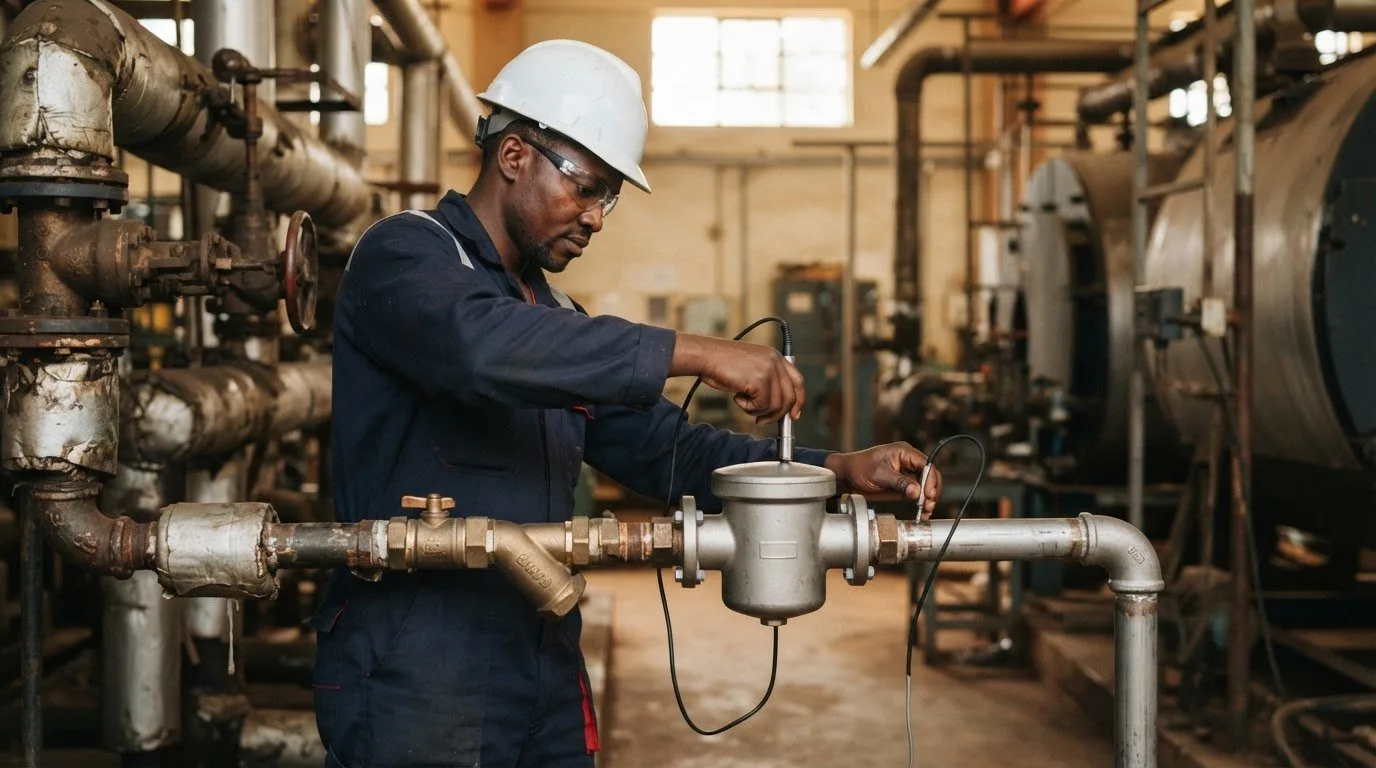
A failed-open thermodynamic steam trap can pass live steam into the condensate return; a failed-closed trap can restrict condensate removal and impair heating. Assessing thermodynamic steam trap failure signs and testing means combining operating observations with temperature and acoustic checks, interpreted in light of trap type and system conditions.
TL;DR: Identify the likely failure mode, assess it using suitable tests, and use the findings to guide maintenance.
| Failure condition | Inspection focus |
|---|---|
| Open | Steam passage into the return |
| Closed | Condensate removal and affected equipment |
Key Takeaways
- Track changes in boiler fuel use, heating performance and condensate return behaviour as potential signs of trap losses.
- Interpret visual observations in context: flash steam and intermittent discharge can make a healthy trap appear faulty.
- Distinguish open failures, which waste live steam, from closed or restricted failures, which allow condensate to back up.
- Combine temperature and acoustic checks with trap type, operating pressure and system conditions to support a reliable diagnosis.
What happens when a steam trap fails?
An open steam trap can pass live steam into the return, while a closed trap can hold condensate upstream. Either fault can reduce heating performance and affect the energy needed to maintain production.
Steam Loss and Operational Impact
A failed-open trap sends usable steam into the return rather than to process equipment. Across a plant with many traps, individual faults can be hard to identify without reviewing the system as a whole.
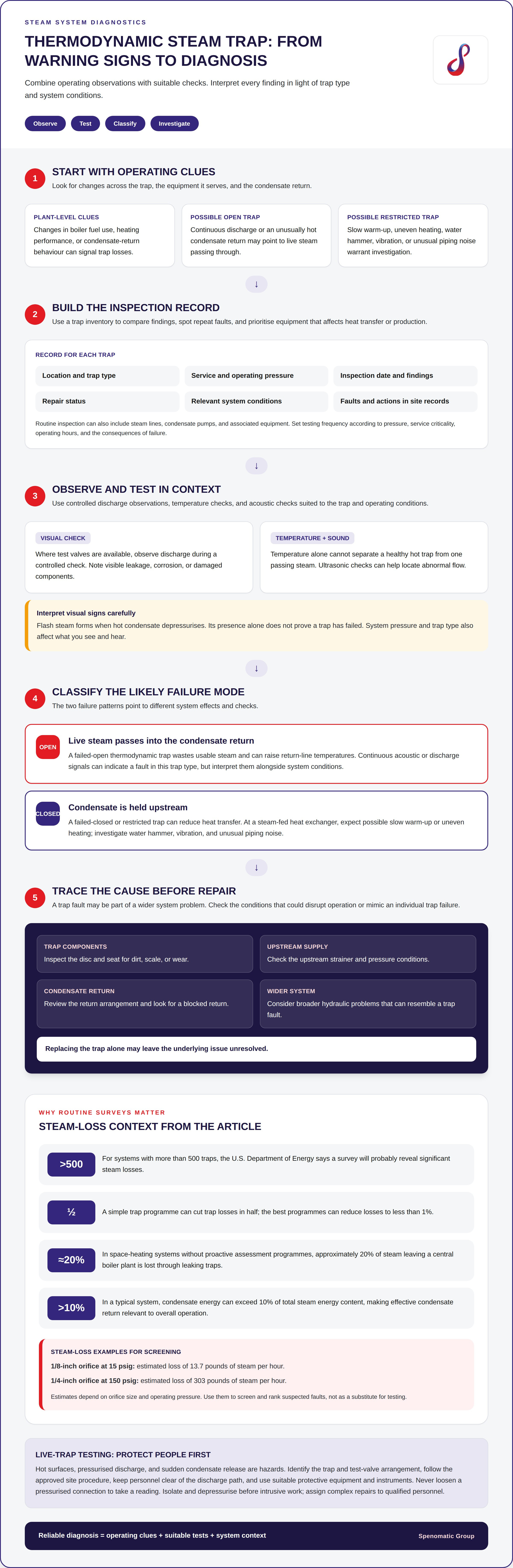
For systems with more than 500 traps, the U.S. Department of Energy says a survey will probably reveal significant steam losses. A simple trap programme can cut trap losses in half, while the best programmes can reduce losses to less than 1%. These estimates show why routine attention matters to plant operation.
Estimating Steam Loss
Steam-loss estimates depend on the trap opening and operating pressure. A stuck-open trap with a 1/8-inch orifice at 15 psig loses 13.7 pounds of steam per hour. With a 1/4-inch orifice at 150 psig, the estimated loss is 303 pounds per hour.
These examples illustrate why pressure and orifice size help maintenance teams rank suspected faults. Actual discharge depends on operating conditions, so use estimates as a screening tool, not as a substitute for testing. In space-heating systems without proactive assessment programmes, approximately 20% of steam leaving a central boiler plant is lost through leaking traps.
Prevent live-steam loss by identifying blow-through traps and arranging repair or replacement of confirmed faulty units. A system-wide survey gives maintenance teams a baseline for prioritising work and reviewing subsequent findings. Condensate also carries recoverable energy; in a typical system, its energy can exceed 10% of total steam energy content. Returning condensate effectively supports overall operation.
How does steam trap inspection work?
Inspection combines visual checks, operating records, and test results to assess trap performance. For industrial teams in Nairobi, Thika, Kiambu, Nakuru, Athi River, Naivasha, Machakos, Kisumu, and Mombasa, document findings against each facility’s system conditions.
Visual Checks with Test Valves
Visual inspection can use test valves and discharge observations to assess whether a trap releases condensate as expected. During a controlled check, observe the discharge and note visible leakage, corrosion, or damaged components. Flash steam forms when hot condensate depressurises, so its presence alone does not prove the trap has failed. Interpret observations in relation to trap type and operating conditions before arranging repairs.
Regular Inspection Programmes
A regular inspection programme records each trap’s location, type, service, pressure, inspection date, findings, and repair status. This inventory helps teams spot repeat faults and prioritise equipment affecting heat transfer or production. The U.S. Department of Energy recommends including traps, steam lines, condensate pumps, and associated equipment in routine inspections. Set testing frequency according to pressure, service criticality, operating hours, and the consequences of failure.
Applicable Inspection Standards and Regulations
In Kenya, plan inspections around applicable workplace-safety and plant requirements, the installation’s design, and manufacturer instructions. Requirements depend on the system and its operating conditions, so document the basis for each inspection interval. Keep findings, identified faults, and repair actions together in the site maintenance record. This creates a traceable history for facilities in Nairobi, Thika, Kiambu, Nakuru, Athi River, Naivasha, Machakos, Kisumu, and Mombasa.
Safety Precautions for Live-Trap Testing
Testing a live trap involves hazards from hot surfaces, pressurised discharge, and sudden condensate release. Before testing, identify the trap and test-valve arrangement, follow the approved site procedure, and keep personnel clear of the discharge path. Use suitable protective equipment and instruments. Never loosen a pressurised connection to take a reading. Isolate and depressurise equipment before intrusive work, and assign complex repairs to qualified personnel.
Open and closed steam trap failures
A failed-open thermodynamic trap passes live steam into the condensate return, wasting energy and raising return-line temperatures. A failed-closed or restricted trap holds condensate upstream, reducing heat transfer at equipment such as a heat exchanger. These failure modes demand different checks and corrective actions.
Thermodynamic disc traps operate through changes in flow and pressure: condensate lifts the disc, then accelerating steam creates a low-pressure zone that snaps it shut. Dirt, scale, disc or seat wear, and operating conditions that disrupt this cycle can cause malfunction. Regular inspection and maintenance help identify developing faults before they interrupt production.
An open trap may discharge continuously or make the condensate return unusually hot. However, temperature alone cannot distinguish a healthy hot trap from one passing steam. Flash steam and system pressure also affect what you observe. Use a diagnostic method suited to the trap type and operating conditions rather than treating a single hot reading as proof of failure.
A closed or capacity-limited trap can cause condensate to collect upstream. At a steam-fed heat exchanger, this may slow warm-up or cause uneven heating. Water hammer, vibration, or unusual piping noise are other signs to investigate. Water hammer occurs when liquid slugs accelerate between steam packets, and the resulting impacts can damage system equipment.
To reduce repeat failures, match the inspection method to the trap’s operating conditions and investigate the cause before replacing components. Check the disc, seat, upstream strainer, pressure conditions, and condensate-return arrangement as part of the diagnosis. A blocked return or broader hydraulic problem can resemble an individual trap fault. Replacing the trap alone may leave the underlying issue unresolved.
For thermodynamic traps, interpret continuous acoustic or discharge signals in context: continuous sound can indicate a fault in this trap type. Ultrasonic checks can help locate abnormal flow, though nearby valves or equipment can affect the signal. Compare findings with expected trap behaviour and actual operating pressure before planning a repair or replacement.
Steam trap testing and failure detection
Reliable detection combines operating observations with temperature and acoustic checks. A practical assessment of thermodynamic steam trap failure signs and testing interprets each result in relation to trap type, steam pressure, and expected discharge behaviour.
Test a trap in operation only under the site’s approved procedure, using suitable protective equipment and a safe position clear of hot discharge. Don’t loosen pressurised fittings or expose yourself to steam. Isolate and depressurise equipment before intrusive inspection.
Observe cycling first. A healthy thermodynamic trap typically discharges 3-10 times per minute; cycling more than 30-40 times per minute may indicate blow-through. A continuous acoustic signal can also indicate a thermodynamic trap fault, although the same signal may be normal for other steam trap types.
For an ultrasonic check, use a suitable contact point and interpret the reading in context. Hold the contact probe for 5-10 seconds and compare the signal with the trap’s expected operating pattern. Nearby valves and mechanical equipment can add background noise, while sound can carry through dense manifolds from another failed trap. Check neighbouring units before assigning the signal to one trap.
Temperature readings provide context, not a verdict. A healthy trap and one passing steam can both be hot, while flash steam, backpressure, insulation, and intermittent discharge can affect readings. Compare inlet and outlet conditions with actual operating pressure and trap type; don’t diagnose from temperature alone.
Record results alongside condensate-return conditions and relevant boiler or blowdown activity. This helps distinguish a trap fault from a wider return-line or control issue. Water hammer, unexpected heat at a receiver, or changes in discharge warrant follow-up, but none confirms failure on its own. Use thermodynamic steam trap failure signs and testing results together before planning corrective work.
For an integrated review of steam-system operation and associated equipment, review your steam system requirements.
Spenomatic Group
Spenomatic Group can support a review of wider site energy requirements when steam-trap findings prompt broader planning. Its Commercial & Industrial Solar and Battery Energy Storage Systems support energy planning for industrial facilities in Kenya. These solutions do not repair failed traps or replace a steam-system inspection, so address confirmed trap faults through your maintenance process first.
Consider Spenomatic Group when assessing how on-site generation or storage could fit your facility’s electrical demand alongside steam-system improvements. Project requirements depend on your operating profile and energy objectives. Contact Spenomatic Group to discuss your site’s wider energy needs.
Turn Inspection Findings Into Ongoing Action
A consistent approach to thermodynamic steam trap failure signs and testing supports better maintenance decisions when findings are recorded and followed up. Use inspection records to identify recurring equipment issues, set repair priorities, and inform future maintenance planning. This gives your team a clearer basis for coordinating steam-system work with wider operational priorities.
Once steam maintenance priorities are clear, consider how site energy planning fits alongside them. Spenomatic Group offers Commercial & Industrial Solar, Home & Small Business Solar, and Grid-Tied, Hybrid & Off-Grid Solar. These solutions support energy planning, while trap inspection and repair remain part of steam-system maintenance.
Take the next step by aligning maintenance records with your facility’s operational objectives. Contact Spenomatic Group to discuss your energy requirements and planned projects.
Frequently Asked Questions
What does a steam trap survey involve, and what can it find?
A steam trap survey maps trap locations and operating conditions, then records test results and faults for maintenance planning. It can reveal patterns such as repeated failures in one service area, traps that are difficult to access, or discharge problems affecting several stations. Comparing results across the system helps your team distinguish isolated equipment faults from recurring operating or installation issues.
When should you repair, replace or repipe a trap station?
Repair a trap when inspection identifies a fault in a serviceable component and the station remains suitable for its operating conditions. Replace it when damage or repeated malfunction makes repair ineffective. Repipe the station if its layout prevents safe access, proper isolation, or effective condensate drainage. Before deciding, assess the trap, valves, strainer, piping, and downstream return arrangement as one assembly.
Which signs should your team investigate?
Investigate unexplained increases in boiler makeup water, slower equipment warm-up, uneven process heating, or unexpected heat at condensate receivers. These changes can point to steam loss, condensate backup, or a wider system issue. Compare observations with production demand and operating records. If conditions change while process requirements remain the same, the affected steam circuit warrants inspection.
How does a thermodynamic steam trap work?
A thermodynamic trap uses a disc and changing pressure conditions to discharge condensate while retaining steam. Incoming condensate lifts the disc from its seat; as steam accelerates beneath it, the pressure above the disc falls and the disc closes. It remains shut until pressure conditions change. This cycle explains why testing must account for the timing of discharge.
What are common signs of a failed thermodynamic steam trap?
Look for persistent steam entering the return, a discharge pattern that differs from the trap’s expected cycle, or poor heating at connected equipment. A trap that stays closed can prevent effective condensate removal, while one that passes steam can heat the return line unexpectedly. A combination of operating changes is stronger evidence than a single observation.
How can you tell if a thermodynamic steam trap has failed open or closed?
A failed-open trap commonly passes steam toward the condensate return, while a failed-closed trap restricts condensate discharge and can leave upstream equipment waterlogged. Compare outlet behaviour with the process symptom: excess downstream heat can suggest steam passage, while poor upstream heat transfer can suggest condensate backup. Confirm the diagnosis with suitable tests and system conditions before choosing corrective work.