
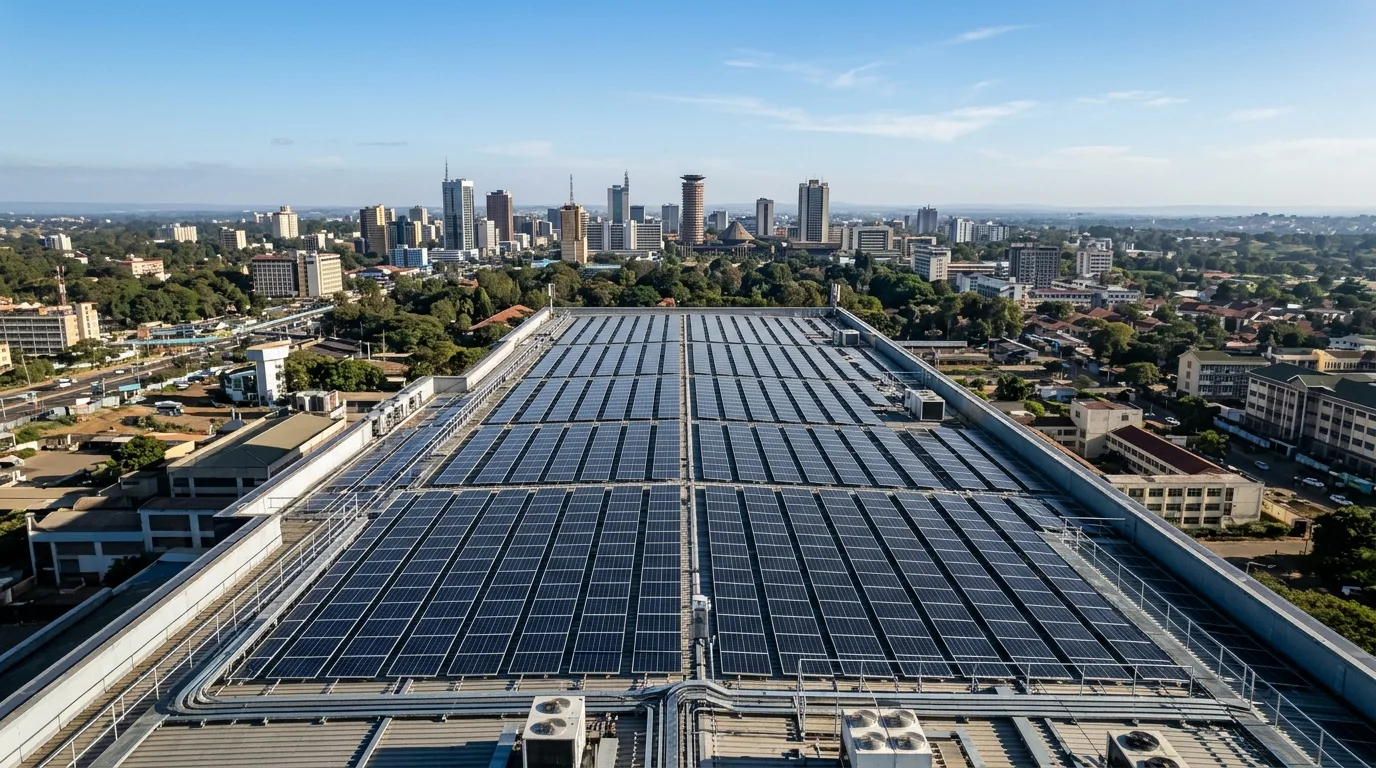
Solar installation in Kenya has moved from a sustainability talking point to a line in the factory budget. The first question most finance directors ask is a blunt one: what does a 100 kW system cost, and how long before it pays for itself? This guide answers that for businesses weighing a solar installation in Nairobi or elsewhere in the country. It uses market ranges where they exist and says plainly where only a site assessment can give you a number.
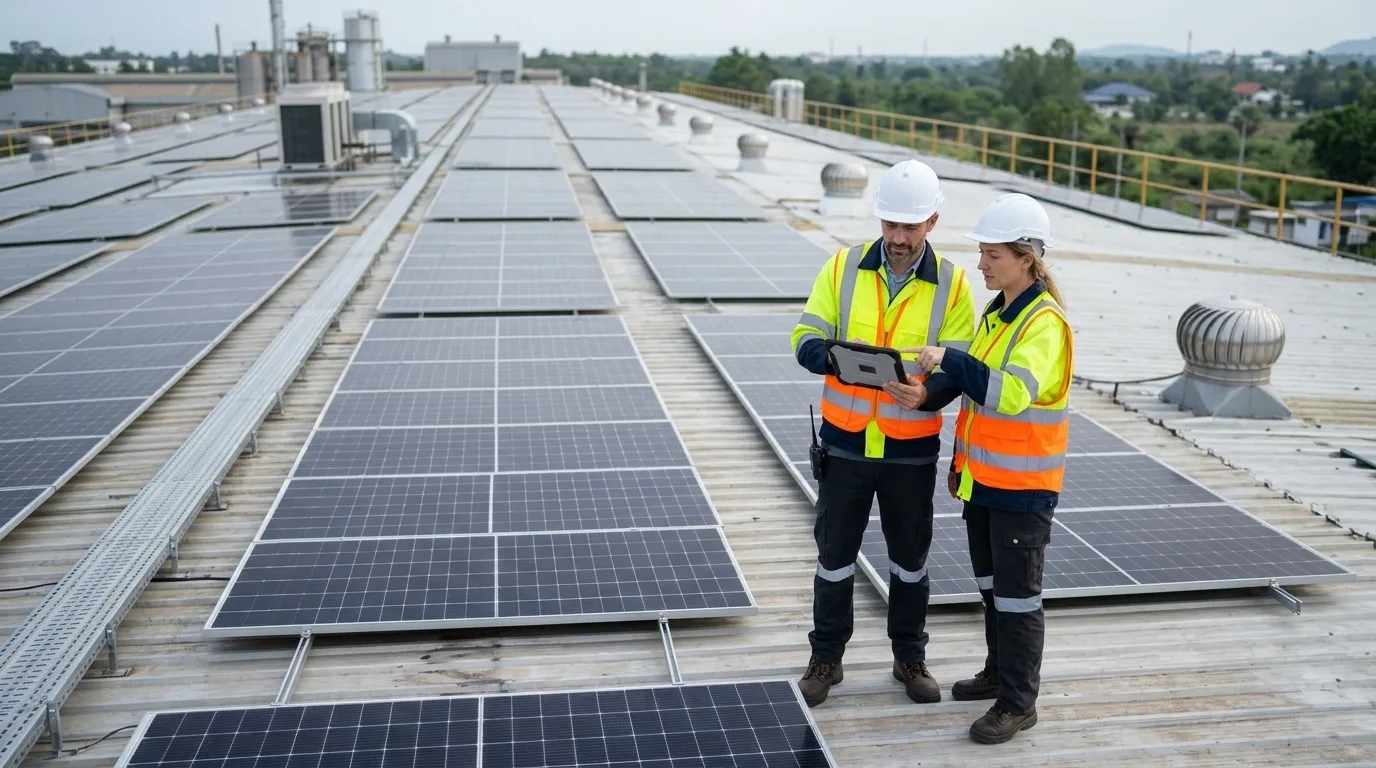
What a 100 kW solar system looks like on site
A 100 kW system, more precisely about 100 kWp of panels, is a mid-sized commercial installation. With 550 W modules that is roughly 180 panels, and on a typical flat or low-pitch roof it needs somewhere between 500 and 700 square metres of usable space once you allow for spacing, walkways and shading. In Kenya's sun, a well-designed system of this size will often produce in the region of 140,000 to 160,000 kWh a year, although the real figure depends on orientation, shading, dust and inverter losses. Treat those numbers as a first filter, not a design.
It suits businesses with steady daytime demand: a mid-sized factory, a cold store, a school, a hotel laundry, a supermarket. A site that shuts at five and uses most of its power while the sun is up gets far more from the same panels than one that runs its heaviest loads at night.
How much does a 100 kW solar system cost in Kenya?
Published installer guides put grid-tied commercial solar at roughly KSh 80 to 100 per installed watt, which puts a 100 kW system at about KSh 8 million to KSh 10 million. That covers panels, inverters, mounting, cabling and installation for a conventional grid-tied design. It is a market range from third-party sources, not a Spenomatic quotation, and it moves with module prices, exchange rates and how awkward your roof is.
Add batteries and the price rises sharply, because storage is sized separately from the panels. Add a zero-export controller, a new distribution board or a roof repair and the total shifts again. The table below shows how the main configurations differ, so you can see what a headline price is and is not buying.
| Configuration | What it includes | How the cost behaves | Best suited to |
|---|---|---|---|
| Grid-tied, no storage | Panels, inverters, mounting, cabling, monitoring | Lowest cost per watt, in line with the KSh 80 to 100 range above | Daytime-heavy loads that use most of the output directly |
| Grid-tied with export control | As above, plus a controller that limits or blocks export | A modest addition to the base price | Sites that cannot or prefer not to export to the grid |
| Hybrid with batteries | Adds batteries, hybrid inverters and extra protection | Storage adds a large block of cost, sized to the load and outage pattern | Sites with frequent outages or evening demand |
| Financed or Energy-as-a-Service | The same plant, paid for through a PPA, lease or financed EPC | Little or no upfront payment, paid over time | Businesses that would rather keep capital for production |
What moves the price up or down
Two quotes for "100 kW" can differ by millions of shillings and both be honest, because the headline capacity hides most of the variables. These are the ones that matter most:
- Roof type and condition. Metal sheeting, concrete slabs and ground-mounted arrays each need different mounting, and an old roof may need repair first.
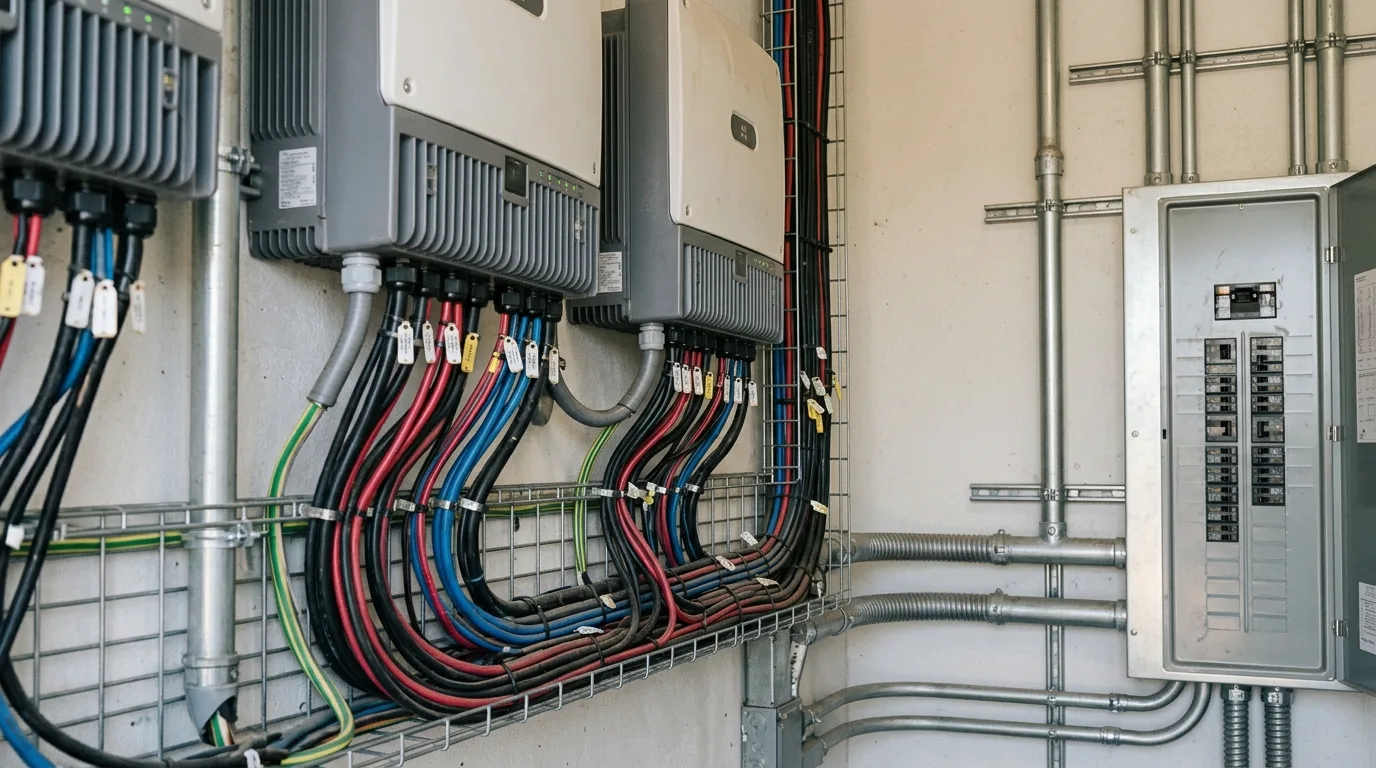
- Distance between the array, the inverters and the main board. Longer cable runs cost more in copper and labour.
- Electrical upgrades. A full distribution board, protection upgrades or a transformer change can add a lot.
- Equipment tier and warranty terms for modules and inverters.
- Scope. Monitoring, operations and maintenance, and any financing arrangement are sometimes in the price and sometimes not.
Solar installation in Nairobi: what is different in the city
Nairobi gets the same strong sun as the rest of the central highlands, but a city site brings its own questions. Many commercial buildings are leased, so the first conversation is with the landlord about roof rights and structural loading. Roofs tend to be crowded with tanks, ducts and aerials that cast shade. And grid connection runs through Kenya Power, which sets the terms for exporting.
Those terms are worth reading before you size anything. Under the Energy (Net-Metering) Regulations, 2024, a commercial system must stay under 1 MW and is capped at your recorded maximum demand, and each exported unit earns only a 50% credit. A 100 kW system sits comfortably inside that limit, but the half-rate credit means it should be sized for on-site use rather than export. Our guide to net metering in Kenya for commercial solar walks through the application steps.
Spenomatic has delivered rooftop solar in the city, and the award-winning rooftop installation at Sarit Centre is one example. The company also runs a solar interactive centre at Sarit where you can simulate sizing and performance before you commit. For an overview of what the team offers locally, see Spenomatic's Kenya solar page.
Payback: a worked example, with caveats
Suppose a 100 kW system costs KSh 9 million and produces 150,000 kWh a year. If the business uses 80% of that on site, and each kWh it avoids buying costs KSh 18, the yearly saving is 150,000 × 0.8 × 18, which is KSh 2.16 million. That is a simple payback of a little over four years.
Every input there is hypothetical. Use your own tariff and load data, and remember the sum ignores panel degradation, maintenance, inverter replacement and future tariff changes. What it does show is what drives the result: how much of the output you use yourself, and the tariff you actually pay. A site with weak daytime demand will see a longer payback from the same panels.
How to compare solar proposals
A cheaper quote is not automatically a better one. Before you compare totals, put the same questions to every supplier. Spenomatic's checklist for evaluating a commercial solar proposal covers the detail, and these are the questions that tend to separate proposals fastest:
- What yield does the proposal assume, and what is it based on?
- How much of the output is expected to be used on site?
- What is excluded: roof repairs, board upgrades, net-metering fees, monitoring?
- Which module and inverter brands are specified, and what are the warranties?
- Who handles the grid application and the required licensing?
- What does the maintenance offer cover, and for how long?
Do you need batteries?
Not necessarily. If your loads run mainly in daylight, direct use of the solar output may already deliver most of the benefit. Batteries earn their place where outages are costly, where evening demand is high or where you want to cut peak demand. They should solve a defined problem, not be added because they are available. Our guide to commercial battery energy storage in Kenya explains how storage is sized and what drives its cost.
Getting a real number for your site
A figure you can budget against comes from your own data. Send twelve months of electricity bills, your operating hours, the site location, and whatever you have on the roof, such as drawings, age and material. Mention any generator, planned expansion and reliability problems. From that, the engineers can size a system around your load rather than your roof area. Start with a solar assessment request, or read about the wider commercial and industrial solar service first.
FAQs
How much does a 100 kW solar system cost in Kenya?
Published market guides suggest roughly KSh 8 million to KSh 10 million for a conventional grid-tied system. Batteries, roof work and electrical upgrades change the total, so a site assessment is needed for a real figure.
How big a roof does a 100 kW solar system need?
Usually between 500 and 700 square metres of usable roof, depending on module size, spacing and shading.
Can I sell excess solar power to Kenya Power?
Not for cash. Under net metering, exports earn bill credits of 50% of each exported unit, so commercial systems are best sized mainly for on-site use.
How long does a solar installation in Nairobi take?
It varies with system size, equipment lead times and grid approvals. The design and approval stages can take longer than the physical installation, so ask any supplier for a schedule that covers both.
Is a solar installation in Kenya worth it for a business?
It often is where daytime demand is high and electricity is a significant cost, but it depends on your tariff, load profile and roof. A worked payback using your own bills is the sensible test.
Ready for a Solar Installation in Kenya That Fits Your Load?
Send your electricity bills and roof details, and Spenomatic's engineers will help scope the right system size, with or without batteries.
Cost ranges are indicative market figures from published third-party guides and are not a Spenomatic quotation. The payback example uses hypothetical inputs. Regulations and tariffs change, so confirm current terms with EPRA and your electricity distributor.